Search results
Query: tone chip
Links: 3 | Categories: 0
-
 RT Systems provides programming software for Windows operating systems, supporting a wide range of amateur radio transceivers, scanners, and receivers from manufacturers like Icom, Yaesu, and Kenwood. The software facilitates memory management and radio settings configuration, often surpassing OEM software in user-friendliness and functionality. Their **USB programming cables**, featuring **FTDI chipsets**, are noted for reliable operation, even in virtualized environments like Windows ARM on a Mac, where OEM cables might fail. Users report that RT Systems software simplifies the often complex process of radio programming, making it less arduous than manual entry. The availability of integrated frequency databases is a significant advantage. The software and cables are frequently cited for their long-term reliability, effective customer support, and thoughtful hardware design, which collectively address common real-world programming challenges for various radio models, including the Icom ID-880H and Anytone 878.
 -
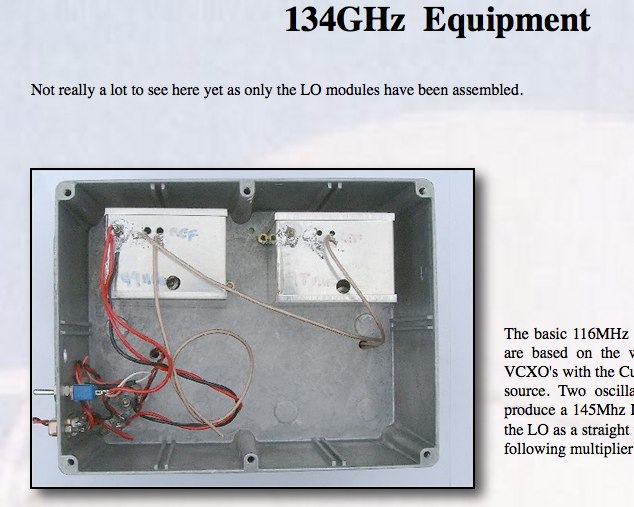 Developing operational amateur radio equipment for the 134 GHz band presents significant technical challenges, particularly in frequency generation and stability. This resource details the construction of a 134 GHz system, outlining its architecture with separate transmit (Tx) and receive (Rx) modules, each employing a local oscillator (LO) and RF head units. The system utilizes a dual Flann 50 GHz lens-type horn antenna configuration for optimal signal coupling. The transmit path incorporates an LMX2541 synthesizer chip operating at approximately 2.8 GHz, referenced by a 10 MHz double-oven Morion OCXO for exceptional stability. This signal is multiplied through a series of stages (X4, then X2) to generate a 22.4 GHz signal, which subsequently drives a dual series diode multiplier to produce the final X6 signal for 134 GHz operation. The receive side features an anti-parallel diode mixer coupled to a 144 MHz transceiver via a preamplifier, ensuring effective downconversion. Operational mode is CW, achieved by keying a multiplier stage. The project includes images of the Tx and Rx head units and describes a successful 3.5 km test with G8ACE, demonstrating stable signal tones due to PLLs locked to OCXOs at both ends, confirming the system's robust performance.
 -
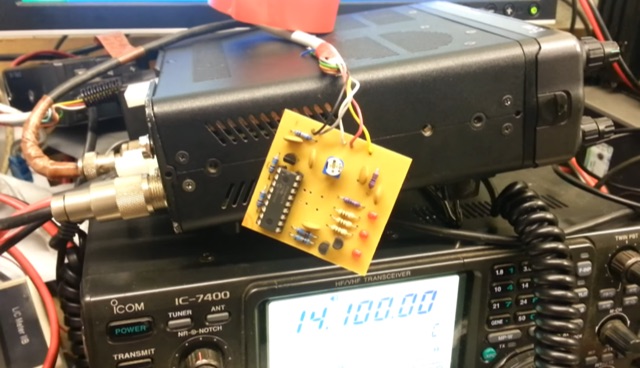 This project details an automatic roger beep circuit for VHF/UHF contests. Built around a Microchip PIC microcontroller, the design detects PTT (Push-To-Talk) activation and generates a brief tone upon release, mimicking a "roger beep" to signal the end of transmission. The circuit utilizes readily available components and includes downloadable resources for PCB layout and firmware.