Search results
Query: net directory
Links: 17 | Categories: 2
-
 Get KB1OIQ - Andy's Ham Radio Linux CD at SourceForge.net. Fast, secure and free downloads from the largest Open Source applications and software directory
 -
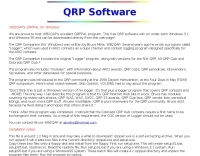 QRPPAL, developed by WB2QAP, functions as a freeware QRP logging application for Windows 3.1 and Windows 95, initially introduced at the 1996 Dayton Hamvention FDIM QRP symposium. The software integrates the original "Logger" program, which was specifically designed for ARCI contest dupe checking and logging, alongside versions tailored for NW-QRP, MI-QRP Club, and Colorado QRP Club contests. It is distributed as a self-extracting archive, _qrppal!.exe_, approximately 1.2 MB in size, which unpacks _qrppal.exe_ and _setup.exe_ for installation. The program's modular design incorporates extensive QRP-centric databases, covering ARCI awards, QRP club listings, QRP periodicals, kit/vendor directories, and detailed rig reviews, often with photos. Noted reviewer Bob Gobrick, _VO1DRB_, described it as a "QRP Internet Web Site in a box" due to its comprehensive data modules, which are also user-modifiable. Installation involves running _setup.exe_ to create batch files like _setup95.bat_, which then establish a c:\qrppal directory and deploy the program files. Users initiate the application by typing "qrp pal.tkn" after setup. The Colorado QRP Club contest version should be avoided due to specific first name exchange requirements not supported by that module.
 -
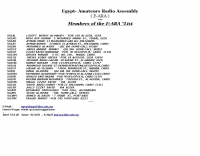 The _Egyptian Amateurs Radio Association (E-ARA)_ provides a directory of its members, detailing callsigns such as SU1AL and SU1ER, along with their full names and QSL routing instructions. Each entry typically includes a postal box or street address in cities like Giza, Cairo, and Port Said, facilitating direct QSL card exchange. Specific entries indicate QSL via home call for operators like SU1BH (A71BH) and SU1DZ (9K2DZ), while others, such as SU1MR and SU1SR, route QSLs through SU1ER. The list also contains details for operators with international home calls, including SU2RS, who QSLs via OE6EEG. This resource serves as a basic callbook for the Egyptian amateur radio community, offering essential contact information for local and international hams seeking to confirm contacts or establish communication.
 -
 Demonstrates a practical online tool for locating amateur radio operators by geographic area, specifically using US ZIP codes. This utility allows users to input at least three digits of a desired ZIP code to retrieve a list of active licensees. Search results can be sorted by _call sign_, name, license expiration date, or ZIP code, providing flexibility in data organization. The service offers two primary output formats: direct display in a web browser, which omits address details for privacy, or export to a tab-delimited file, which includes full address information suitable for import into spreadsheet or database applications like _Excel_. This lookup service proves useful for local club organizers seeking to identify potential members within their service area or for hams planning local nets or events. The ability to export data with address details facilitates direct mailings for club newsletters or event announcements, while the browser view maintains privacy for casual lookups. The tool's design prioritizes ease of use, requiring minimal input to generate relevant local amateur radio contact information.
 -
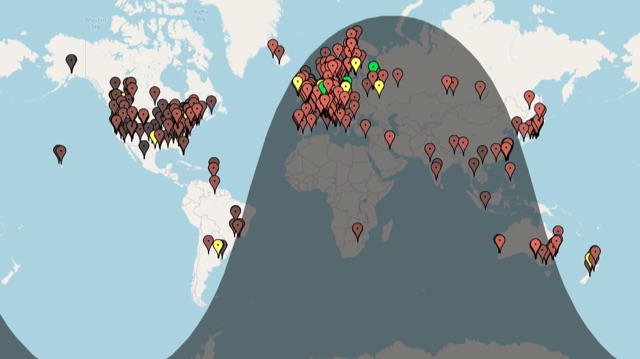 A live map of current KiWiSDR receivers available on the network. It allows users to explore a directory of web-controlled receivers for listening to HF and VHF stations worldwide. The site provides access to remote ham radio stations online, making it a valuable resource for amateur radio operators.
 -
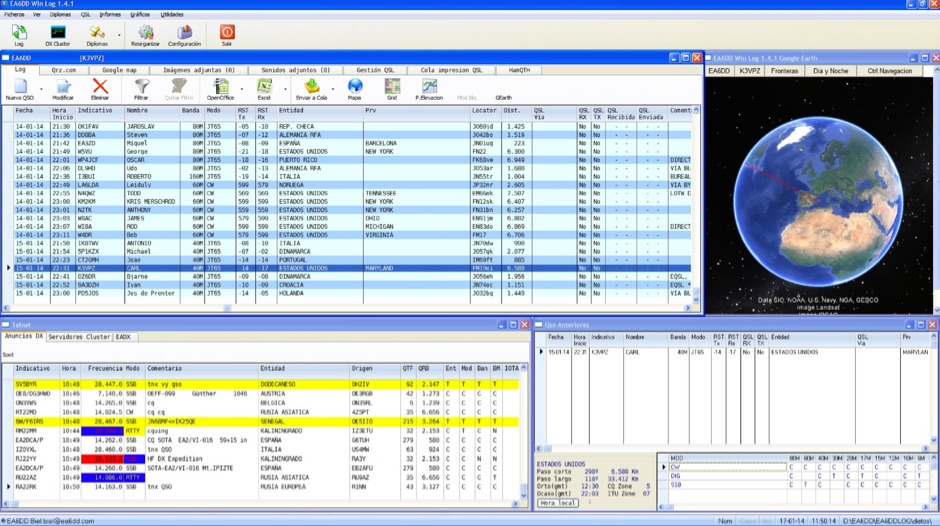 Win EA6DDlog is a freeware logging application for Windows, developed by EA6DD Biel. It integrates features from existing software like Swislog, Urelib, Logger, and HamRadio Deluxe, presenting a Multi-Document Interface (MDI) similar to Logger. The program prioritizes simplicity, practicality, and operational speed, allowing functionality even on less powerful PCs. It does not require a formal installation; users can run it directly from a portable drive or any directory. This logging utility supports CAT control through Omnirig by Alex Shovkoplyas, VE3NEA, which is automatically installed if not already present on the system. It also offers QSL printing capabilities and connections to online callbook services such as QRZ and HamQTH for contact information. EA6DDlog includes an automatic update mechanism that checks for new versions upon startup, requiring internet access. For Windows Vista users, disabling User Account Control (UAC) is recommended for proper update functionality. The software is part of a broader development effort aiming for cross-platform compatibility, with future versions planned for Windows Mobile, Linux, and macOS.
 -
 For radio amateurs seeking to identify or verify callsigns from Bosnia and Herzegovina, an online callbook service offers a direct search utility. This resource focuses exclusively on the _T9_ prefix, allowing users to input a specific callsign and query a dedicated database. It serves as a historical reference for contacts made prior to its last update. The utility provides a straightforward interface for callsign lookups, presenting results based on data compiled up to _July 31, 2000_. While the information is static and not current, it remains useful for confirming older contacts or for historical research within the amateur radio community. The service is maintained by _Boris Knezovic, T93Y_, offering a focused resource for this specific geographic region.
 -
 The only worldwide amateur radio repeater directory. Supports Android, iPhone, web, RT Systems, CHIRP GPS enabled. AvMap, Garmin, TomTom
 -
 For radio amateurs seeking to verify contacts or identify stations from Tajikistan, the _Tajikistan EY Callbook_ serves as a dedicated online resource. This callbook, compiled and maintained by Irage M. Tursoon-Zadeh, _EY8WW_, offers a focused database of callsigns within the EY prefix region. It provides a practical utility for DXers and contesters aiming to confirm QSLs or prepare for operations involving stations in this specific geographic area, streamlining the process of identifying active hams. The resource's utility is particularly evident for those engaged in award programs like _DXCC_ or _WAZ_ where accurate callsign verification is crucial for credit. Unlike broader, worldwide callbooks, this specialized listing ensures high relevance and accuracy for its target region, reflecting the local expertise of EY8WW. Its direct focus on Tajikistan makes it a valuable, albeit niche, tool for operators with specific interest in Central Asian DX.
 -
 The LU2EE Radio Club Tandil maintains a minimal web presence, primarily serving as a directory listing under the `qsl.net` domain. The resource itself offers no direct content, instead presenting an "Index of /l/lu2ee" page with a link to the "Parent Directory." This structure suggests a placeholder or an outdated web address rather than an active information hub, providing only the club's callsign and location. Without specific content, the resource does not offer technical details, operational results, or practical applications. It functions solely as a basic identifier for the _LU2EE_ club in _Tandil_, Argentina, without further elaboration on activities, membership, or technical contributions to the amateur radio community.
 -
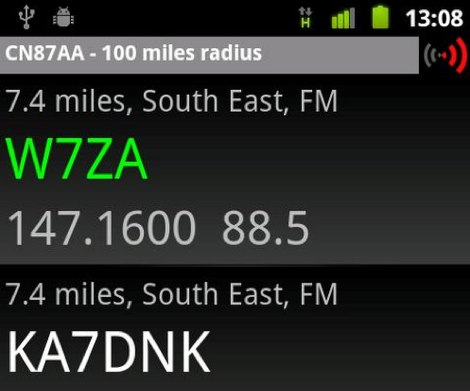 Enables every Ham to easily find repeaters across the the World, USA, Canada, Mexico and over 35 other countries, for free and without a network connection using the RepeaterBook Directory.
 -
 First released around 1995 and significantly redesigned as QWTelnet 2, this software provides a dedicated interface for monitoring DX-Cluster traffic via Telnet. It integrates a **SOTAwatch parser** with configurable audio alerts, allowing operators to receive notifications for specific search patterns in DX-Cluster remarks without constant screen attention. The application also supports parsing for **GMAwatch (German Mountain Award)**, providing alerts for German Mountain Award activations. QWTelnet 2.4.0, released on 07-APR-2012, runs on Windows (tested on W7) and is distributed as a ZIP file containing the `qwtelnet.exe` executable. It does not require a formal installation process; users simply extract and run the program. The software can display DX information for single bands, integrate with the Reverse Beacon Network, and link to external web resources for DXCC and SOTA information. It also supports local reference files for IOTA, WFF, and RDA awards, which users must source and place in the `qwtelnet/files` directory. For IOTA data, users can convert `IOTA.CSV` from UCX-Log or `DX4WIN_IOTA.TXT` into `iota.csv`. WFF and RDA reference files are directly sourced from their respective websites.
 -
 The _DL4EBY_ resource page provides operational data for Earth-Moon-Earth (EME) communications on VHF, UHF, and microwave bands. It includes a 432 MHz and above EME Directory in ASCII and HTML formats. _K1RQG_ provides 432 MHz and up EME Net Notes. EME Operating Procedures were confirmed at the EME Conference 2002 in Prague. A lunar calendar from _DL7APV_ is linked via _G4CCH_'s pages. Resources for CW contest operation include the _PED411i.zip_ file. A "Cheat Sheet 432 & up" is available for EME operations. The _Dubus_ 70cm CW EME Activity Event is referenced for moonbounce activity. DXZone Focus: Operating Activity | Global | EME, CW | VHF, UHF, Microwave
 -
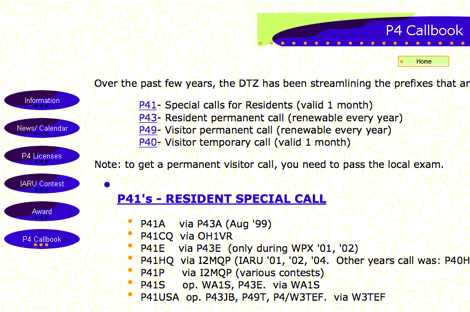 The P4 Aruba Callbook, last updated in 2010, serves as a directory for amateur radio operators active from the Caribbean island of Aruba. It meticulously categorizes P4 callsigns into several types: **P41-** for special resident calls valid for one month, **P43-** for permanent resident calls renewable annually, **P49-** for permanent visitor calls also renewable annually, and **P40-** for temporary visitor calls valid for one month, often used in contests. The resource notes that obtaining a permanent visitor callsign requires passing a local examination. The callbook lists numerous specific callsigns, including their QSL routes, operator names, and sometimes addresses or activation dates. For instance, P41A routes via P43A, and P40HQ was used by P43ARC via I2MQP for IARU contests. The entries include both active and Silent Key (SK) operators, with dates of passing where known, such as P43ADA (SK, Sep 2014) and P43JB (SK Jan 2012). This detailed listing assists DXers and contesters in verifying contacts and ensuring proper QSLing for Aruba operations.
 -
 Effective operation of amateur radio repeaters, particularly in high-density areas, relies on coordinated frequency assignments to prevent interference. This resource from the _Illinois Repeater Association_ (IRA) serves as the official frequency coordination body for the state of Illinois, providing essential information for repeater owners and users. It details coordination policies, guidelines, and application forms for new and existing repeaters, ensuring fair and consistent spectrum utilization. The site also includes a comprehensive band plan, last revised in 2006, and a selective access policy (PL/Squelch Plan) updated in 2015, which are critical for maintaining orderly operations. The IRA website offers various repeater directories, sortable by frequency, city, and region, including a dedicated section for digital systems. These directories are invaluable for hams traveling through Illinois or setting up new repeater projects, helping them identify available frequencies and coordinated systems. The resource also provides meeting minutes, newsletters, and links to other regional repeater councils, demonstrating its role in fostering inter-state coordination. This structured approach to frequency management helps ensure reliable communications and minimizes QRM across the state, supporting thousands of repeater contacts annually.
 -
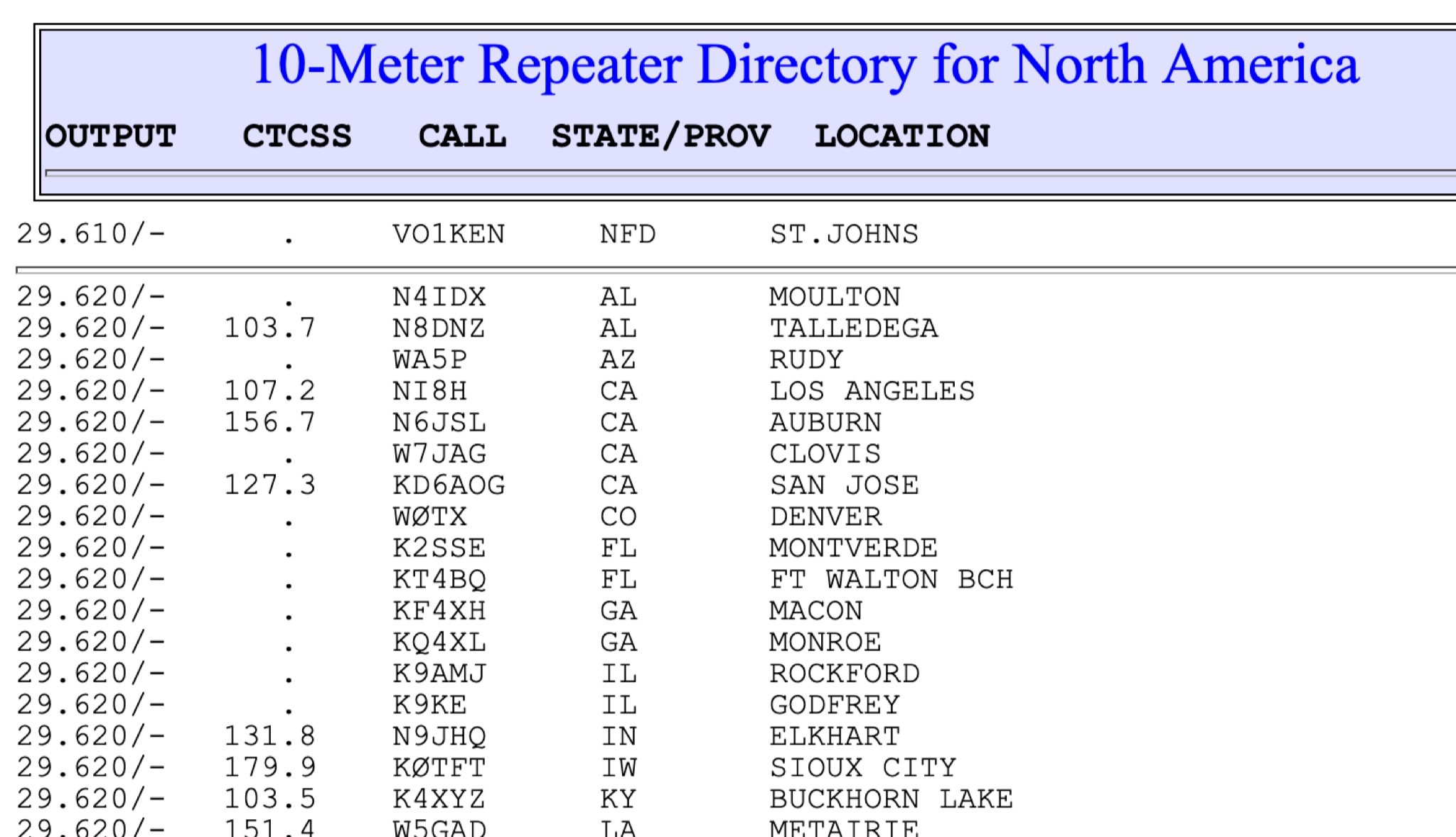 This page show a list of repeaters in north america transmitting from 28 MHz to 29 MHz. The most of them are in the 29.620 to 29.700 frequency range. Some repeaters may be active and on the air while others may not
 -
 NetFinder is the ultimate directory for Ham Radio and SWL enthusiasts, designed to connect Amateur Radio operators through organized nets. Nets are scheduled gatherings on specific frequencies, ranging from formal emergency communication training to casual chats among Hams. Offering a platform for camaraderie and skill-building, NetFinder simplifies the process of discovering nets, fostering deeper engagement in the hobby. With a vision of cataloging every net worldwide, NetFinder aims to make these vital connections accessible to all operators, enriching the Amateur Radio community.