Search results
Query: vertical bazooka
Links: 5 | Categories: 0
-
 Build Your Own Bazooka Dipole: A VHF/UHF vertical dipole made from coax
 -
 The Little Stick antenna is an aluminium version of the Vertical Bazooka design which was made from coax.
 -
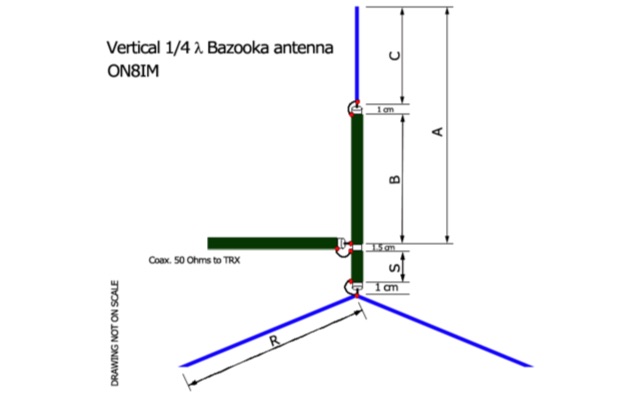 A quarter wave vertical omni-directional antenna for 7 MHz. Formulas for dimensions in feet and meters are provided. Ideal radial angle is between 35° and 45°. Velocity factor (Vf) varies based on coax type.
 -
 The Bazooka antenna, a coaxial dipole, functions as an omnidirectional antenna with vertical or horizontal polarization. Patented in 1939 and refined in 2006, it features a quarter-wavelength coaxial cable with separated conductors. The outer conductor connects to a sleeve, while the inner conductor extends vertically. Initially complex, it has been simplified for versatile use, including military applications. Adding elements can modify its behavior for NVIS or Yagi-Uda configurations. Experiments in 2007 at the Campus de Pesquisas GeofÃsicas in Paula Freitas-PR demonstrated consistent VHF and UHF performance, showing reliable return loss measurements despite variable weather.
 -
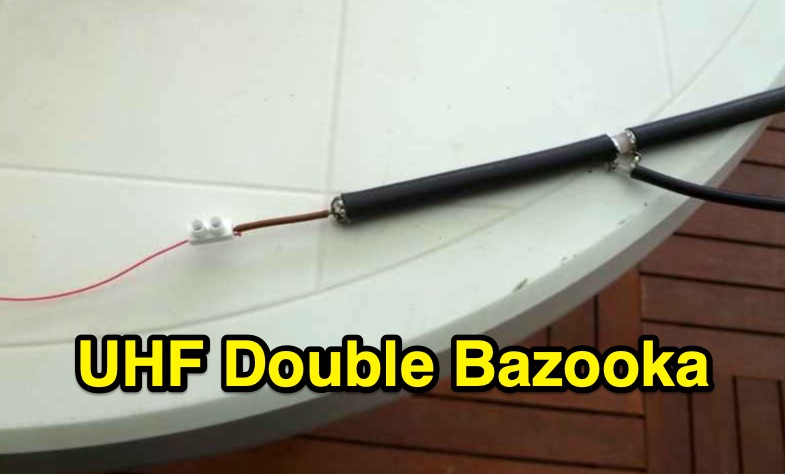 This article details the construction of a double bazooka antenna for the UHF band, specifically targeting 435 MHz. It describes a simple design that can be built from a length of good quality coaxial cable, intended for vertical polarization. The article provides formulas for calculating the total length of the radiating element (140.208 / F (MHz)) and the coaxial cable (99.06 / F (MHz)). Step-by-step images illustrate the construction process, starting with cutting RG213 coaxial cable, short-circuiting extremities, interrupting the braid at the center, and attaching an insulating support. It covers preparing the definitive mounting with a quality coaxial feedline (RG58 mentioned as a temporary option) and weatherproofing using PVC electrician's tube, glue, adhesive tape, or heat-shrink tubing. The antenna is designed to be mounted on a small aluminum mast, with the cable passing inside. The article reports a very satisfactory SWR measurement, with approximately +/- 3% HF return.