WSJT-X
Weak-signal digital communication software for FT8, FT4, Q65, JT65, MSK144, and WSPR modes
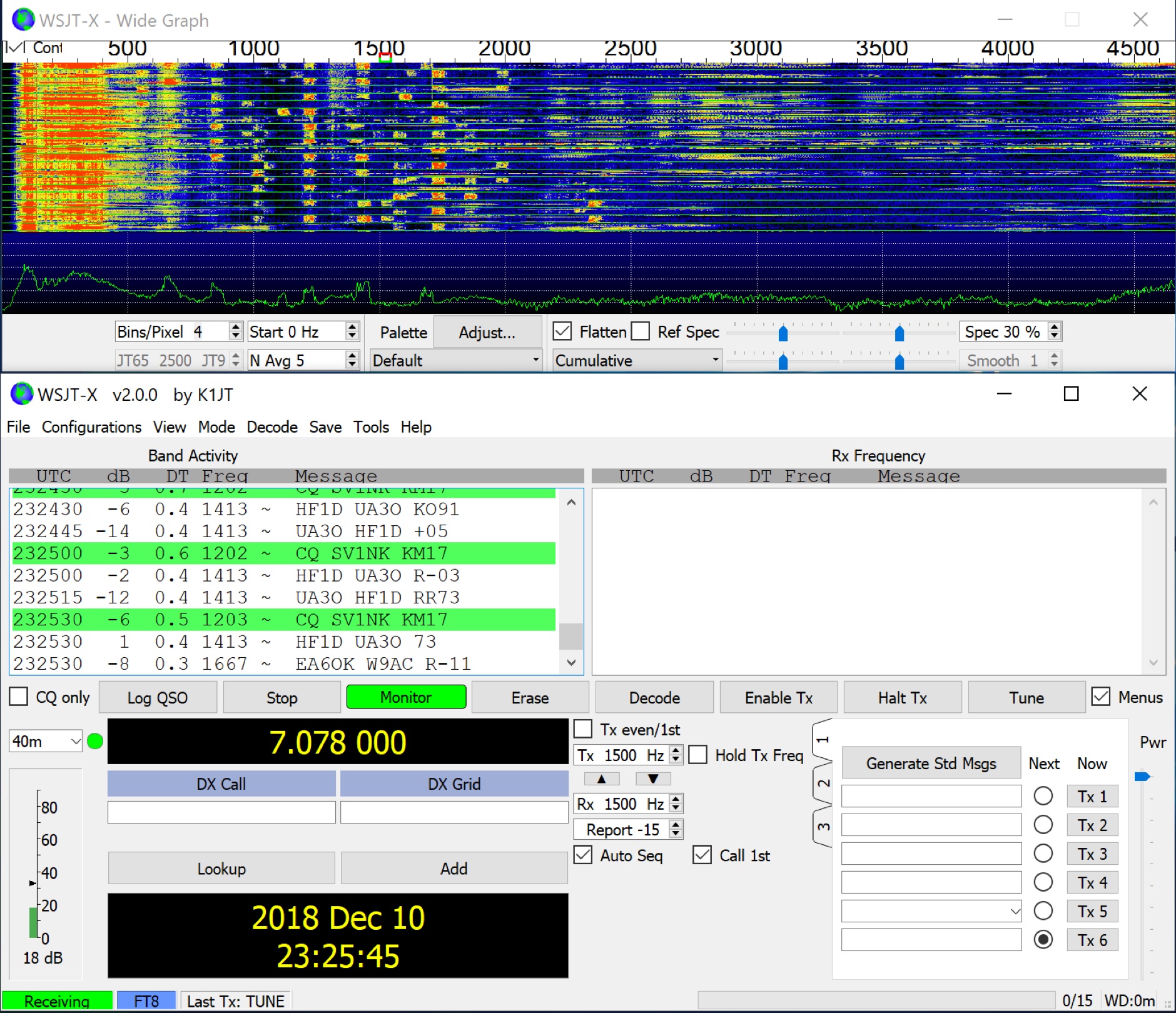
Description
Facilitates reliable two-way communication under challenging propagation conditions, WSJT-X provides a suite of digital modes optimized for weak-signal operation across the amateur bands. These modes, including FT8, FT4, and Q65, are designed to decode signals significantly below the noise floor, enabling DX contacts, EME (Earth-Moon-Earth), and meteor scatter QSOs with modest station setups. The software supports various T/R sequence lengths and tone spacings, tailored for specific propagation phenomena and band characteristics, such as JT9 for MF/HF with 2 dB greater sensitivity than JT65, and MSK144 for VHF meteor scatter.
WSJT-X also integrates specialized tools like MAP65 for wideband EME reception with polarization matching to counter Faraday rotation, and QMAP for wideband Q65 reception with Earth-Moon-Earth Doppler correction. These companion programs extend the software's capabilities for advanced weak-signal work, particularly on VHF, UHF, and microwave frequencies.
The project, maintained by Joe Taylor, K1JT, and the WSJT Development Team, is the official home and reference implementation for these weak-signal digital communication protocols. Recent releases, such as WSJT-X 3.0.2, introduce enhancements like the QMAP program, Q65 Pileup, and SuperFox mode, which offers approximately +10 dB system gain for Fox-and-Hound operations.