How do Repeater Work ?
Understanding simplex vs. duplex operation and how repeaters extend radio communication range.
Description
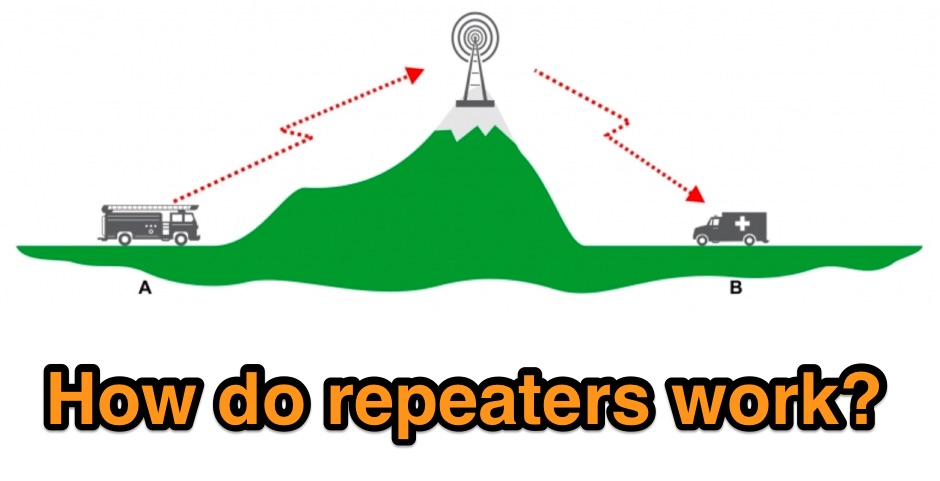
Illustrates the fundamental principles of radio repeaters, detailing their role in extending communication range beyond line-of-sight limitations. It begins by defining simplex communication as a direct radio-to-radio link, effective only when no obstructions impede the signal path. The resource then introduces the concept of a repeater (or base station) strategically positioned on elevated terrain, such as a mountain, to overcome geographical barriers.
The article clarifies the repeater's operational mechanism: it receives a signal on one frequency and simultaneously re-transmits it on a different frequency, enabling users on opposite sides of an obstruction to communicate. This duplex operation is likened to satellite communication for VHF propagation, but with a fixed terrestrial station.
Specific examples of signal paths are provided, showing how a handheld radio transmits up to the repeater, which then relays the message down to another user, effectively bypassing obstacles like hills or large buildings.
Featured by DXZone Editorial
Learn how amateur radio repeater works. Ten great resource to learn amateur radio repeaters beasics, operations and how to configure radios to work repeaters