


The Man Who Refused to Accept Limits
In the autumn of 1894, a twenty-year-old Guglielmo Marconi read an obituary. It was for Heinrich Hertz, the physicist who had experimentally confirmed the existence of electromagnetic waves just a few years earlier. That obituary planted a question in Marconi’s mind that would consume the next decade of his life: if Hertz could produce and detect radio waves in a laboratory, could those waves be made to carry information across distances no wire could reach?
The question sounds obvious in retrospect. At the time, it was closer to heresy. The prevailing scientific consensus held that radio waves, like light, traveled in straight lines and could not follow the curvature of the Earth beyond the visible horizon. Sending a signal from Europe to North America was not just technically unproven — it was theoretically impossible according to the best physics of the day.
Marconi ignored the theory and ran the experiment anyway.
From the Attic in Bologna to Signal Hill
His early experiments took place on his family’s estate at Pontecchio, near Bologna. Using a modified Hertzian oscillator, a coherer as detector, and an increasingly elaborate antenna system, Marconi extended wireless signal range from a few metres to several kilometres in the space of two years. When the Italian government showed no interest in funding further research, his mother Annie — Irish by birth, and well-connected in Britain — helped him relocate to London in 1896.
The move proved decisive. Britain, with its vast maritime empire and acute need for ship-to-shore communication, understood immediately what Marconi was offering. He filed his first patent in June 1896, demonstrated his apparatus to the British Post Office, and in 1897 founded The Wireless Telegraph & Signal Company — later the Marconi Company — in London. He was twenty-three years old.
The years between 1897 and 1901 were a relentless sequence of public demonstrations, each pushing range further. Across Salisbury Plain. Across the Bristol Channel. Between ships of the Royal Navy. Each demonstration silenced one set of critics and produced a new one. The further Marconi pushed his signals, the more confidently the physicists told him the horizon would stop him.
December 12, 1901
On that date, at Signal Hill in St. John’s, Newfoundland, Marconi and his assistant George Kemp held a wire antenna aloft using a kite. Across the Atlantic, at the high-power transmitting station at Poldhu in Cornwall, a telegraph key was being tapped. The agreed signal was the Morse letter S — three dots, repeated.
Marconi heard it.
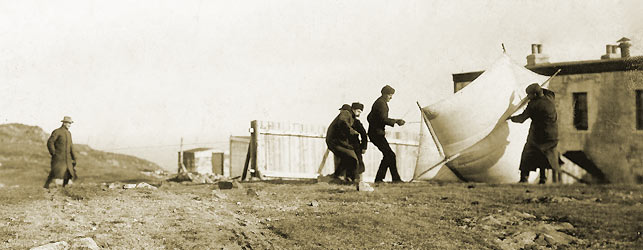
The distance covered was approximately 3,500 kilometres. The scientific establishment was sceptical — no independent witnesses, no recorded signal on paper tape. The controversy has never fully dissolved. But the demonstration triggered a global shift in how governments, navies, and commercial enterprises thought about communication. Whatever one concludes about the technical details of that December morning, it was Marconi’s audacity that forced the question into the open.
What he had understood — and the theorists had not yet worked out — was that radio waves at long wavelengths follow the curvature of the Earth through a combination of ground-wave propagation and reflection from the ionosphere. The physics caught up with the experiment, not the other way around.
Innovator, Entrepreneur, and Reluctant Credit-Sharer
Amateur radio operators familiar with the history of wireless know that Marconi did not work in a vacuum. He built systematically on the foundational work of James Clerk Maxwell, who formulated the theory of electromagnetic waves; Heinrich Hertz, who proved their existence; Édouard Branly, whose coherer Marconi adapted; and Oliver Lodge, whose syntonic tuning patents Marconi later acquired. The Serbian-American inventor Nikola Tesla has his own claim to elements of radio theory, a dispute the US Supreme Court would address — inconclusively — decades later.
Marconi’s singular contribution was not a single invention but a capacity: the ability to synthesise existing science, iterate rapidly on hardware, stage compelling public demonstrations, and turn laboratory curiosity into operational technology. He was, in the language of today, a systems integrator with an unusually high tolerance for risk and failure.

In 1909, he shared the Nobel Prize in Physics with Karl Ferdinand Braun, whose coupled-circuit transmitter had substantially improved transmission efficiency. Marconi accepted the honour without apparent resentment at the shared credit — a grace that contrasts with some of the fiercer priority disputes of the era.
LINK: Radio History resources on DXZone
A Legacy Measured in Every QSO
Marconi died in Rome on 20 July 1937, aged sixty-three. Radio stations around the world observed two minutes of silence. It was the medium he had created paying tribute to its creator — a gesture that would have been literally impossible without him.
For amateur radio operators, the connection is direct and personal. Every HF contact made across an ocean, every weak-signal exchange on 40 metres at grey line, every EME attempt bouncing signals off the Moon traces its conceptual lineage to the experiments Marconi ran on a hillside in Bologna in the 1890s. The tools are unrecognisably different. The principle — that the atmosphere carries signals to places wire cannot reach — is exactly what he proved.
He did not discover radio. He demonstrated, repeatedly and publicly, that it was useful. In the long run, that may have mattered more.
The question is more complex than it appears. Marconi holds the first patent for a practical wireless telegraphy system, but he built on the theoretical work of Maxwell and Hertz, and the hardware contributions of Branly and Lodge. His role was less sole inventor than exceptional integrator — the person who turned existing science into working, commercially viable technology.
On that date, Marconi claimed to have received the Morse letter S transmitted from Poldhu, Cornwall, at his receiving station in St. John’s, Newfoundland — a distance of roughly 3,500 km. Though the demonstration lacked independent verification, it triggered worldwide recognition that transatlantic wireless communication was achievable, fundamentally changing naval, commercial, and eventually amateur radio.
The Italian government declined to fund his early research. Britain, with a global maritime empire dependent on ship-to-shore communication, had far stronger institutional and commercial incentives to support wireless development. Marconi’s mother, who was Irish, also had useful family connections in the UK that helped open doors.
Marconi’s public demonstrations of long-distance wireless communication established the technical and cultural foundation on which amateur radio developed. His work proved that HF propagation could bridge intercontinental distances, the same principle that underpins DX operating today. The Marconi Company also trained some of the first professional operators, many of whom later became active amateurs.
Marconi shared the 1909 Nobel Prize in Physics with German physicist Karl Ferdinand Braun, whose coupled-circuit transmitter design had significantly improved the efficiency of wireless transmission. The award recognised their combined contributions to the development of wireless telegraphy.
DXZone maintains curated link collections covering radio history and resources specifically dedicated to Marconi’s life and work, covering historical archives, biographical sites, and technical analyses of his experiments.


