Search results
Query: short callsigns
Links: 3 | Categories: 0
-
 This resource provides a historical listing of **unlicensed amateur radio beacons** active in the United States as of December 1993, specifically detailing both **LOWFER** (Low Frequency Experimental Radio) and **MEDFER** (Medium Frequency Experimental Radio) operations. The data includes beacon frequencies in kilocycles (Kc), identification codes, state locations, and the callsigns or names of the beacon operators. Frequencies range from 166.667 Kc for LOWFER to 1706.0 Kc for MEDFER, illustrating the spectrum utilized by these experimental stations. The information was originally compiled by Mark Burkart and relayed to the rec.radio.shortwave newsgroup by Rick Robinson, KF4AR. The list serves as a snapshot of experimental beacon activity from the early 1990s, offering insight into the types of operations and the individuals involved in unlicensed, low-power transmissions. It highlights specific beacon IDs like "ABC SC" on 510.5 Kc and "GK HI" on 1620 Kc, alongside operator details such as Todd Roberts (WD4NGG) and Herb Vanderbeek (WY6G). While not a current operational guide, it is a valuable historical document for those interested in the evolution of LF/MF experimental radio and the early days of internet-based amateur radio information sharing.
 -
 This is a service for finding the shortest available vanity callsign in your amateur radio class. It filter through all possible callsigns and provide just the unused ones weighted by their length in morse code or their actual number of letters.
 -
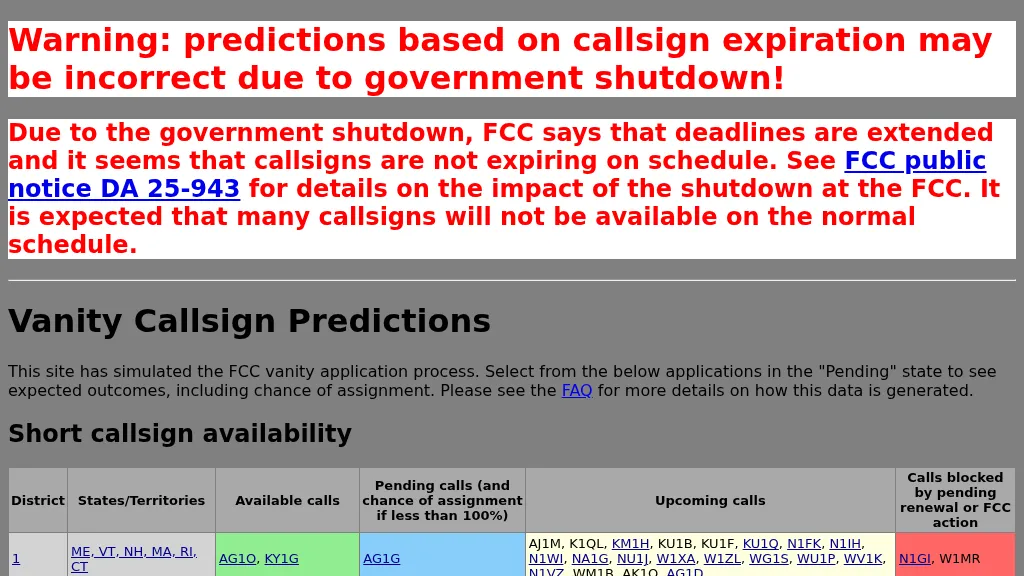 This resource provides a predictive database for FCC vanity callsign assignments, simulating the FCC's application process. The methodology involves analyzing pending applications and calculating the probability of assignment for specific callsigns, such as _KD3Q_ at **94%** or _N9QC_ at **97.8%**. The data is organized by FCC district, listing available, pending, and upcoming callsigns, along with those blocked by renewal or FCC action. The database details specific application entries, including the date entered, receipt date, process date, applicant callsign, and the vanity callsigns applied for. Each entry allows for examination of predicted outcomes, including assignment, competition, non-assignment, unneeded, curable, or unknown status. For example, an application for _K7DM_ shows multiple applicants, indicating competitive assignment. DXZone Focus: Predictive Database | FCC Application Simulation | Assignment Probability | Call Sign Availability