


From Release Candidate to Your Shack
After months of testing by the community — and an RC1 that expired on April 30, 2026 — WSJT-X 3.0 has reached stable status. This is not a point release. The jump from 2.7.0 to 3.0 reflects a genuine architectural step forward, consolidating features that had been circulating in the unofficial Improved branch (the i+ editions) and adding new ones that go well beyond cosmetic changes.
Operators who skipped the RC phase will notice the difference immediately. Those who tested RC1 will find a cleaner, more polished experience — and a version that won’t suddenly stop working.
The Features That Change How You Operate
The headline addition is parallel FT8 decoding, now running up to a dozen concurrent threads. On a modern multi-core machine, the practical effect is a faster and more complete decode list at the end of each 15-second period — particularly useful on busy DX frequencies where marginal signals compete for decode slots. This is not simply a speed improvement; it recovers calls that would have been missed in a single-threaded pass.
Full Duplex Mode is the other change with real operational consequences. WSJT-X can now transmit and receive simultaneously, opening a legitimate path for satellite work where the audio source is the transponder downlink, and for monitoring your own transmitted signal via a WebSDR as the audio input. Until now, this required external workarounds or separate software.
The new filter system is more capable than anything in previous stable releases. You can suppress, highlight, or simply hide stations already worked on the current band, worked today, or worked yesterday — all configurable from File | Settings | Filters. The Filters menu then lets you toggle categories on the fly during a session. For contest operators or DXers running high-traffic frequencies, this significantly reduces visual noise without losing information.
Wait and Reply, Wait and Call, and Wait and Pounce — previously available only in FT8 — now apply to all WSJT-X QSO modes, including JT4, JT9, JT65, FST4, FT4, MSK144, and Q65. The logic is straightforward: the software holds off transmitting until propagation conditions make a response worthwhile, minimizing wasted TX periods.
Band Buttons can now be enabled directly from the View menu, with two sets: one HF-oriented (160 m through 70 cm) and one VHF-and-up (8 m through 24 GHz). A small detail, but one that eliminates several mouse clicks per operating session.
TCI (Transceiver Control Interface) support adds a software layer for rig control and audio I/O that works across a wide range of hardware and applications — a welcome alternative to CAT for operators already using TCI-capable SDR front-ends.
SWR monitoring via Hamlib or FLRig now appears in the Status Bar, with an automatic TX cutoff if SWR exceeds 2.5. The right-click on the Tune button can trigger ATU tuning on compatible rigs. Neither feature is glamorous, but catching a mismatched antenna before you blow a finals is the kind of protection that pays for itself once.
For EME operators, 3.0 adds quick-access buttons for Echo mode and six popular Q65 sub-modes, easier dial frequency selection within EME sub-bands, and experimental decoding of sub-modes 15A, 15B, and 15C with EME delay.
Resources and Community Support
The official documentation and binaries are available through the WSJT-X project page on SourceForge. Discussion continues on the WSJT-X Groups.io reflector, where the development team actively monitors bug reports. if you find an issue in 3.0, that’s the place to report it with your system details and a reproducible test case.
What to Do Before You Upgrade
Back up your log and your WSJT-X.ini configuration file before installing 3.0. Settings are generally preserved across upgrades, but given the scope of changes in this release, having a clean restore point is basic housekeeping.
The CALL3.TXT file for terrestrial or EME use can now be downloaded directly from File | Settings | Colors — no need to source it separately. Saved audio files can be set for automatic deletion after 30 days, which matters if you’ve been accumulating recordings on a small SSD.
OpenSSL is now bundled with the installer on Windows. The only exception requiring manual attention is if an incompatible OpenSSL version is already present on the system. High-resolution monitors are better handled as well, with improved font and widget scaling that makes the interface usable on 4K displays without manual workarounds.
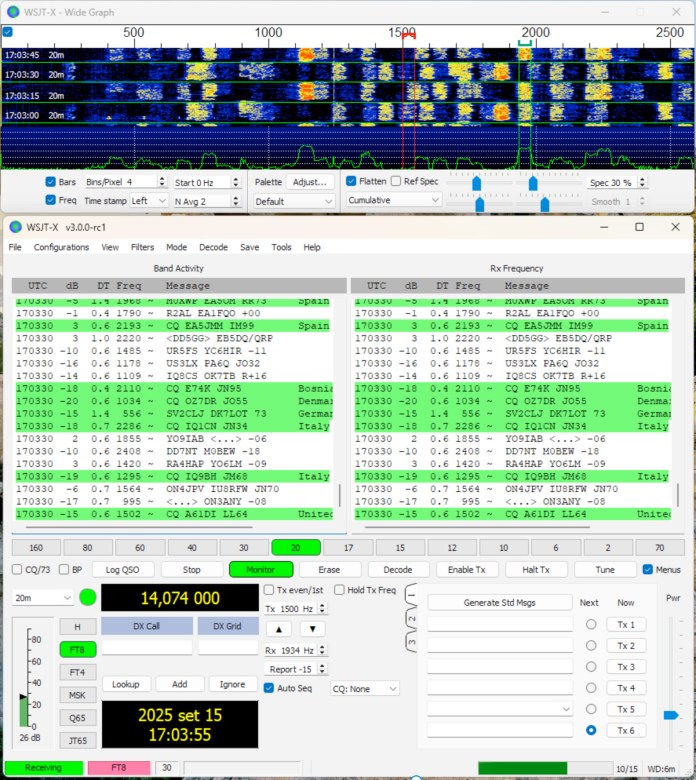
About WSJT-X
WSJT-X is a computer program designed to facilitate basic amateur radio communication using very weak signals. The first four letters in the program name stand for “Weak Signal communication by K1JT,” while the suffix “-X” indicates that WSJT-X started as an extended branch of an earlier program, WSJT, first released in 2001. Bill Somerville, G4WJS, Steve Franke, K9AN, and Nico Palermo, IV3NWV, have been major contributors to development of WSJT-X since 2013, 2015, and 2016, respectively.
Download the new version i’m using an icon 756 pro ii now it will not receive it shows I’m transmitting.\n Is there a setting I need to look at?\n Using this rig? Thank you for your time douglas fitts kd9jtt