ATV: Amateur Television Technical Information and Projects
Find schematics, construction guides, and handbooks for building and operating Amateur Television (ATV) equipment.

Amateur Television, or ATV, allows hams to transmit live or recorded video and audio signals on amateur radio bands. Operators use specialized equipment to send full-motion video, often in conjunction with voice, creating a unique way to communicate and experiment with video technology over the air. ATV activity spans various bands, from VHF/UHF to microwave frequencies, pushing the boundaries of whats possible with amateur radio.
Many hams enjoy building their own ATV gear, from simple video control boxes to more complex transmitters for bands like 2.3 GHz. Antenna projects are also popular, with designs ranging from omnidirectional antennas for the 23 cm band to directional arrays like the express-pizza antenna. The British Amateur Television Club provides valuable resources, including handbooks, to guide operators in setting up their stations and exploring digital modes, such as experimental 2 Mbit modems, for high-speed data and video transmission.
Related Categories
-
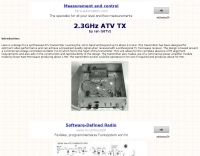 A synthesized 2.3 GHz Amateur Television (ATV) transmitter design by G6TVJ, optimized for broadcast-quality video performance on the 13cm band.
 -
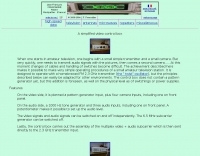 When one starts in amateur television, one begins with a small simple transmitter and a small camera. But very quickly, one needs to transmit audio signals with the pictures, then comes a second camera
 -
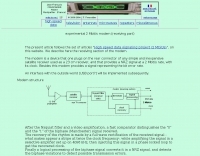 Description of a 2 Mbit Modem project
 -
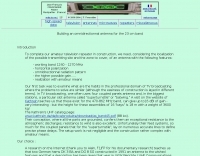 Building an omnidirectionnal antenna for the 23 cm band
 -
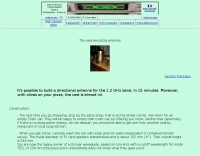 Build a directional antenna for the 1.2 GHz band, in 15 minutes