Search results
Query: Yaesu support
Links: 55 | Categories: 0
-
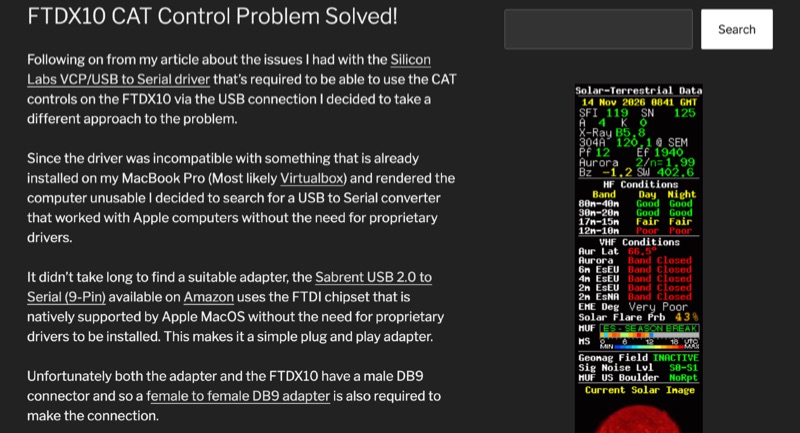
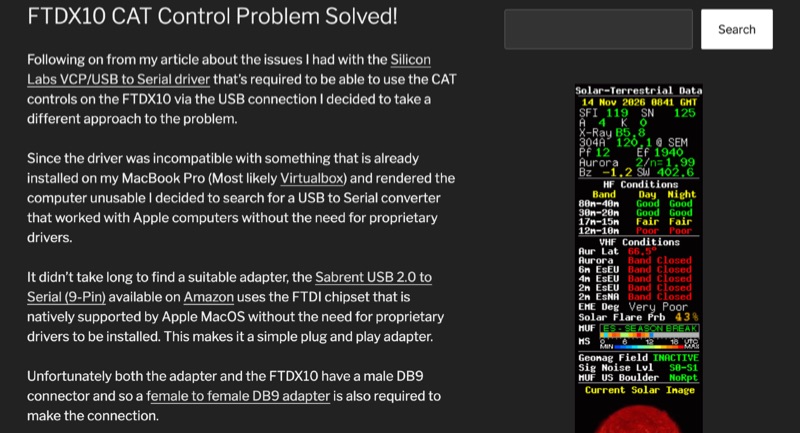 This resource details a solution for establishing CAT control and digital mode operation for the _Yaesu FTDX10_ transceiver on Apple macOS systems. The methodology focuses on bypassing Silicon Labs VCP/USB to Serial drivers, which caused system instability on a MacBook Pro. The author utilized a Sabrent USB 2.0 to Serial (9-Pin) adapter, featuring an FTDI chipset, which provides native driver support within macOS. This setup enables direct control of the FTDX10 via a USB connection without proprietary driver installations. The article specifies the use of a female-to-female DB9 adapter to connect the Sabrent unit to the FTDX10. Configuration details include setting the RS232 port to **38400** baud on the radio and within WSJT-X software. Audio routing for digital modes is achieved by connecting a standard USB lead from the FTDX10 to a second USB port on the MacBook, leveraging the transceiver's integrated sound card, which is natively supported by macOS 11.6.2 (Big Sur). The configuration was validated using FT8 on the 30-meter band.
-
 Presents an extended-period review of the Yaesu FTDX10 HF transceiver, focusing on its operational usability and long-term reliability after approximately ten months of alternating use. The analysis details aspects such as the radio's interface logic, menu navigation, and overall functional consistency, contrasting these with published specifications and common user expectations. It addresses specific operational scenarios and evaluates the radio's behavior under various conditions, providing observations on potential discrepancies between advertised features and practical application, including issues like panel timing, knob placement, and DNR aggressiveness. The review compares the FTDX10's performance and user experience against the Icom IC-7610 and Icom IC-7300 transceivers, particularly regarding receiver performance, roofing filters, APF, and dedicated width/shift controls. It highlights disadvantages such as disabled functions during transmit, slow internal ATU performance, lack of spectrum scope averaging, and various quality assurance issues like volume knob faults, failing screens, and FT8 harmonics. The document also includes commentary on Yaesu's product support, noting a lack of response to user feedback, and observed reliability of the FTDX10 unit over time, offering a perspective beyond initial laboratory measurements like those from Sherwood Engineering.
-
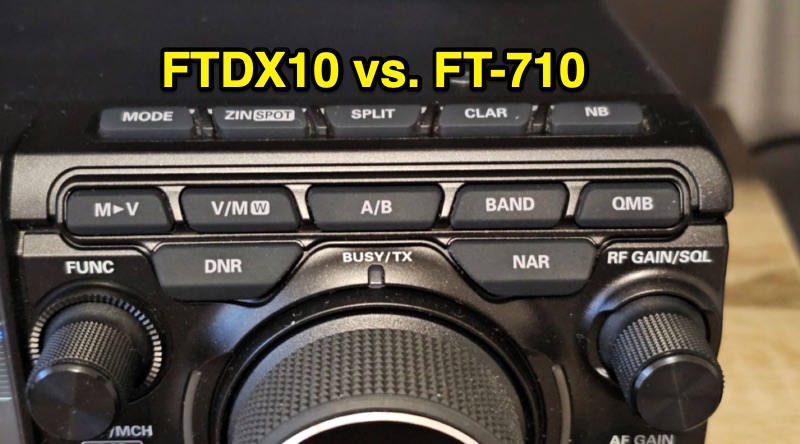 The Yaesu FTDX10 and FT-710 HF transceivers underwent three weeks of side-by-side operational testing, revealing marginal differences in CW selectivity. At a 500Hz bandwidth, the FTDX10 allowed approximately 40Hz closer signal approach before audio detection compared to the FT-710. No discernible performance variations were observed in SSB mode or the efficacy of Noise Blanker (NB), Digital Noise Reduction (DNR), or Digital Notch Filter (DNF features. Physical dimensions differentiate the units: the FTDX10 measures 266 x 91 x 263 mm and weighs 5.9 kg, while the FT-710 is 239 x 80 x 247 mm and 4.5 kg. The FTDX10 incorporates a larger, brighter display with a cooler blue tone, contrasting with the FT-710's warmer screen hue. Ergonomic considerations include the FTDX10's bottom-left AF/RF knob placement versus the FT-710's right-side arrangement, which separates AF and RF into distinct controls. Further distinctions include the FTDX10's dedicated Shift, Width, Notch, Contour, and APF knobs, which are menu-driven on the FT-710. The FTDX10 also features a customizable C.S. key and separate CLAR TX/RX keys controlled by the outer VFO dial, a more intuitive implementation than the FT-710's single Clarifier key. Amplifier integration also varies, with the FTDX10 supporting simultaneous amplifier and FH-2 keypad use, a capability absent in the FT-710 when an ALC connection occupies the REMOTE jack.
-
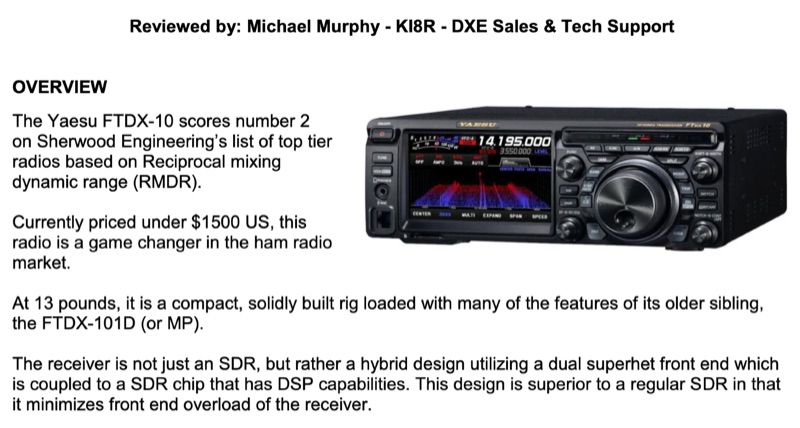
 The Yaesu FTDX-10 transceiver features a hybrid receiver design, integrating a dual superheterodyne front end with an SDR chip for advanced DSP. This architecture aims to mitigate front-end overload, a critical consideration for HF operations. Performance data indicates a Reciprocal Mixing Dynamic Range (RMDR) that places the FTDX-10 at number two on Sherwood Engineering's ranking, highlighting its strong signal handling capabilities. The unit includes a 5-inch TFT touch screen and an internal antenna tuner effective up to 3:1 SWR, covering receiver frequencies from 30 kHz to 75 MHz. Operational aspects include a spectrum scope with 2D and 3DSS display modes, offering adjustable frequency spans from 1 kHz to 1000 kHz and five waterfall speeds. The review evaluates the efficacy of the noise blanker and Digital Noise Reduction (DNR) functions, essential for mitigating interference in various operating environments. Connectivity is supported via USB drivers for N1MM and HRD software, alongside DVI output for external display mirroring. The Multi-Purpose VFO Outer Dial (MPVD) enhances user interaction. The FTDX-10's design and features cater to serious amateur radio operators seeking high performance in a compact HF/50 MHz platform.
-
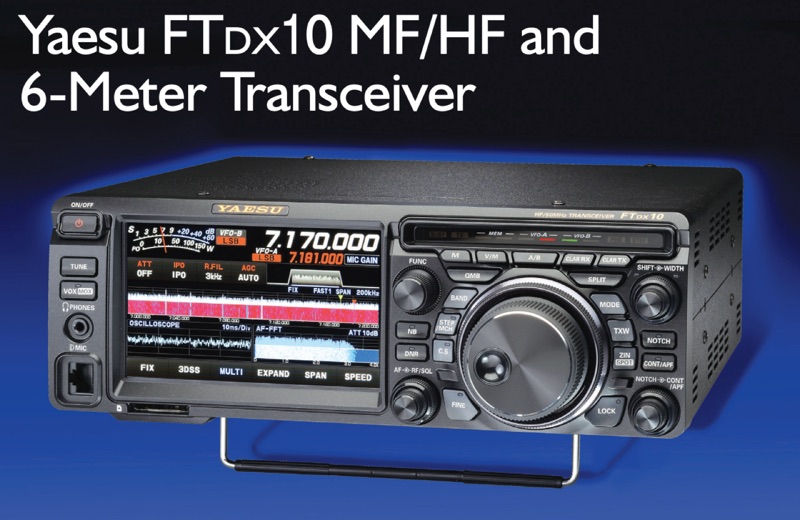 The Yaesu FTDX10 MF/HF and 6-meter transceiver, a 100-watt rig, is designed to bring high-performance receiver architecture to the intermediate-price class. It offers continuous receive coverage from 30 kHz to 75 MHz and transmit capabilities across all amateur bands from 160 through 6 meters, including five preset CW and SSB channels on 60 meters. The transceiver supports AM, FM, SSB, CW, and digital modes, with integrated decoders for CW, RTTY, and PSK31, making it a versatile station for various operating preferences. Physically, the FTDX10 measures 3½ × 10½ × 10½ inches and weighs 13 pounds, requiring a 20–25 A DC power supply for full 100 W output. Its front panel features a 5-inch TFT color touchscreen and a large VFO knob, complemented by an SD memory card slot for recording audio and saving settings. Rear panel connectivity includes a single SO-239 antenna port, multiple USB ports for CAT control and peripherals, and DIN jacks for external digital mode hardware and linear amplifiers, though it lacks a dedicated low-noise receive antenna provision. ARRL Lab tests confirm excellent receiver performance, with blocking dynamic range exceeding 137 dB at 2 kHz spacing and robust IMD dynamic range figures. The hybrid receiver design incorporates selectable roofing filters at 500 Hz, 3 kHz, and 12 kHz, along with two preamplifiers and various attenuation levels, allowing operators to tailor reception characteristics to challenging band conditions. Transmitter performance is also rated very good, with low transmit phase noise.