Search results
Query: coils or traps
Links: 5 | Categories: 0
-
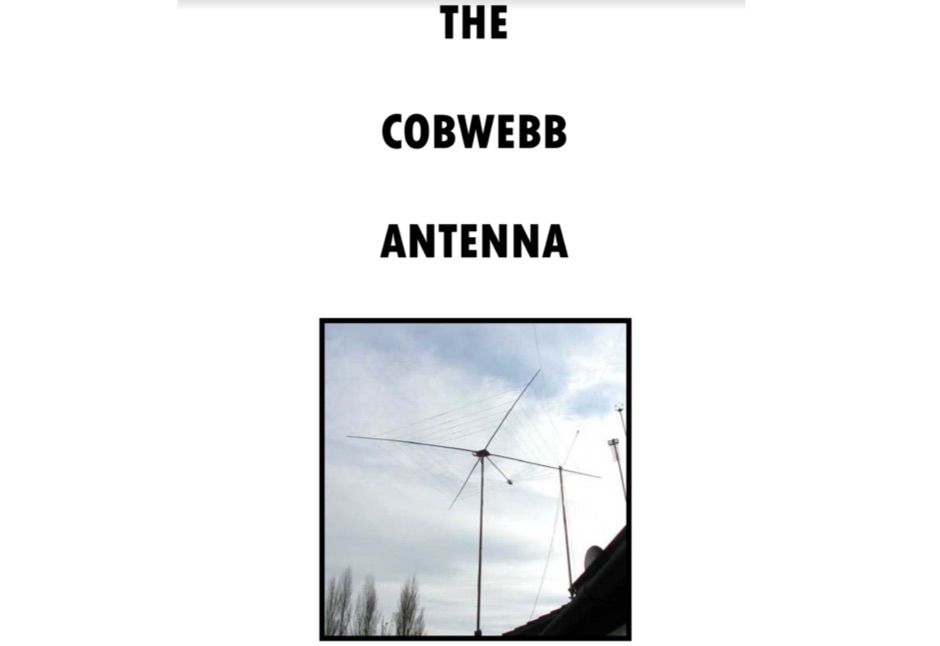 The G3TPW CobWebb antenna design provides a compact, horizontally polarized, omni-directional solution for 20m, 17m, 15m, 12m, and 10m bands. This antenna utilizes five full-size half-wave dipoles, each bent into a square configuration to achieve omni-directional radiation without the nulls typically found in straight dipoles. The design incorporates a single 50-ohm coaxial feedline with an integrated air-core choke balun, minimizing feeder radiation and reducing EMC issues. Construction details include using PVC-covered multi-stranded copper twin cable for elements, supported by a fiberglass cross. The document specifies tapping points for impedance matching to 50 ohms on all five bands, ensuring high radiation efficiency without lossy traps or loading coils. Physical dimensions are compact, with 2.6-meter (8.5 feet) sides and a total weight of 6 kg (14 lbs), making it suitable for mounting on a 20-foot aluminum scaffold pole. Detailed instructions for assembling the junction box, including terminal strip wiring and the coaxial choke balun, are provided with photographs and diagrams. The design emphasizes a confined electric field to reduce coupling to nearby conductors, which helps mitigate TVI and makes the antenna less sensitive to mounting height or ground conductivity.
-
 A new and simple method for tuning traps. You need 2-3Watt of your TRX and two homemade coupling coils by DK7ZB
-
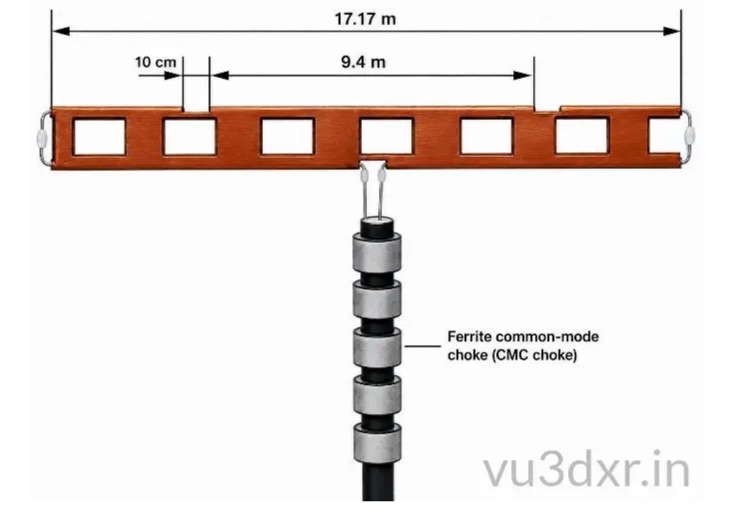 Constructing a dual-band antenna for 40 and 20 meters often involves compromises in size or complexity. This resource presents a compact _open sleeve dipole_ design that addresses these challenges by using 450-ohm ladder line and folded elements to achieve a total length of approximately **17.17 meters**, significantly shorter than a full-size 40-meter dipole. The design leverages electromagnetic coupling, where a primary radiator handles the 40-meter band, and a second conductor resonates on 20 meters without direct electrical connection. This configuration eliminates the need for traditional traps, loading coils, or switching components, simplifying construction and reducing potential loss points. The antenna is fed with RG-58C/U coaxial cable, and a common-mode choke is recommended at the feed point to suppress sheath currents, ensuring a cleaner radiation pattern and minimizing RF in the shack. The design is well-suited for portable operations, field deployments, temporary installations, and restricted urban environments where space is a premium, offering solid performance on both HF bands.
-
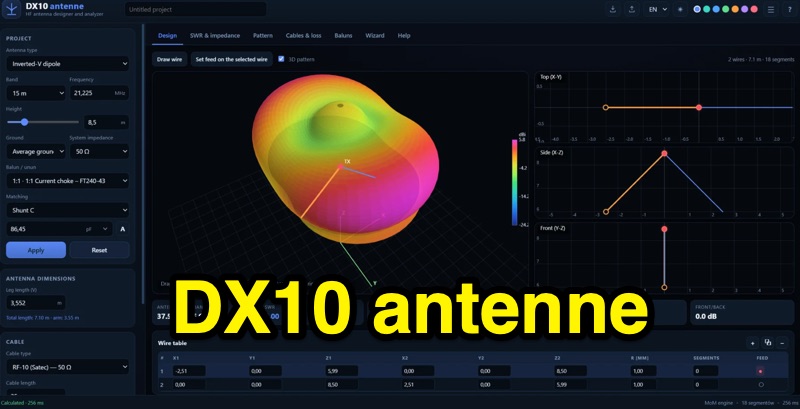 DX10Antenne, version 1.6.2, functions as a freeware **HF antenna designer** and analyzer for Windows 10/11. It enables users to graphically define antenna geometry in both 2D and 3D environments, subsequently calculating critical parameters such as SWR, impedance, and displaying results on a Smith chart. The software also generates comprehensive 3D radiation patterns, providing a visual representation of antenna performance across various azimuth and elevation angles. A distinctive feature is its multiband dipole wizard, capable of designing antennas for 2 to 5 bands with up to 8 integrated traps. The program incorporates traps and coils directly into its Method of Moments (MoM) solver, automating inductance selection for optimal performance. It supports multiband tuning, allowing adjustments to balun ratios (1:1 to 9:1), L/C values, and geometry corrections. Users can import SWR measurement data from external antenna analyzers via CSV files, facilitating direct comparison between modeled and real-world antenna characteristics. The software provides specific recommendations for antenna improvements based on its analysis. It features an integrated help center and supports multiple interface languages, including Polish, English, and German. Available as either an installer (116 MB) or a portable version (105 MB), DX10Antenne offers a robust toolkit for amateur radio operators focused on HF antenna optimization.
-
 Zero-G Antenna Service, run by Ron (PA1XZ) and Gerton (PD0G), specializes in giving amateur radio antennas a second life through comprehensive repair, restoration, and maintenance. Their expertise covers restoring antennas, **traps**, coils, and electrical connections to optimal performance. The service actively seeks antenna parts, including aluminum and plastic, and old stored antennas for refurbishment, contributing to the amateur radio community by extending the lifespan of equipment. Zero-G also provides sales of new and used antennas, alongside a professional removal service for old installations. They perform detailed measurements and testing of antennas, traps, and resonant frequencies to ensure precise tuning and optimal performance. From August 1, 2025, Zero-G will supply original **Fritzel** parts directly from the manufacturer, with examples of their work including the renovation and refurbishment of Fritzel FB13 and FB23 antennas.