Search results
Query: foreign stations
Links: 6 | Categories: 0
-
 Large collection of audio clips of foreign radio stations, with identification announcements in various languages, signature tunes and jingles, and of course interval signals.
-
 Collection of audio clips of foreign radio stations, with identification announcements in various languages, signature tunes and jingles, and of course interval signals
-
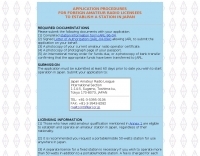 The Japan Amateur Radio League (JARL) outlines the application process for foreign amateur radio operators seeking to establish a station in Japan. Required documentation includes a completed JARL-96-04 station information form, a signed JARL-04-09A Letter of Authorization, photocopies of the current amateur radio operator certificate, passport or Residence Card, and proof of bank transfer or PayPal payment. Applications must be submitted at least 60 days prior to the desired operation start date to the JARL International Section in Tokyo. Licensing information specifies eligibility for those with valid amateur qualifications listed in Annex 1, regardless of nationality. A portable/mobile 50W station license is recommended for nationwide operation, costing JPY 2,750. Fixed station licenses for output power exceeding 50W but not more than 200W cost JPY 5,400. Licenses are granted for the authorized stay period, up to five years, and are renewable for JPY 1,700. Operations exceeding 200W require a different procedure involving direct submission to the Ministry of Internal Affairs and Communications (MIC) and an on-site inspection. Radios without a 'Technical Standard Certification Number' require assurance by JARD, incurring a JPY 5,500 fee for the first radio and JPY 1,100 for each additional unit. Payment options include bank transfer to MUFG Bank, Ltd., Komagome Branch, or PayPal. The document also details guest operation rules, allowing validly licensed foreign amateurs to operate local stations under specific conditions, including host presence and identification with the host's callsign followed by their own.
-
 W/VE amateurs work as many amateur stations in as many DXCC countries of the world as possible on 160, 80, 40, 20, 15, and 10 meter bands. Foreign amateurs (also including KH6, KL7, CY9, and CYØ) work as many W/VE stations in as many of the 48 contiguous states and provinces as possible.
-
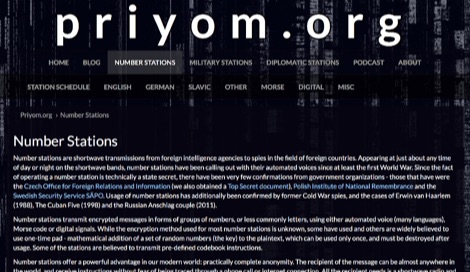 Number stations are shortwave transmissions from foreign intelligence agencies to spies in the field of foreign countries.
-
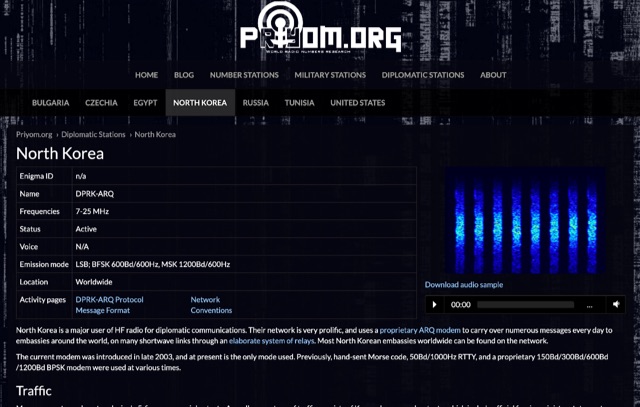 The resource details active HF radio networks maintained by foreign ministries for diplomatic communications, specifically listing operational schedules and frequencies. It currently covers networks for Bulgaria, Czechia, Egypt, North Korea, Russia, Tunisia, and the United States. The content provides specific operational parameters for these government-run shortwave stations. Information includes details on _legacy modes_ of operation and specific transmission times. The site also includes schedules for various _number stations_ which often utilize similar HF spectrum allocations. The data presented aids in identifying and monitoring these unique, non-amateur radio signals across the shortwave bands. Specific sections are dedicated to the networks of North Korea and the United States, offering granular data for each.