Search results
Query: international travel
Links: 10 | Categories: 1
Categories
-
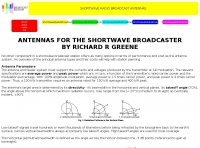 Selecting an appropriate antenna system for shortwave broadcasting involves evaluating various types based on performance, cost, and operational parameters. This resource details the critical specifications for broadcast antennas, including average and peak power ratings, directivity, takeoff angle (TOA), horizontal beamwidth, and gain, emphasizing that a 100-kW transmitter requires an antenna rated for 150 kW average and 400 kW peak. It clarifies that low TOA signals travel thousands of kilometers, while high TOA is for local coverage, and nearly all modern shortwave broadcast antennas are horizontally polarized. The article explores specific antenna types, such as Log-Periodic Antennas (LPAs), which offer wide frequency ranges (e.g., 2-30 MHz) and directional patterns with 11 dBi gain, costing from $20K to over $100K for multi-curtain versions. Dipole arrays, also known as curtain antennas, are prevalent in international broadcasting, featuring steerable beams (±15° and ±30°) and mode-switching capabilities to alter TOA, with high/low pairs costing over $1 million. Fan dipoles are noted for omnidirectional patterns, smaller size, and lower cost for low-power applications, while rhombics, though simple, require resistive termination and incur several dB of I2R losses. Balun considerations are crucial, as most communications baluns are not rated for the higher average and peak powers of AM broadcast transmitters. Modern shortwave antennas utilize durable materials like Alumoweld wire rope for radiators and support elements, avoiding copper, fiberglass, or materials prone to stretching or deterioration. Feeder systems for high-power stations often require tapered-line baluns to convert 50-ohm unbalanced power to 300-ohm balanced for connection to the antenna.
-
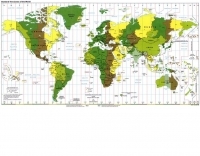 The "Time Zone Map" is presented as a JPEG image file, providing a visual representation of standard time zones across the globe. This resource directly supports amateur radio operations by enabling quick conversion between local times and Coordinated Universal Time (UTC), which is essential for logging contacts, participating in contests, and scheduling DX operations. The map delineates the various time offsets from the prime meridian, offering a practical reference for hams worldwide. Its utility extends to planning international contacts, understanding propagation windows relative to different geographical regions, and ensuring accurate timekeeping for QSL card exchanges. The visual format of the map allows for rapid identification of time differences between a station's location and potential DX targets, simplifying complex time calculations. This specific image file serves as a straightforward, readily accessible operating aid, directly addressing the need for time zone awareness in the amateur radio community. It is categorized under Operating Aids for Travelling, Time, and Maps, reflecting its broad applicability.
-
 The ARRL Reciprocal Permit page addresses international amateur radio operating privileges, specifically focusing on how a US-issued amateur radio license can be recognized and validated for operation in foreign jurisdictions. It outlines the process for obtaining reciprocal operating permits, which are essential for US hams wishing to transmit legally while abroad, ensuring compliance with local telecommunications regulations. The resource details the specific requirements and agreements between the United States and other nations regarding amateur radio licensing. This information is crucial for DXpeditioners and traveling amateurs to understand the legal framework governing their operations outside their home country. It clarifies which countries have reciprocal agreements or require specific temporary permits, preventing unauthorized transmissions. The page serves as a central point for US licensees to research the necessary steps before embarking on international travel, covering aspects like application procedures and required documentation for foreign operating authorization.
-
 Presents the DXFC (DX Feet Century) award program, a unique operating activity for licensed radio amateurs who enjoy international travel. The program defines a 'visit' as physically stepping foot in a _DXCC entity_, aligning with the ARRL's 340 current entities list. Users register with their callsign and log their visited entities, with the website automatically calculating their score. The resource details the rules for counting entities, such as tarmac or jetty visits being sufficient, while remaining onboard a vessel in transit does not qualify. It also includes an optional scoring column for being _QRV_ (ready to operate) in each entity. The site provides historical updates on DXCC entity changes, including additions like _St Barthelemy_ (FJ) and _Kosovo_ (Z6), and deletions such as _Kingman Reef_ (KH5K). Furthermore, the page showcases the "DXFC Century Club," listing callsigns of operators who have visited over 100 entities and updated their records within the last two years, demonstrating active participation in this travel-oriented amateur radio pursuit.
-
 More than 130 currencies are supported by the _Universal Currency Converter_, a digital utility designed for real-time foreign exchange rate calculations. This tool is particularly useful for radio amateurs traveling internationally for DXpeditions, contests, or hamfests, allowing them to quickly ascertain local currency values against their home currency, which can be crucial for budgeting and transaction planning in unfamiliar territories. The platform also facilitates international money transfers to over 190 countries, providing features like rate alerts and historical currency rate analysis. Users can track exchange rate trends over days, weeks, or years, and receive daily market analyses via email updates. Additional functionalities include an IBAN calculator for validating bank account numbers and an API for integrating real-time currency data into other applications. The service is widely trusted, with **4.8** ratings on both the App Store and Google Play, reflecting its reliability for global financial transactions.
-
 Navigating international travel often requires specific documentation, and this service addresses the need for expedited visa and passport processing. It streamlines the often complex requirements for entry into numerous countries, a critical consideration for DXpedition planning or any amateur radio operator traveling internationally for contests or activations. The service focuses on efficiency, aiming to reduce the lead time for obtaining necessary travel documents. Travel Docs offers assistance with visa applications for destinations such as Russia, China, India, and Brazil. This can be particularly useful for hams organizing activations in remote or less frequently visited entities, where visa acquisition might otherwise present a significant logistical hurdle. The platform aims to simplify the bureaucratic process, providing a clear path to securing travel authorization. Their expertise covers various visa types, including tourist and immigration visas, alongside passport services. This specialized support helps ensure that operators can focus on their radio objectives rather than getting bogged down in administrative details, potentially saving weeks of processing time.
-
 Navigating international travel for amateur radio operations, such as DXpeditions or IOTA activations, often requires meticulous attention to passport and visa requirements. While not directly about radio, the services offered by Bucktown Visas & Passports, Inc. address a critical logistical component for operators planning to transmit from foreign soil. They specialize in expediting United States passports and various travel visas, with processing times as short as **24-48 hours** from their Chicago, Illinois office. This can be particularly useful for hams needing rapid document turnaround for last-minute travel opportunities or unexpected operational changes. The company, led by _John J. Luna_, a U.S. Navy veteran, provides services for new passports, renewals, and assistance with lost or damaged documents, which are essential for maintaining legal travel status.
-
 The World Radiosport Team Championship (WRTC) is a unique on-site ham radio competition, typically held every four years, bringing together top operators globally. Unlike traditional contests where participants operate from their home QTH, WRTC competitors travel to a designated location and operate from identical stations under field conditions, ensuring a level playing field. Past events have taken place in diverse locations such as Seattle (1990), Slovenia (2000), Russia (2010), and Italy (2023), showcasing the international scope of this **radiosport** challenge. Because each WRTC event is organized by a dedicated, volunteer-driven committee, historical information and results often become dispersed across various online platforms. This resource serves as a centralized repository, diligently collecting and preserving data from all previous WRTC competitions. It provides a consistent point of reference for participants, enthusiasts, and researchers interested in the history and evolution of this premier **DX contesting** event. The WRTC Sanctioning Committee officially endorses this site, ensuring its accuracy and completeness.
-
 This document serves as a thorough guide to amateur radio nets throughout Australia and includes some international (DX) nets. It outlines key information like frequencies, schedules, and the people responsible for managing these nets. Among the nets covered are Ron's 10 A.M. net, the Australian Travellers Net, and several others, each operating on different bands and regions. Additionally, it offers technical details about repeaters, such as frequency, offset, and CTCSS tones where applicable. Any updates are clearly marked, and further details are included for linked repeater systems and network connections.
-
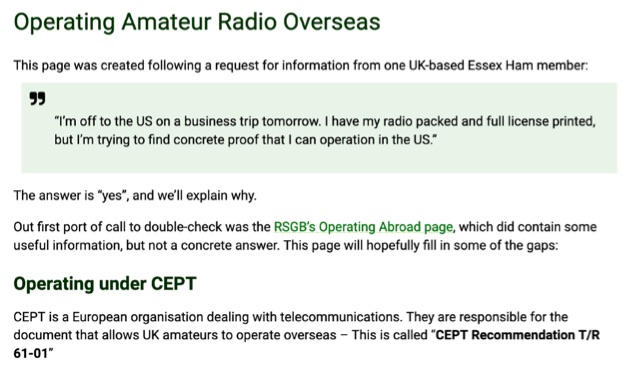 Explains the procedures for UK-licensed radio amateurs to operate their stations while traveling internationally. It clarifies the **CEPT** operating rules, which permit operation in many European countries and beyond, often without needing a separate license. The resource specifically addresses operating in the United States, confirming that UK Full licensees can operate under **reciprocal agreements** by simply carrying their UK license. The content outlines the specific requirements for operating in the US, including the need to append the appropriate US call area to one's UK callsign (e.g., G0XYZ/W1). It also touches upon obtaining a permanent overseas license, providing guidance for those relocating rather than just visiting. The information is presented clearly, drawing from common inquiries from the Essex Ham community regarding international amateur radio privileges.