Search results
Query: keying circuits
Links: 2 | Categories: 0
-
 Presents a collection of homebrew amateur radio projects and circuit ideas developed by EA5/G3PTO, a licensed operator since 1961. The resource details various transmitters and receivers constructed for frequencies ranging from 1.8 MHz to 10 GHz, emphasizing CW and BPSK31 operation. Specific projects covered include a "Bombproof 7Mhz Receiver" and several keying circuits, providing insights into designs that have proven effective over decades of use. The site also integrates personal photography, showcasing scenes from the West of England and Southeast Spain, reflecting the author's interest in connecting with other amateurs and visualizing their locations. Additionally, it offers a curated list of links to other home construction sites and DX information, serving as a hub for DIY enthusiasts and DXers. The content is distinctively personal, blending technical project documentation with a broader view of the amateur radio lifestyle and community engagement.
-
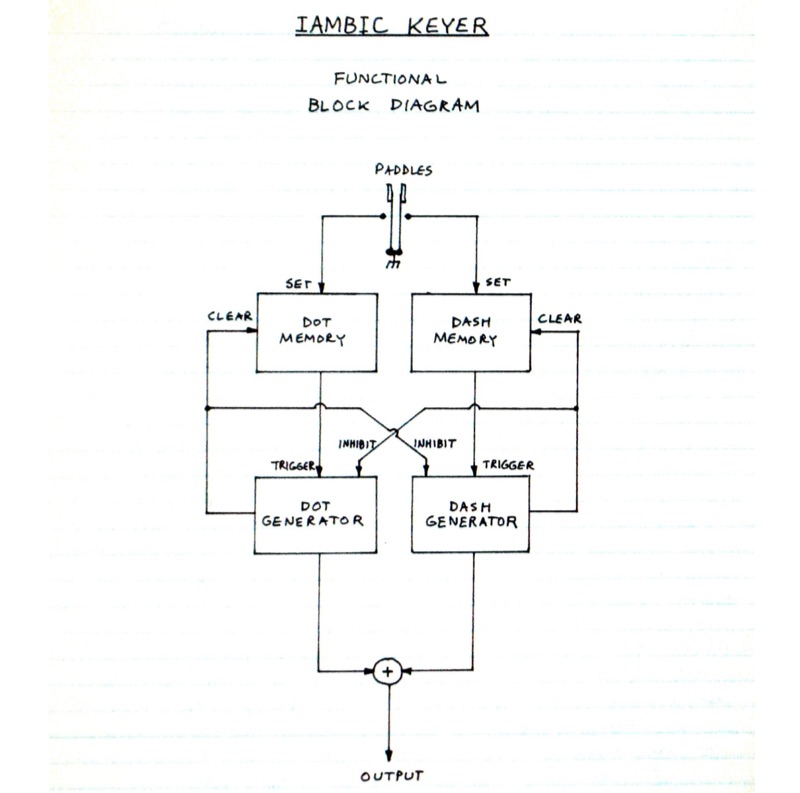 The design of a clockless iambic keyer is presented, detailing the circuit's operational principles for generating Morse code from dual-lever paddle inputs. It incorporates a 7805 regulator (U1) to provide a stable 5V supply to all integrated circuits. Dot and dash memory latches are implemented using NAND gates (U2A–U2D) to manage paddle input requests and ensure correct Morse element sequencing. Additional logic gates (U3, U4) provide inhibit functions, controlling dot and dash signal generation based on the keyer's operational state. Voltage-controlled current sources, utilizing transistors (Q1–Q4), regulate the charging rates of timing capacitors, while resistors (R1–R4) allow for adjustments to overall keying speed, individual dot and dash durations, and inter-element spacing. The circuit combines logic-based memory, signal control, and adjustable timing for consistent Morse code generation. The document provides a comprehensive schematic, component values, and a detailed explanation of how each section contributes to the keyer's functionality, including the sidetone oscillator and output keying stages. This design offers a robust solution for CW operators seeking a reliable iambic keyer without a microcontroller.