Search results
Query: license upgrades
Links: 6 | Categories: 0
-
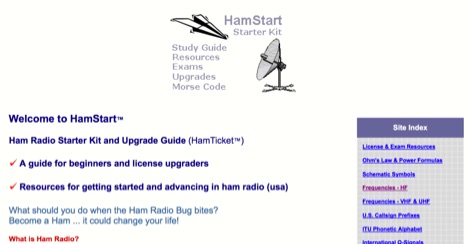 Ham Start, starter kit. Stugy guides, resources, exams, upgrades and morse code. A guide for beginners and license upgraders, Resources for getting started and advancing in ham radio (USA)
 -
 Analyzing FCC amateur radio license issuance data, this resource presents monthly graphs and raw numerical statistics detailing the number of new and upgraded amateur radio licenses. The primary focus is on the impact of the Element 1 Morse Code test removal on HF privileges, specifically observing the transition rates from _Technician_ to _General_ and _Extra_ class licenses. Data is sourced from _QRZ Archives_ and processed using a custom Perl script to tally "Issued" licenses each month. The presented data, available in graphical, tabular, and raw XML formats, clearly illustrates the "spike" in General class upgrades following the rule change. It also highlights a consistent rise in new Technician licenses observed in March of both 2006 and 2007. While the dataset currently extends back to January 2006, providing a limited statistical snapshot for long-term Technician trends, it effectively captures the immediate climb in General class licenses.
 -
 Operating on the 146.880 MHz repeater, the Inland Empire VHF Radio Amateurs (IEVHFRA) hosts a weekly net, providing a consistent on-air gathering for amateurs within Eastern Washington and Spokane County. My experience with similar regional VHF nets confirms their value in fostering local ham radio community and sharing information, often covering topics from equipment troubleshooting to upcoming hamfests. The club, active for over **50 years**, also organizes the _Inland Empire VHF Tailgate Swap_, an event featuring vendors, emergency communication demonstrations by Spokane ARES-ACS, and POTA/SOTA activity setups. Such events are crucial for hands-on learning and direct interaction, which I've found invaluable for new licensees and seasoned operators alike. Beyond on-air activities and events, IEVHFRA supports the hobby through amateur radio classes and testing, facilitating new license acquisition and upgrades. They also maintain an online messaging group for members, ensuring continuous communication and information exchange.
 -
 100-watt UHF repeater (444.500+ PL100) and a 6-meter repeater (53.68- PL114.8) are owned and maintained by South County ARES to support emergency communications for Belmont, East Palo Alto, Foster City, Menlo Park/Atherton, Redwood City, San Carlos, San Mateo, and Woodside/Portola Valley. The organization emphasizes training, including weekly nets and practice sessions, to improve message passing accuracy and brevity, crucial skills for **emergency communication**. Resources like the San Mateo County Sheriff's Office Ham Radio Frequency Plan Recommendation and **Chirp-compatible CSV files** for Baofeng radios are provided. Participation in community events is encouraged to build skills and connections among members. The group operates without collecting dues, relying on donations and member contributions of time and expertise. Training pages are available for new hams and those seeking license upgrades, along with a "Tips for New Hams" section. The site also features a monthly calendar of events, including board meetings, general meetings, and hospital nets, alongside a newsletter, the "South County Communicator," and various operational documents like the Net Control Manual and SCARES Handbook.
 -
 The High Point Amateur Radio Club (HPARC), operating under the callsign W4UA, provides a central hub for amateur radio enthusiasts in High Point, North Carolina, and surrounding communities. The club's website outlines its long-standing traditions and civic service, which date back to the 1930s, highlighting its sustained leadership and strong membership support over decades. It serves as a resource for individuals interested in obtaining or upgrading an FCC amateur radio license, offering assistance through direct contact with club officers. The site also features a newsletter archive for meeting notices and information on club activities, including Field Day. HPARC's diverse membership shares a common interest in the amateur radio hobby, encompassing various aspects such as VHF, UHF, HF, and digital modes like D-STAR. The club's commitment to public service is evident through its involvement in ARES and Skywarn, alongside educational initiatives for new hams and those pursuing license upgrades. The site also lists repeaters and provides information on emergency communications, technical projects, and participation in events like DXCC and contests, reflecting the broad interests of its members.
 -
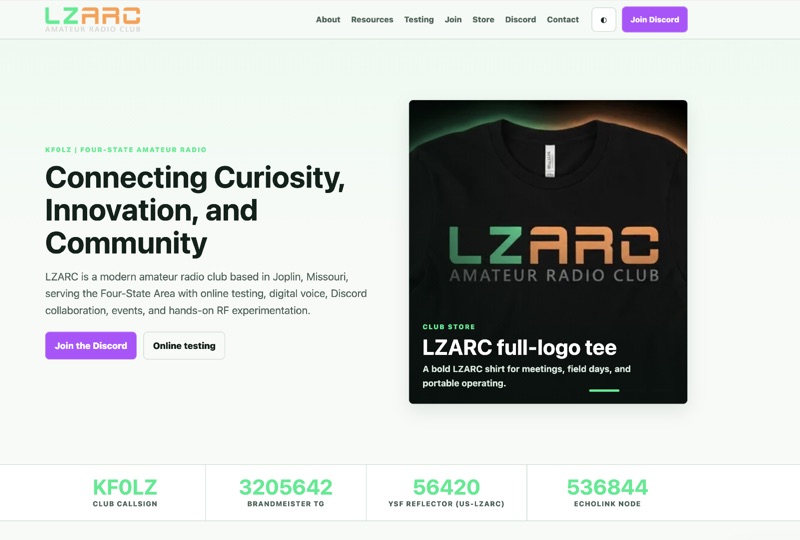 The LZ Amateur Radio Club (LZARC) operates with the club callsign **KF0LZ** and utilizes BrandMeister Talkgroup 3205642, YSF Reflector 56420 (US-LZARC), and EchoLink node 536844 for digital voice communications. This club, based in Joplin, Missouri, provides online FCC amateur radio license testing for Technician, General, and Amateur Extra class licenses, facilitating entry into the hobby. LZARC actively promotes hands-on RF experimentation, mesh networking with **Meshtastic**, and participation in **Parks on the Air** (POTA) activations. LZARC hosts regular events including the N0NMS Youth Net on 145.350 MHz (PL 91.5), the LZMesh Net on the LZMesh Meshtastic Channel, and the LZARC Digital Voice Net (CHAOS Net) via BrandMeister TG 3205642. The club maintains an active Discord server with over 300 members for daily conversations, project discussions, and quick support. Recent updates highlight member upgrades and participation in local hamfests, demonstrating a focus on community engagement and operator development across Missouri, Arkansas, Oklahoma, and Kansas.