Search results
Query: strong signal handling
Links: 2 | Categories: 0
-
 The Yaesu FTDX-10 transceiver features a hybrid receiver design, integrating a dual superheterodyne front end with an SDR chip for advanced DSP. This architecture aims to mitigate front-end overload, a critical consideration for HF operations. Performance data indicates a Reciprocal Mixing Dynamic Range (RMDR) that places the FTDX-10 at number two on Sherwood Engineering's ranking, highlighting its strong signal handling capabilities. The unit includes a 5-inch TFT touch screen and an internal antenna tuner effective up to 3:1 SWR, covering receiver frequencies from 30 kHz to 75 MHz. Operational aspects include a spectrum scope with 2D and 3DSS display modes, offering adjustable frequency spans from 1 kHz to 1000 kHz and five waterfall speeds. The review evaluates the efficacy of the noise blanker and Digital Noise Reduction (DNR) functions, essential for mitigating interference in various operating environments. Connectivity is supported via USB drivers for N1MM and HRD software, alongside DVI output for external display mirroring. The Multi-Purpose VFO Outer Dial (MPVD) enhances user interaction. The FTDX-10's design and features cater to serious amateur radio operators seeking high performance in a compact HF/50 MHz platform.
-
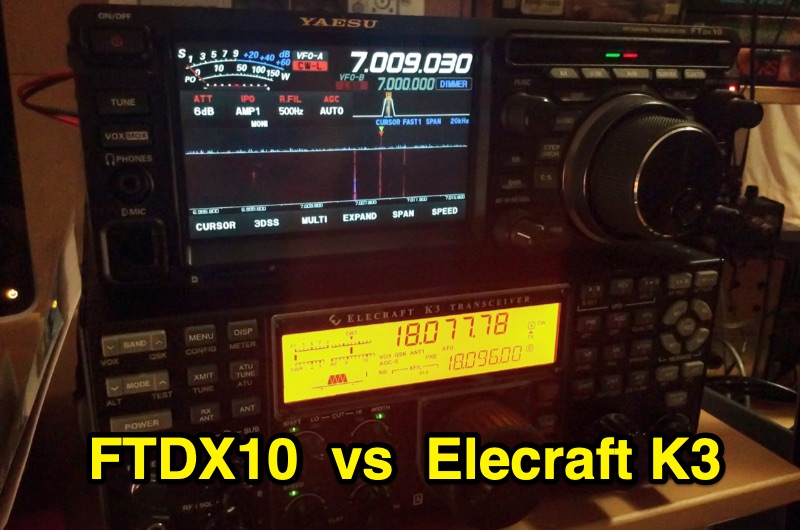 Evaluates the Yaesu FTDX10 receiver performance against an Elecraft K3 (serial #216) during the NAQP CW contest, specifically assessing weak signal reception adjacent to strong signals. Testing involved a 300 Hz bandwidth, Audio Peak Filter (APF) activation, 6 dB attenuation, and preamplifier deactivation to simulate challenging operating environments. The FTDX10's adjustable APF, offering NARR, MED, and WIDE settings, is directly compared to the K3's single APF setting. Observations highlight the FTDX10's superior suppression of a strong signal at X+100Hz, demonstrating less bleed-through into the passband compared to the K3, even with the K3's 500Hz roofing filter engaged. This indicates improved dynamic range and selectivity in the FTDX10's receiver architecture under high-intensity signal conditions. The analysis also briefly notes transmit T/R relay noise characteristics, providing a comprehensive, albeit concise, technical comparison of these two popular HF transceivers.