20 Meter Yagi Antenna Designs and Construction Plans
Find various plans and resources for building 20-meter Yagi antennas, including monoband and portable options.

Yagi antennas for the 20-meter band are a popular choice for hams seeking directional gain and improved signal-to-noise ratio on 14 MHz. This band is excellent for DX, and a well-designed Yagi can make a significant difference in working distant stations, especially during contests or when propagation is challenging. Operators often build monoband Yagis to optimize performance specifically for 20 meters, focusing on gain, front-to-back ratio, and bandwidth.
This section provides numerous designs for 20-meter Yagis, ranging from compact 2-element models suitable for portable or Field Day operations to larger 5-element or even 7-element arrays for serious DXers. Many plans include details on matching systems like the DK7ZB match, while others, such as the W2PV 4-element Yagi, are classic designs from the ARRL Antenna Handbook. You'll find options for both permanent installations and lightweight wire Yagis for temporary setups, helping hams improve their signal on this vital HF band.
Related Categories
-
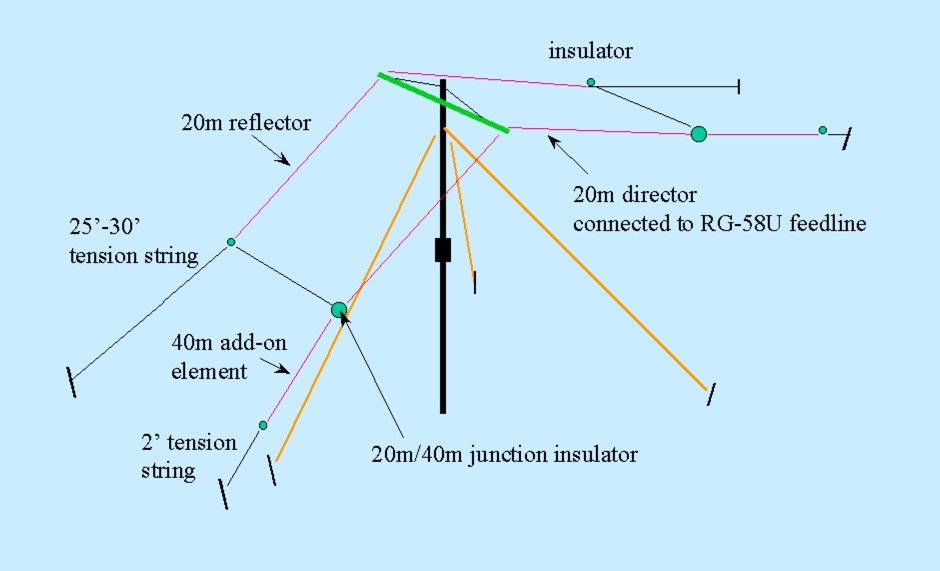 A wire yagi antenna for 20 and 40 meters band suitable for outdoor and field day operations
 -
 2-Element parasitic Yagis for the Shortwave-Bands 10-12-15-17-20-30m. The antennas are feeded with the DK7ZB-match. A quarter-wave choke of coax is grounded at the socket.
 -
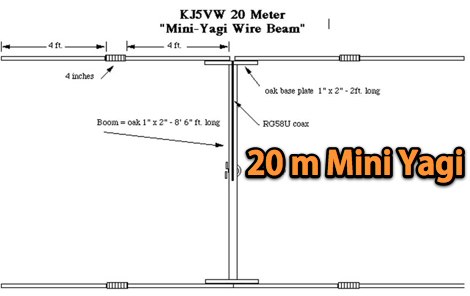 The KJ5VW 20 Meter Mini Yagi by Gary R. Hanson, Austin, Texas
 -
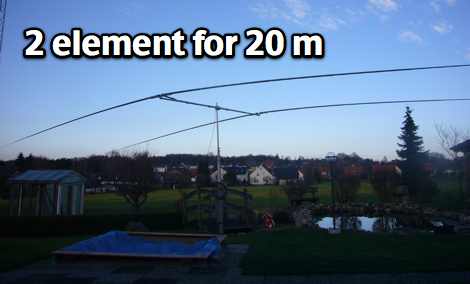 20m 2-element light-weight Yagi antenna
 -
 All these plans use the DK7ZB match
 -
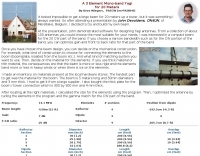 A 3 Element Mono-band Yagi for 20 meters by Kees Wiegers, PA5CW (ex-PA3BHS)
 -
 Pictures and plans of a 4 elements yagi beam antenna for 14 Mhz
 -
 Picture and construction details of a 5 element 20 meter monobander
 -
 A 7 elements yagi beam monoband antenna for 14 Mhz by VE3GK
 -
 Homebrew a compact yagi antenna for 14 Mhz suitable for those with small plots based on a design by AB4GX
 -
 AB4GX K4EAA Mononband yagi antenna for 20 Meters
 -
 A monoband yagi for 14 MHz a PDF article from 73 amateur radio magazine by AB4GX
 -
 A Portable 2 element Triband Yagi antenna that can work on 10 15 20 meter band by VE7CA
 -
 Presents **NW3Z** optimized wideband Yagi antenna designs for 20m, 15m, and 10m bands, originally featured at Dayton 2001. Includes design files.
 -
 A simple to build Yagi 2 element antenna for 15 or 20 meters band by 9m2mso
 -
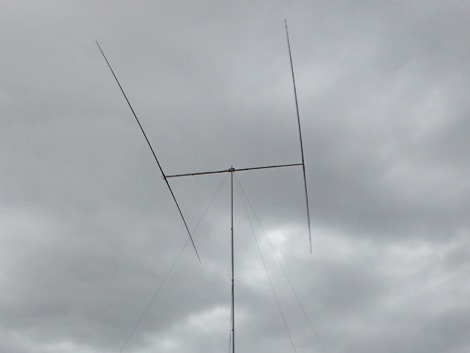 This antenna was designed for the CQ WW CW 2009 at EA8URL. All elements are made out of fishing rods with an insulated copper cable fixed on the rods by cable ties. Both fishing rods and cable are UV resistant.
 -
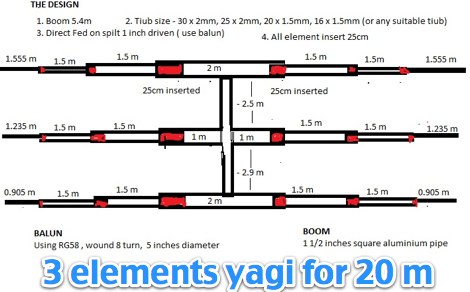 An homebrew project for a 3 elements yagi monoband antenna for the 20 meters by 9M2MSO
Frequently Asked Questions
What are the advantages of using a monoband 20-meter Yagi compared to a multiband antenna?
A monoband 20-meter Yagi is specifically designed and optimized for the 20-meter band, often resulting in superior performance in terms of gain, front-to-back ratio, and SWR across that specific frequency range. While multiband antennas offer versatility, a monoband Yagi typically provides better efficiency and directivity on its intended band.
What types of 20-meter Yagi antenna designs can I expect to find resources for?
You can find plans and resources for various 20-meter Yagi antenna designs. This includes traditional monoband Yagis, which are optimized specifically for the 20-meter band, as well as designs tailored for portable operation, offering flexibility for field day or temporary setups.
Are the resources primarily for building Yagi antennas from scratch, or do they cover modifications too?
The resources are focused on providing plans and information for building 20-meter Yagi antennas. While the primary emphasis is on construction from scratch, understanding these plans can also be beneficial for those looking to modify existing Yagi designs or troubleshoot performance issues.
Could the plans for 20-meter Yagi antennas be adapted for other HF bands?
While the plans are specifically for 20-meter Yagi antennas, the fundamental principles of Yagi design, such as element spacing, length calculations, and impedance matching, are transferable. With appropriate scaling and recalculations, the knowledge gained from these resources could potentially be applied to design Yagis for other HF bands, though direct adaptation without modification is unlikely to be effective.
What kind of materials are typically required for building a 20-meter Yagi antenna based on these plans?
Building a 20-meter Yagi antenna typically requires materials such as aluminum tubing for elements and booms, insulating materials for element mounting, and hardware for assembly. Depending on the specific plan, you might also need coaxial cable for the feedline, baluns, and mast mounting hardware. The resources should detail the exact material lists for each design.
For which frequency bands are Yagi antennas commonly used in amateur radio?
Yagi antennas are widely used across various amateur radio frequency bands, particularly where directional gain is beneficial. They are very popular for VHF (e.g., 2 meters, 6 meters) and UHF (e.g., 70 cm) operations, including satellite communications and weak-signal work. On HF bands, Yagis are common for 10, 15, and 20 meters, where their gain and directivity are crucial for long-distance DXing. While technically possible, building efficient multi-element Yagis for lower HF bands (like 40 or 80 meters) becomes physically very large and challenging due to the longer wavelengths.
What is the origin of the name 'Yagi' for this type of antenna?
The Yagi antenna is named after its inventors, Shintaro Yagi and Hidetsugu Uda, who developed it in 1926 at Tohoku Imperial University in Japan. Although Uda did most of the design work, Yagi's name became more widely associated with the antenna due to his English-language publication describing the invention. This directional antenna design revolutionized radio communication and broadcasting, becoming one of the most recognized and utilized antenna types globally.