Broadband Over Power Line (BPL) and Ham Radio Interference
Understand how Broadband Over Power Line (BPL) technology works and its potential impact on amateur radio operations.

Broadband over Power Lines (BPL), also known as Power Line Communications (PLC), uses existing electrical power lines to transmit high-speed data. This technology injects radio frequency energy onto power lines, allowing them to carry internet traffic alongside electrical current. For ham radio operators, BPL raises concerns due to its potential for generating significant radio frequency interference (RFI) across many amateur radio bands, impacting QSOs and DX operations.
Operators often find that BPL systems can create noise that makes weak signal reception difficult, especially on HF. Resources in this category provide tutorials and technical explanations of BPL technology, including its operational principles and potential impact on amateur radio activity. Hams can also find information on regulatory developments from entities like the FCC and JARL, along with reports from various countries like Japan and Canada detailing BPL trials and their effects on local radio environments.
-
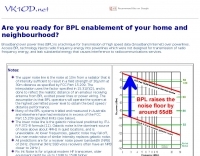 Broadband over power lines (BPL) is a technique for transmission of high speed data (broadband Internet) over powerlines. Access BPL technology injects radio frequency energy into powerlines which were not designed for transmission of radio frequency energy, and leak substantial energy that causes interference to radiocommunications service
 -
 North Carolina amateur is refuting a clean bill of health the FCC gave this summer to a BPL field trial system in the Raleigh area.
 -
 Blog post announcing that Ham Radio, shortwave listeners and broadcast band listeners will be protected by Law in Europe
 -
 VK1OD informations on BPL
 -
 Another general tutorial on BPL
 -
 The Japan Amateur Radio League (JARL) is cautiously watching new developments concerning the commercialization of Power Line Communications (PLC), while continuing to carry out joint experiments with a high speed power line communication promoters' alliance to reduce potential interference to radio communications.
 -
 An ARRL tutorial detailing Broadband over Power Line (BPL) technology and the FCC regulations governing its deployment to mitigate RFI to amateur radio.
 -
 Europeam perspective on BPL PLC