50 MHz Sporadic-E Antenna Height Analysis for Single-Hop Propagation
Description
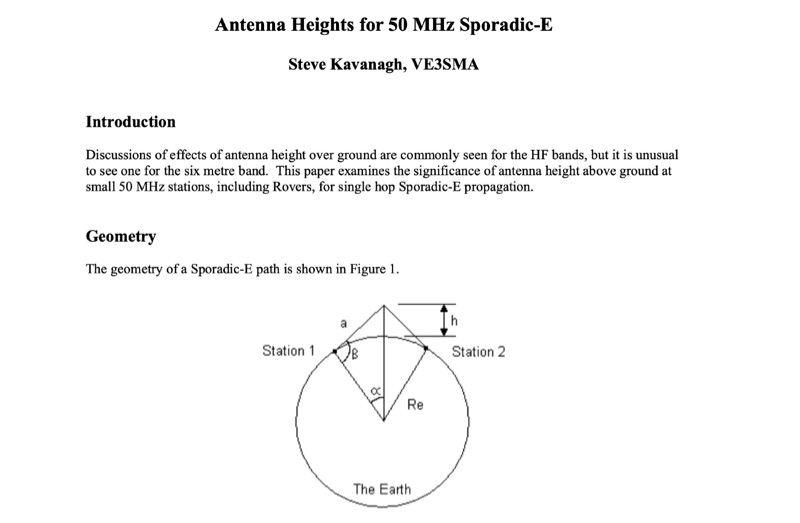
This resource presents a technical analysis of antenna height effects for 50 MHz Sporadic-E propagation, specifically focusing on single-hop paths. The methodology employs a geometric model assuming Sporadic-E clouds act as a horizontal mirror at an altitude of 110 km. Calculations are provided for elevation angle versus distance, utilizing Earth's radius at 6378 km. The paper examines path lengths and elevation angles for distances ranging from 1000 km up to the maximum single-hop distance of 2352 km. Data is presented in tabular format, detailing elevation angles for specific distances, such as 10.05 degrees at 1000 km and 2.27 degrees at 1900 km. The analysis considers the area covered by different elevation angle ranges, noting that 3 to 10 degrees (1000-1800 km) covers an area approximately equal to 0 to 3 degrees (1800-2352 km). This information is relevant for optimizing antenna performance for 6-meter band operations, including Rover stations, to maximize contacts over varying Sporadic-E path lengths.