Search results
Query: Grid Square
Links: 53 | Categories: 2
-
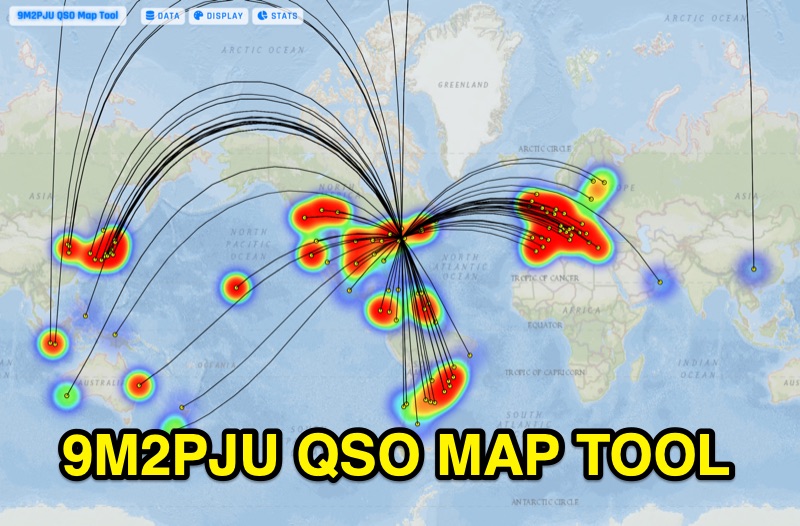 Presents the 9M2PJU QSO Map Tool, a web-based utility designed by Ian Renton for visualizing amateur radio contacts. This tool processes ADIF, Cabrillo, and SOTA CSV log files, allowing operators to plot their QSOs on a selection of base maps, including ESRI NatGeo World Map and OpenStreetMap Mapnik. Users can configure display options such as simple dot markers or xOTA hunter markers, QTH location, outlines, shadows, and geodesic lines, with coloring by band or a fixed hue. The application supports drawing per-band heatmaps and offers overlays for Maidenhead grid squares, CQ zones, ITU zones, and Worked All Britain/Ireland grids. It also provides QSO filtering capabilities and displays comprehensive log statistics, including unique calls, grid squares, CQ zones, ITU zones, and worked DXCCs. Customizable band and mode colors, alongside specific xOTA icons for programs like POTA, SOTA, WWFF, IOTA, and WCA, enhance the visual analysis of operating activity.
-
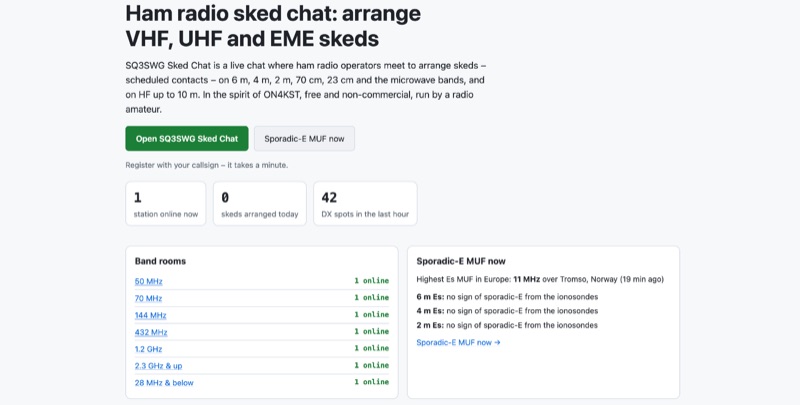 Facilitates real-time coordination of scheduled contacts (skeds) for weak-signal modes on VHF, UHF, and microwave bands, including meteor scatter, tropo, sporadic-E, and EME. The platform features dedicated band rooms for 50 MHz, 70 MHz, 144 MHz, 432 MHz, 1.2 GHz, 2.3 GHz & up, and 28 MHz & below, displaying online users with their locator, distance (QRB), and beam heading (QTF). Users can propose skeds specifying frequency, mode, and UTC time, receiving a countdown and antenna pointing instructions. It integrates propagation alerts, including solar data and Sporadic-E MUF from ionosondes, indicating potential band openings for 6m, 4m, or 2m. DX spots from clusters and users are sorted into band rooms, offering a "Sked" button for online stations. A station map displays users with Maidenhead grid squares and great-circle paths. Verified callsigns through QRZ.com enhance trust among operators. The service is free, non-commercial, and operates without advertising or tracking.
-
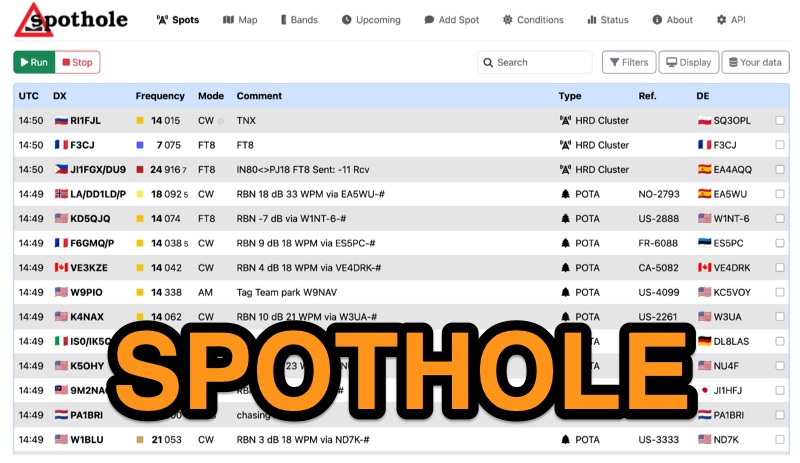 Spothole aggregates real-time amateur radio spots from various sources, including traditional **DX clusters** and specialized outdoor activity programs like POTA and SOTA. The platform provides a highly customizable web interface where users can configure display options such as DX and DE continents, local time, and a 'ping' notification for new spots. Users can also adjust the number of spots displayed and select from several UI color schemes, including PSK Reporter and Ham Rainbow. The tool integrates with external callbook services like QRZ.com and HamQTH, allowing users to remember login credentials for seamless data reloading. A distinctive feature is the ability to input a personal grid square and manage lists of 'worked' and 'wanted' callsigns. Wanted callsigns, entered as space- or comma-separated lists, receive a gold highlight when a matching DX callsign appears in the spot feed, aiding in targeted DXing efforts. Beyond the interactive web interface, Spothole offers a universal JSON **API**, enabling developers to build custom applications leveraging its aggregated spotting data.