Search results
Query: tempo
Links: 52 | Categories: 0
-
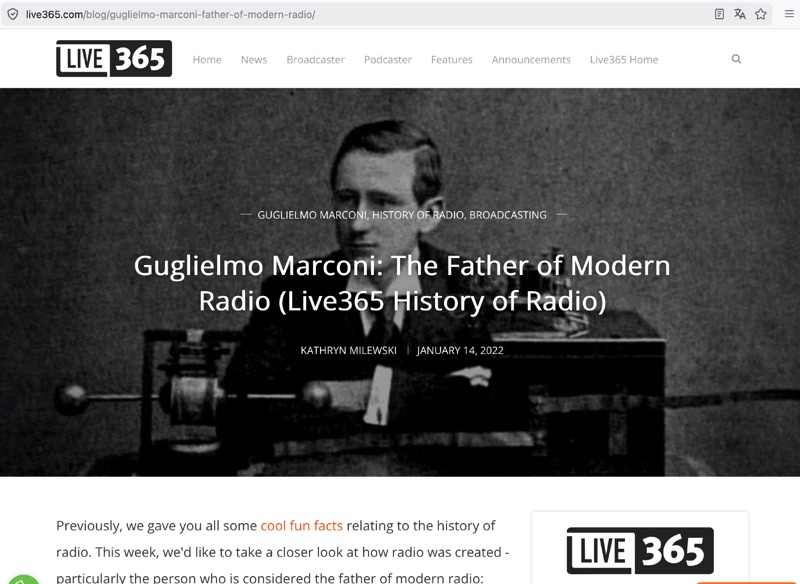 Tracing the foundational work of Guglielmo Marconi, this article details his early laboratory experiments in 1895, where he successfully transmitted wireless signals over 1.5 miles. It highlights his 1896 patent for a wireless telegraphy system in England and subsequent demonstrations, including signal transmissions up to 6.4 km (4 miles) on Salisbury Plain and nearly 14.5 km (9 miles) across the Bristol Channel. Marconi's work built upon the mathematical theories of _James Clerk Maxwell_ and the experimental results of _Heinrich Hertz_, proving the practical feasibility of radio communication. The resource further chronicles the formation of The Wireless Telegraph & Signal Company Limited in 1897 and Marconi's relentless efforts to popularize radiotelegraphy. A significant milestone was the 1901 transatlantic reception of the Morse code letter "S" from Poldhu, Cornwall, at St. John's, Newfoundland, using a kite-supported wire antenna, defying contemporary mathematical predictions about Earth's curvature limiting range. This achievement underscored the global potential of radio. The article also touches upon Marconi's later discoveries, such as the "daytime effect" concerning atmospheric reflection of radio waves, and his 1902 patent for a magnetic detector, which became a standard wireless receiver. His contributions earned him a Nobel Prize in 1909.
 -
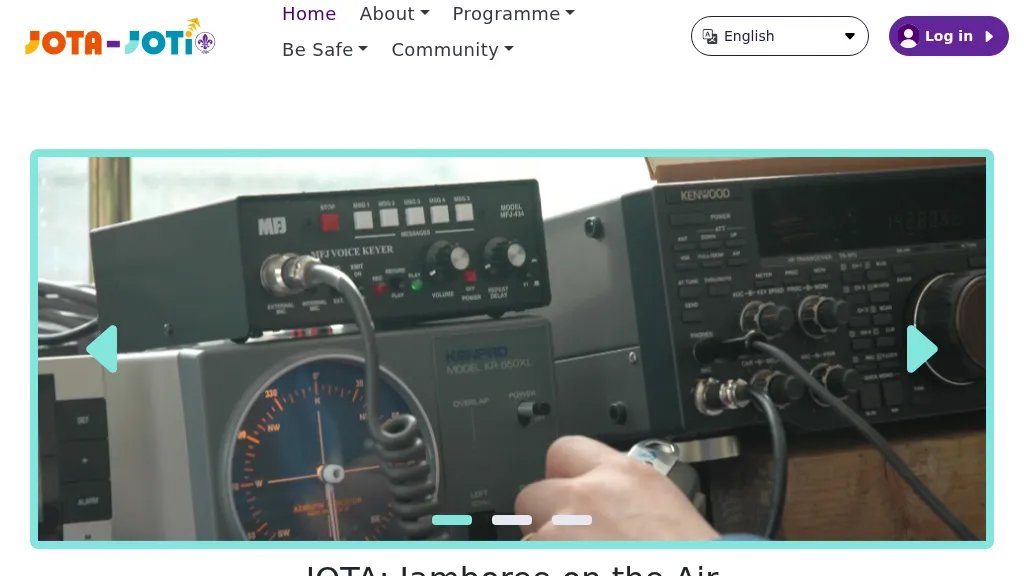 Jamboree on the Air (JOTA) is an annual Scouting event held on the third full weekend of October, coinciding with Jamboree on the Internet (JOTI). This global event facilitates communication among Scouts worldwide using amateur radio, enabling participants to exchange Scouting experiences and ideas over short-wave signals. It serves as an educational platform for Scouts to learn about wireless radio techniques and basic electronics. Participation necessitates the support of at least one licensed amateur radio operator or a local amateur radio club. National amateur radio organizations can assist in locating local operators. Licensed operators, having passed technical examinations, may host Scouts at their stations, transport equipment to Scout headquarters, or establish temporary stations in various locations. Depending on national regulations, Scouts may speak directly over the air, or special permission might be required, with the licensed operator making contacts on their behalf. Operators are encouraged to familiarize themselves with Scouting principles to facilitate more informative and engaging exchanges.