Search results
Query: 10m antenna
Links: 152 | Categories: 1
Categories
-
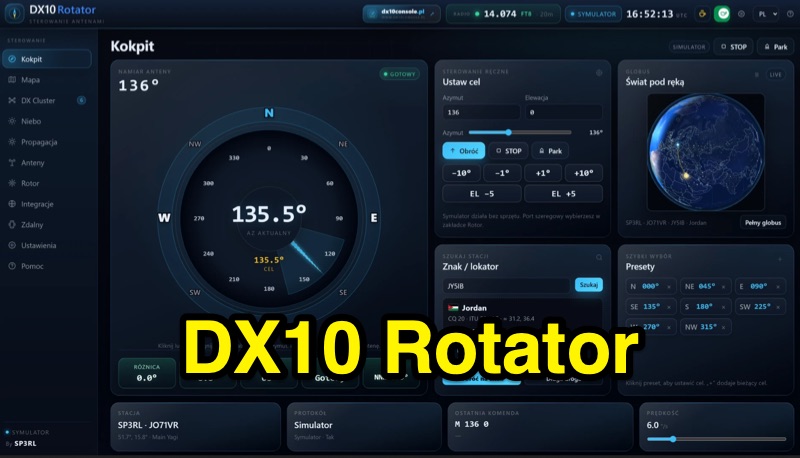 DX10 Rotator, a freeware application, provides comprehensive control for amateur radio antenna rotators, addressing the need for precise antenna positioning in various operating scenarios. It supports a wide array of popular rotor protocols, including **Yaesu GS-232**, Hy-Gain DCU-1/2, MDS RC-1, Green Heron, AlfaSpid, Prosistel, M2, and Easycomm, facilitating connectivity via serial COM port. Additionally, it offers wireless control capabilities through ESP32 via Wi-Fi (TCP 8765), enhancing operational flexibility. The software features a detailed cockpit display showing compass, azimuth, target, and beam information, alongside user-definable presets. It integrates a 3D globe and a 2D map with satellite pass predictions, crucial for satellite operations, and includes Doppler RX/TX and AZ/EL tracking. Operators can create custom antenna profiles, specifying beam width, gain, and offset, which aids in optimizing signal reception and transmission. Beyond rotor control, DX10 Rotator displays live propagation data such as SFI, SN, A, K, X-ray, Bz, and band conditions for 160-10m, along with Kp forecasts. It also provides local wind conditions from Open-Meteo. The software integrates with DX10 Console for automatic antenna rotation based on radio frequency and station bearing via rigctld (127.0.0.1:4532), streamlining station automation.
-
 TX5EU 2026 DXpedition to Raivavae Island, **OC-114**, within the Austral Islands, providing a detailed account of the German/Dutch team's operations. The resource outlines the participation of operators such as DL2AWG Guenter, PA2KW Evert, and DK2AMM Ernoe, who engaged in CW, SSB, RTTY, and various digital modes. It documents the real-world challenges encountered, including significant equipment failures and antenna damage to 80/60m, 30m, and 10m verticals due to adverse storm conditions. The page offers timely news updates on the expedition's progress, noting repairs to a power amplifier's 10/12m bandpass filter, which enabled three stations to utilize amplification. Earlier reports highlighted power failures and the loss of multiple power amplifiers, necessitating one station to operate barefoot FT-8 with 100W. The team's persistent efforts to repair antennas as weather permits are also detailed, reflecting the dynamic nature of remote island operations.