Search results
Query: user interface
Links: 156 | Categories: 3
-
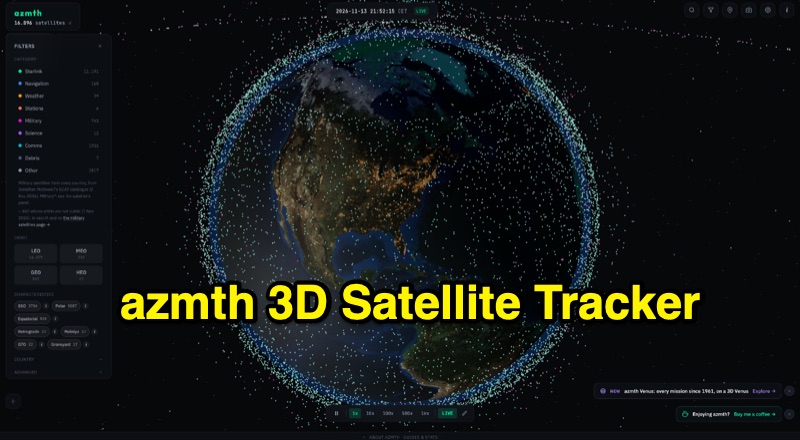 azmth 3D Satellite Tracker demonstrates a sophisticated, free 3D globe in the browser that visualizes every active satellite live, leveraging _CelesTrak orbital data_ for precise positioning. This interactive tool enables users to track a vast array of satellites, from the International Space Station (ISS) and Starlink constellations to dedicated amateur radio satellites like SO-50, RS-44, and GreenCube. The platform provides real-time orbital paths and allows for detailed observation of satellite movements relative to Earth. Users can input their specific location to generate accurate pass predictions and determine visibility windows for any selected satellite, a crucial feature for satellite operators planning contacts. The interface is designed for intuitive exploration, allowing manipulation of the 3D globe and selection of individual satellites for detailed information. The tracker's ability to display over **16,800** active satellites simultaneously offers a comprehensive view of the orbital environment, aiding in understanding satellite dynamics and optimizing amateur radio satellite operations.
-
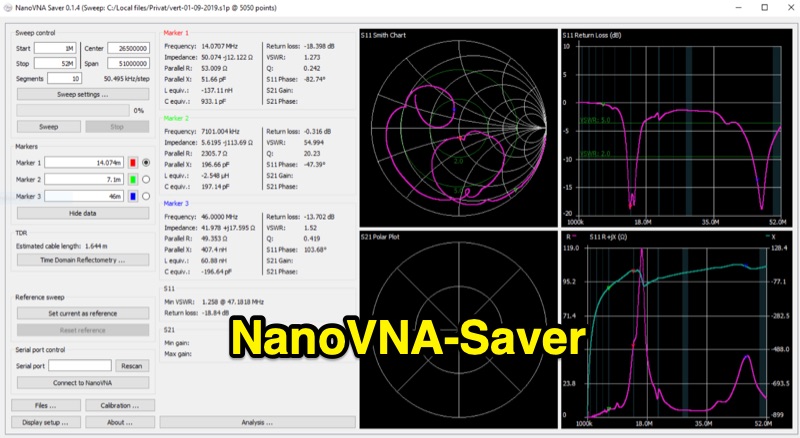 Facilitates interfacing with various NanoVNA models, including NanoVNA-H, NanoVNA-H4, NanoVNA-F, AVNA, and LiteVNA, to extract and display measurement data on a computer. The application supports splitting frequency ranges into multiple segments, increasing resolution beyond the standard 101 data points, with reported tests achieving up to 10,000 points for detailed analysis. Data averaging is also implemented to improve measurement accuracy, particularly beneficial at higher frequencies where noise can be more prevalent. Displays data across several chart types, such as Smith, LogMag, Phase, and VSWR charts, for both S11 and S21 parameters. Markers provide specific readouts for impedance, VSWR, Q factor, and equivalent capacitance or inductance at selected frequency points. Users can define and display customizable frequency bands as reference overlays on the charts. Developed in Python 3 (specifically >=3.10), the software leverages pyside6 for its graphical user interface, numpy for numerical operations, and scipy for scientific computing. This robust framework ensures stable performance and accurate data processing for amateur radio operators and electronics enthusiasts performing antenna and circuit characterization.
-
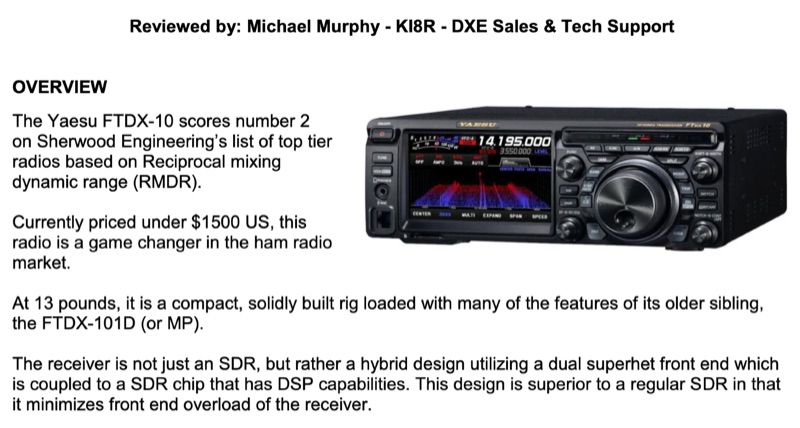 Presents an extended-period review of the Yaesu FTDX10 HF transceiver, focusing on its operational usability and long-term reliability after approximately ten months of alternating use. The analysis details aspects such as the radio's interface logic, menu navigation, and overall functional consistency, contrasting these with published specifications and common user expectations. It addresses specific operational scenarios and evaluates the radio's behavior under various conditions, providing observations on potential discrepancies between advertised features and practical application, including issues like panel timing, knob placement, and DNR aggressiveness. The review compares the FTDX10's performance and user experience against the Icom IC-7610 and Icom IC-7300 transceivers, particularly regarding receiver performance, roofing filters, APF, and dedicated width/shift controls. It highlights disadvantages such as disabled functions during transmit, slow internal ATU performance, lack of spectrum scope averaging, and various quality assurance issues like volume knob faults, failing screens, and FT8 harmonics. The document also includes commentary on Yaesu's product support, noting a lack of response to user feedback, and observed reliability of the FTDX10 unit over time, offering a perspective beyond initial laboratory measurements like those from Sherwood Engineering.
-
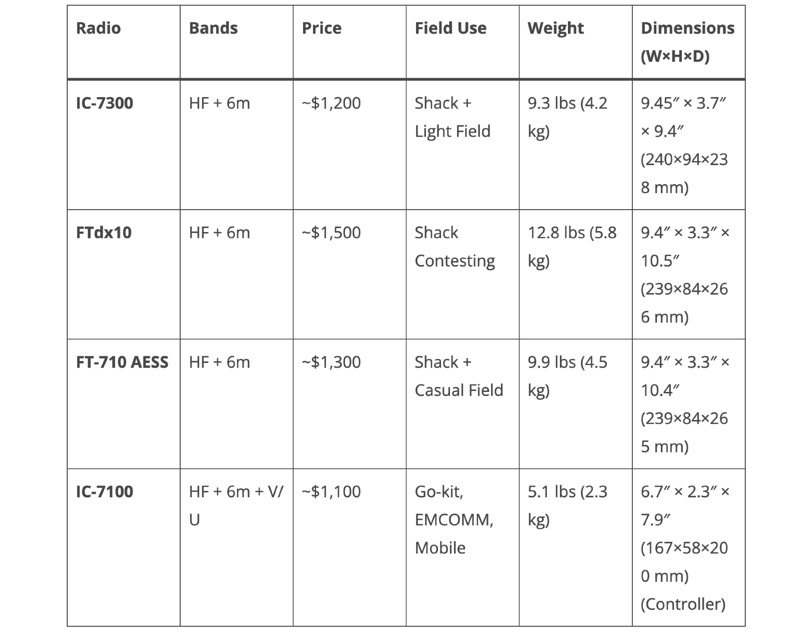 The page presents a collection of blog posts tagged with "yaesu-ftdx10" from the VE3IPS WordPress site. It serves as an index for content related to the Yaesu FTdx10 transceiver, often in comparison with other popular HF rigs like the Icom IC-7300 and Yaesu FT-710 AESS. The aggregated content details specifications such as 100W output power and various SDR architectures. Specific articles linked from this tag page likely delve into operational aspects, including receiver performance, audio clarity, and user interface characteristics of these transceivers. Mentions of features like the IC-7300's real-time spectrum scope and USB integration, or the FTdx10's roofing filters and contest-proven Contour and DNR filters, indicate a focus on technical distinctions. The resource also highlights limitations, such as the basic 3:1 internal tuner in some models and the absence of VHF/UHF coverage in the IC-7300. The Yaesu FTdx10's superheterodyne and SDR approach, along with its placement on the Sherwood Engineering receiver performance list, are key points of discussion within the linked posts.
-
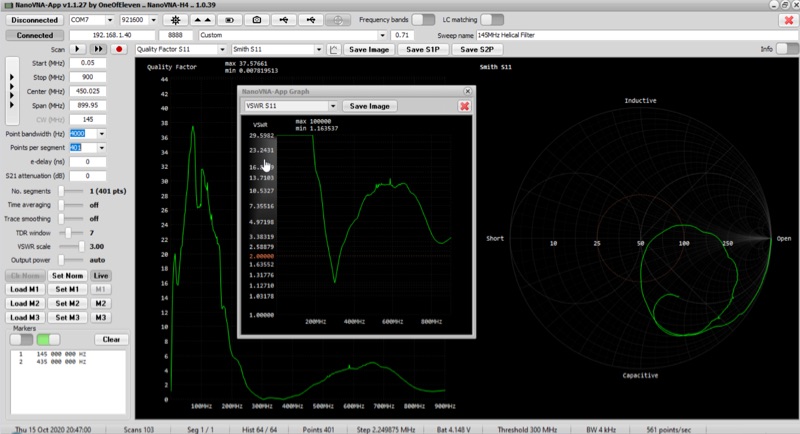 Presents a Windows software application specifically engineered to interface with NanoVNA vector network analyzers. The application's source code reveals modules like Calibration.cpp and GraphUnit.cpp, indicating robust functionalities for VNA calibration procedures and graphical visualization of RF measurement data. It supports various NanoVNA firmware versions, including NanoVNA H v1.2.24.dfu and NanoVNA H4 v1.2.24.dfu, ensuring broad compatibility across popular hardware iterations. Key components such as BatteryVoltageUnit.cpp, ColourPickerUnit.cpp, and SerialPort.cpp manage battery monitoring, user interface customization, and serial port communications, respectively. DataUnit.cpp handles measurement data processing, while SettingsUnit.cpp provides comprehensive control over application configurations, allowing hams to tailor the software to their specific analysis needs. The project integrates USB100.H and USBDI.H for direct USB connectivity and TCPIP.cpp for network-based communication, offering flexible options for connecting to NanoVNA devices. This software streamlines the process of analyzing and interpreting RF characteristics, making it a practical tool for antenna tuning and circuit analysis.
-
 Eight specific user interface limitations are identified in the Yaesu FTdx10 transceiver's firmware, drawing on the author's extensive software engineering background and experience with Icom IC-705 and IC-7300 interfaces. The analysis highlights issues such as the main dial Lock button disabling the RX/TX Clarifier, which impedes net control and pile-up operations. It also points out the FTdx10's spectrum scope display modes lack a "Scroll-F" equivalent for efficient band scanning, a feature common in Icom radios. Further points address the inability to access screen-based settings during transmit, the need for improved antenna tuner behavior with an option to reset settings and intelligent segment recall, and limitations when using an external mouse, such as the scroll wheel not functioning as the main dial or function knob. The author also notes the lack of automatic power reduction when using external LDG tuners and the CW decoder's all-caps display, which hinders readability. These observations aim to guide Yaesu in enhancing the FTdx10's user experience, leveraging its strong receiver performance and advanced features.