Search results
Query: HF transceiver
Links: 307 | Categories: 35
Categories
- Radio Equipment > HF Transceivers
- Technical Reference > HF Radios
- Manufacturers > Transceivers
- Radio Equipment > VHF-UHF Mobile
- Radio Equipment > HF Transceivers > Drake TR7
- Radio Equipment > HF Transceivers > Elecraft KX2
- Radio Equipment > HF Transceivers > Elecraft KX3
- Radio Equipment > VHF-UHF Mobile > ICOM IC-2100H
- Radio Equipment > HF Transceivers > Icom IC-703
- Radio Equipment > HF Transceivers > Icom IC-7600
- Radio Equipment > HF Transceivers > Icom IC-7610
- Radio Equipment > HF Transceivers > Icom IC-7700
- Radio Equipment > HF Transceivers > Icom IC-7760
- Radio Equipment > HF Transceivers > Icom IC-7851
- Radio Equipment > VHF-UHF Mobile > Kenwood TM-241
- Radio Equipment > HF Transceivers > Kenwood TS-450S
- Radio Equipment > HF Transceivers > Kenwood TS-690S
- Radio Equipment > HF Transceivers > Kenwood TS-850
- Radio Equipment > HF Transceivers > Kenwood TS-940S
- Radio Equipment > HF Transceivers > Kenwood TS-950SDX
- Radio Equipment > VHF-UHF Amplifiers > Mirage BD-35
- Technical Reference > Programming Radio
- Radio Equipment > HF Transceivers > Ten-Tec Jupiter
- Radio Equipment > HF Transceivers > X1M
- Radio Equipment > HF Transceivers > XIEGU G90
- Radio Equipment > HF Transceivers > Yaesu FT-2000
- Radio Equipment > HF Transceivers > Yaesu FT-710
- Radio Equipment > HF Transceivers > Yaesu FT-847
- Radio Equipment > VHF-UHF Mobile > Yaesu FT-8800R
- Radio Equipment > HF Transceivers > Yaesu FT-891
-
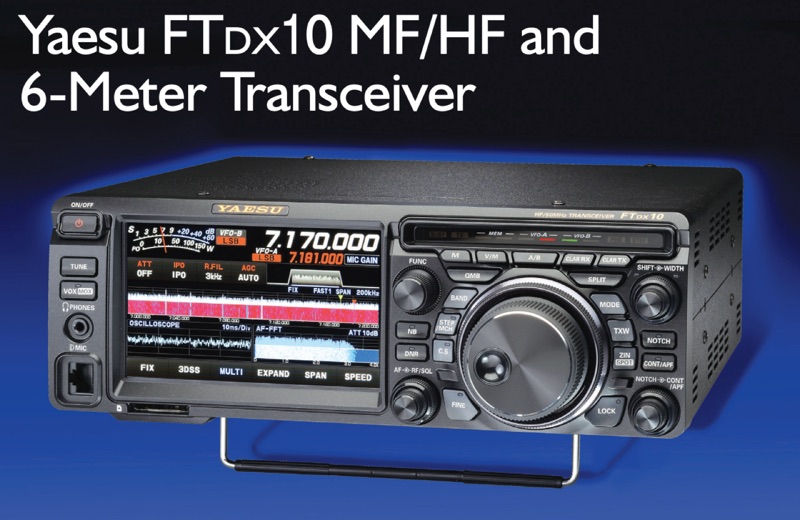 The Yaesu FTDX10 MF/HF and 6-meter transceiver, a 100-watt rig, is designed to bring high-performance receiver architecture to the intermediate-price class. It offers continuous receive coverage from 30 kHz to 75 MHz and transmit capabilities across all amateur bands from 160 through 6 meters, including five preset CW and SSB channels on 60 meters. The transceiver supports AM, FM, SSB, CW, and digital modes, with integrated decoders for CW, RTTY, and PSK31, making it a versatile station for various operating preferences. Physically, the FTDX10 measures 3½ × 10½ × 10½ inches and weighs 13 pounds, requiring a 20–25 A DC power supply for full 100 W output. Its front panel features a 5-inch TFT color touchscreen and a large VFO knob, complemented by an SD memory card slot for recording audio and saving settings. Rear panel connectivity includes a single SO-239 antenna port, multiple USB ports for CAT control and peripherals, and DIN jacks for external digital mode hardware and linear amplifiers, though it lacks a dedicated low-noise receive antenna provision. ARRL Lab tests confirm excellent receiver performance, with blocking dynamic range exceeding 137 dB at 2 kHz spacing and robust IMD dynamic range figures. The hybrid receiver design incorporates selectable roofing filters at 500 Hz, 3 kHz, and 12 kHz, along with two preamplifiers and various attenuation levels, allowing operators to tailor reception characteristics to challenging band conditions. Transmitter performance is also rated very good, with low transmit phase noise.
-
 Optimizing on-air audio for SSB, DXing, and contesting operations is addressed through a range of specialized audio processing equipment. The offerings include multi-band equalizers, specifically 5-band, 8-band, 10-band, and 12-band units, some integrated with features such as compressors, echo effects, noise gates, and phase rotation capabilities. These devices are engineered to interface with common amateur radio transceivers, with explicit compatibility noted for models like the Yaesu FT-DX10, FT-DX101D, FT-1000MP, FT-DX5000, Collins HF-380, and Flex 6300, alongside analog S/P meters for Icom rigs. The product line focuses on enhancing microphone audio characteristics, supporting XLR dynamic microphones for improved signal clarity and presence. The manufacturer, DB6QW Electronics, emphasizes direct support and a 100% manufacturer's warranty, reflecting confidence in product quality and operational reliability. This resource details specific audio processing tools designed to refine the transmitted audio signal, providing operators with granular control over their voice characteristics for competitive and casual amateur radio communications.
-
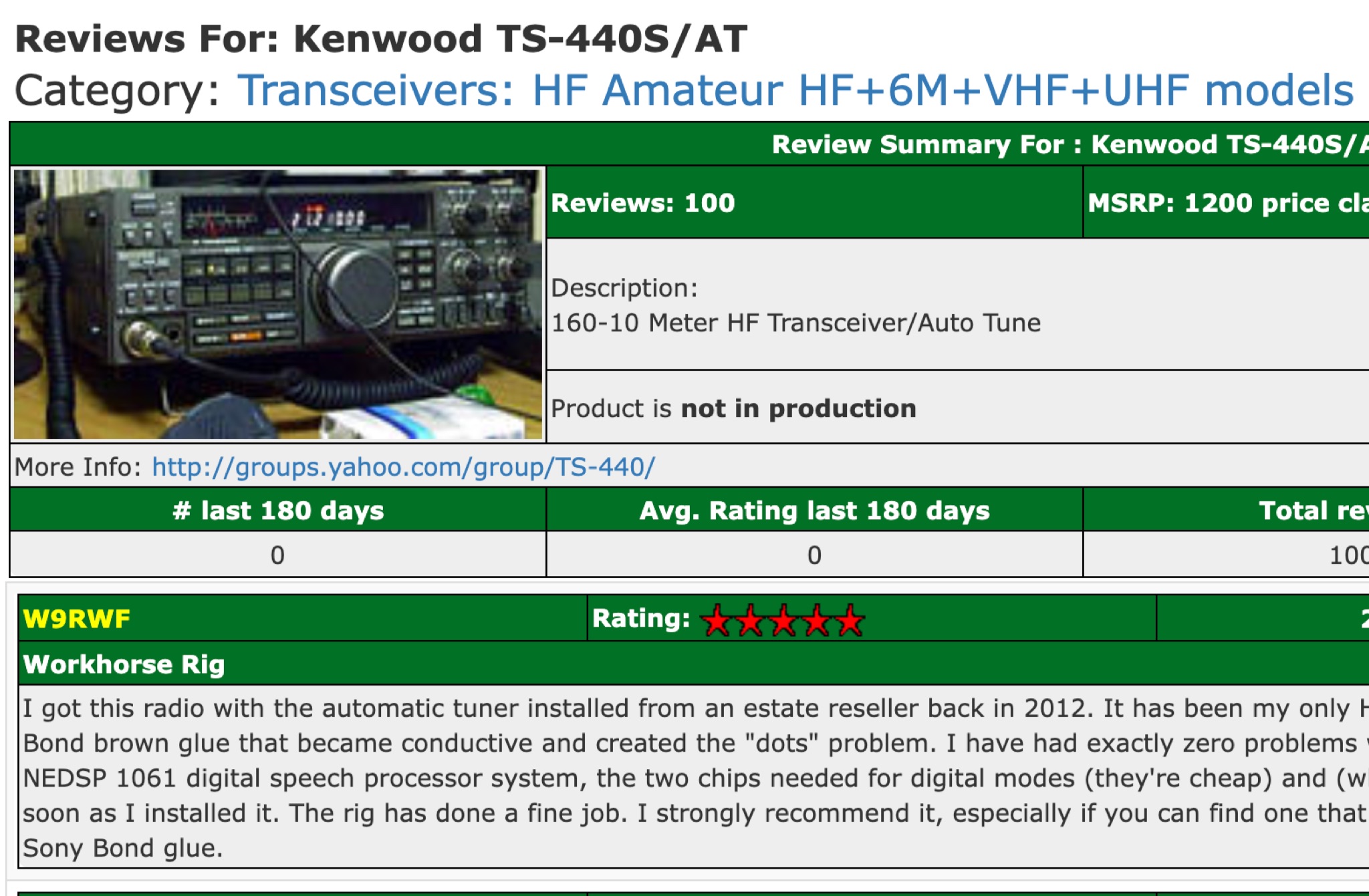 eham reviews of the Kenwood TS-440S, and Kenwood TS-440S/AT, 160-10 Meter HF ham radio Transceiver/Auto Tune.
-
 The Yaesu FTDX-10 transceiver features a hybrid receiver design, integrating a dual superheterodyne front end with an SDR chip for advanced DSP. This architecture aims to mitigate front-end overload, a critical consideration for HF operations. Performance data indicates a Reciprocal Mixing Dynamic Range (RMDR) that places the FTDX-10 at number two on Sherwood Engineering's ranking, highlighting its strong signal handling capabilities. The unit includes a 5-inch TFT touch screen and an internal antenna tuner effective up to 3:1 SWR, covering receiver frequencies from 30 kHz to 75 MHz. Operational aspects include a spectrum scope with 2D and 3DSS display modes, offering adjustable frequency spans from 1 kHz to 1000 kHz and five waterfall speeds. The review evaluates the efficacy of the noise blanker and Digital Noise Reduction (DNR) functions, essential for mitigating interference in various operating environments. Connectivity is supported via USB drivers for N1MM and HRD software, alongside DVI output for external display mirroring. The Multi-Purpose VFO Outer Dial (MPVD) enhances user interaction. The FTDX-10's design and features cater to serious amateur radio operators seeking high performance in a compact HF/50 MHz platform.
-
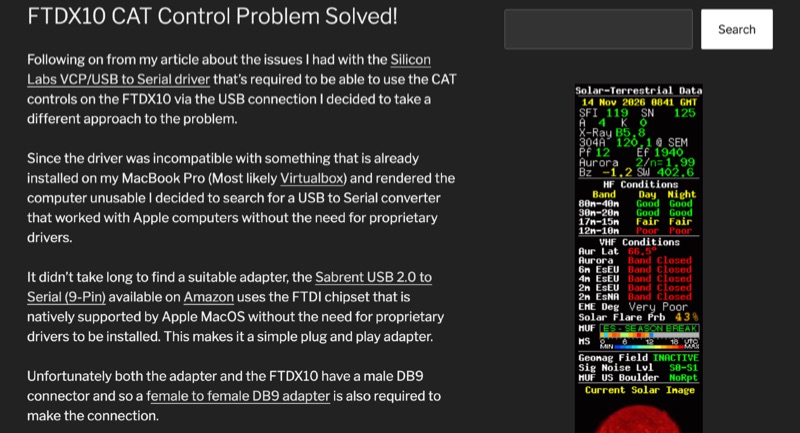
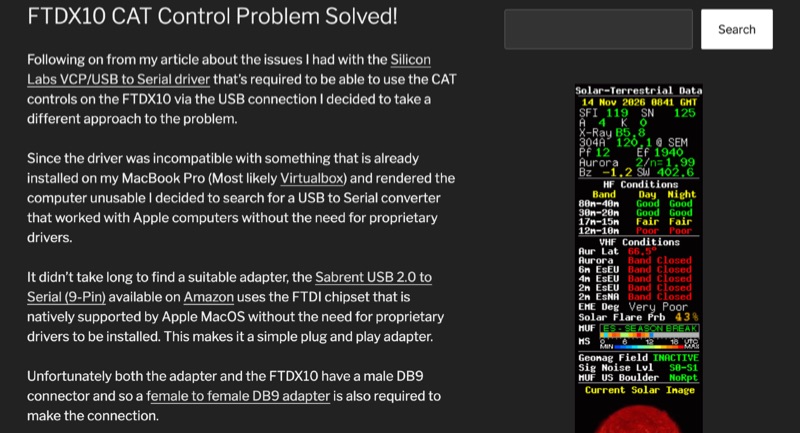 The Yaesu FTDX10 transceiver, a popular HF/50 MHz rig, often presents CAT control challenges on macOS systems due to driver incompatibilities. This resource addresses a specific issue encountered with Silicon Labs VCP/USB to Serial drivers causing system instability on a MacBook Pro running macOS 11.6.2 (Big Sur). The author details a robust solution involving a Sabrent USB 2.0 to Serial (9-Pin) adapter, which incorporates an FTDI chipset, ensuring native driver support within the macOS environment. This setup facilitates direct control of the FTDX10 without requiring proprietary driver installations. Configuration specifics include connecting the Sabrent adapter to the FTDX10 via a female-to-female DB9 adapter, setting the RS232 port to 38400 baud on both the radio and the WSJT-X software. For digital mode audio routing, a standard USB lead connects the FTDX10 directly to a second USB port on the MacBook, leveraging the transceiver's integrated sound card, which macOS natively recognizes. This dual-USB approach separates CAT control from audio I/O. The methodology was successfully validated through FT8 operation on the 30-meter band, confirming stable CAT communication and proper audio interfacing. This guide provides a practical workaround for macOS users seeking reliable digital mode operation with their FTDX10, avoiding common driver-related frustrations.
-
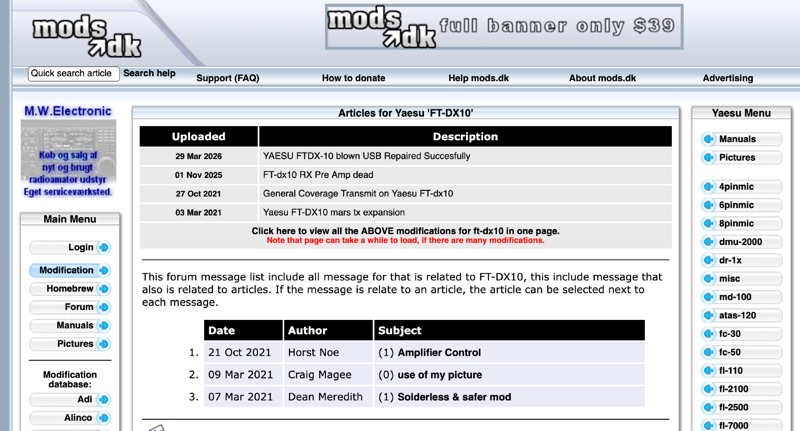 The Yaesu FT-DX10 Transceiver Modifications and Repair Database compiles technical articles and user-contributed messages specifically for the FT-DX10 HF transceiver. It features documented procedures such as "YAESU FTDX-10 blown USB Repaired Succesfully" and an entry detailing a "FT-dx10 RX Pre Amp dead" issue. The resource also includes instructions for "General Coverage Transmit on Yaesu FT-dx10" and "Yaesu FT-DX10 mars tx expansion," providing specific adjustments for the radio's operational parameters. This platform organizes content to allow viewing all modifications for the FT-DX10 on a single page, streamlining access to various technical adjustments. Users can find discussions on topics like amplifier control and solderless modifications, offering practical insights from the amateur radio community. The database serves as a central point for operators seeking to enhance or repair their FT-DX10 units. Each entry is dated, with examples like a March 2026 article on USB repair and a November 2025 entry concerning the RX pre-amplifier. The site also facilitates user interaction through a message board, where operators can post comments or new modification ideas not yet documented.
-
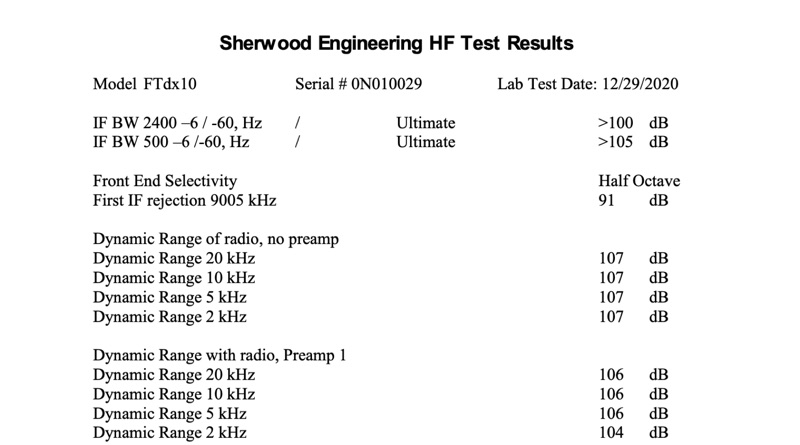 The Yaesu FTdx10 HF transceiver underwent comprehensive laboratory testing by Sherwood Engineering, with results documented on December 29, 2020. Key receiver performance metrics include IF bandwidth measurements at -6 dB and -60 dB for 2400 Hz and 500 Hz filters, showing ultimate rejection exceeding 100 dB and 105 dB respectively. Front-end selectivity and first IF rejection at 9005 kHz were measured at 91 dB. Receiver dynamic range, both with and without preamps, was consistently 107 dB at 20 kHz, 10 kHz, 5 kHz, and 2 kHz spacings without preamplification, and 106 dB with Preamp 1 at 20 kHz. Blocking performance reached 141 dB at 100 kHz offset with a 1uV signal. Phase noise was normalized across offsets from 2.5 kHz to 500 kHz, with a value of -145 dBc/Hz at 2.5 kHz and -155 dBc/Hz at 500 kHz. Reciprocal Mixing Dynamic Range (RMDR) peaked at 128 dB at 500 kHz spacing. Noise floor measurements for SSB and 500 Hz bandwidths at 14 MHz and 50.125 MHz showed -133 dBm with Preamp 2 at 14 MHz SSB. Sensitivity figures and S-meter accuracy were also documented, with one S unit equating to 3 dB from S3 to S9. Transmitter composite noise was measured at 100 watts and 30 watts, with values like -123 dBc/Hz at 2 kHz offset for 100 watts. Operational observations from the January 2021 CQWW 160m CW contest highlighted ergonomic issues, such as VFO knob placement and small buttons. A significant firmware limitation noted was the band scope and waterfall data being erased upon transmission, which severely reduces its utility for search and pounce operations.