Search results
Query: NASA audio
Links: 4 | Categories: 0
-
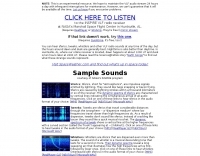 Hear VLF audio from NASA online VLF radio receiver in Huntsville, Alabama.
-
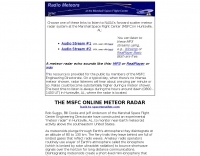 Two live MP3 audio streams provide real-time reception of meteor forward scatter signals, allowing listeners to hear radar echoes from meteoroid disintegration. The system operates on **67.25 MHz**, utilizing an Icom PCR-1000 receiver with a 6-element Yagi antenna pointed skyward. This setup detects reflections from ionized meteor trails created at altitudes of 80 to 130 km, using distant Channel 4 TV transmitters in the southeastern USA as signal sources. Scientists Rob Suggs, Bill Cooke, and Jeff Anderson of the Marshall Space Flight Center Engineering Directorate developed this experimental radar to monitor near-Earth meteoroid activity. A typical day yields about one meteor ping per minute, with significantly higher rates during meteor showers. The optimal listening period is generally around dawn, from 0800 to 1400 UT, due to Earth's orbital motion encountering more space dust on the dawn side. The system's **CW demodulator** processes the 67.250 MHz signal, presenting it at approximately 700 Hz with a 3 kHz bandwidth and AGC off, inverting the passband for Doppler shift analysis.
-
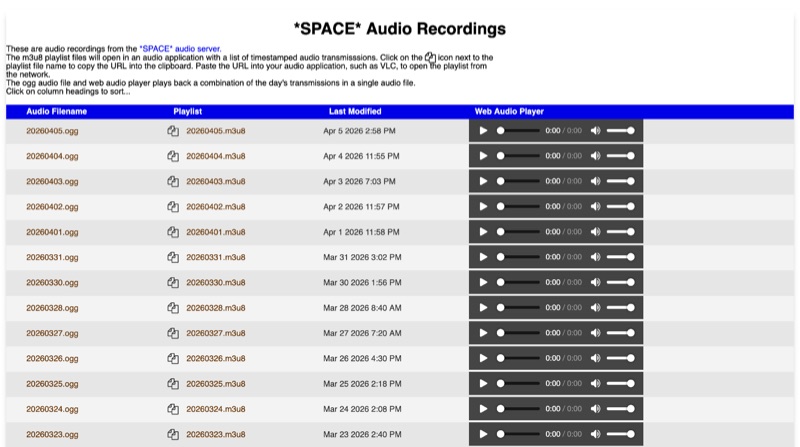 The *SPACE* Amateur Radio over Internet Protocol (RoIP) system offers public audio transmissions from NASA Mission Control and astronauts, primarily for educational purposes. This service streams NASA public media sources, including *Artemis II* and the ISS public audio channel 2 feed, which predominantly features English communications. Astronaut activities on the ISS typically occur between 0700 UTC and 19:00 UTC, with transmissions most common during early mornings USA time, alongside special events such as launches or spacewalks. Users can connect to the live stream via EchoLink to the *SPACE* conference, via IRLP to the 0100 experimental reflector, or via Allstar to node 516221. EchoLink connections utilize the GSM CODEC, while IRLP and other connections default to uncompressed or u-law CODEC. The service notes that long periods of silence are common, and NASA audio sources can be periodically unavailable or noisy. Daily recordings of these transmissions are published at space.rfnet.link/recordings/, available as .ogg audio files for direct playback or .m3u8 playlist files for network streaming in applications like VLC. Each playlist file provides a list of timestamped audio transmissions, allowing users to review specific segments of interest.
-
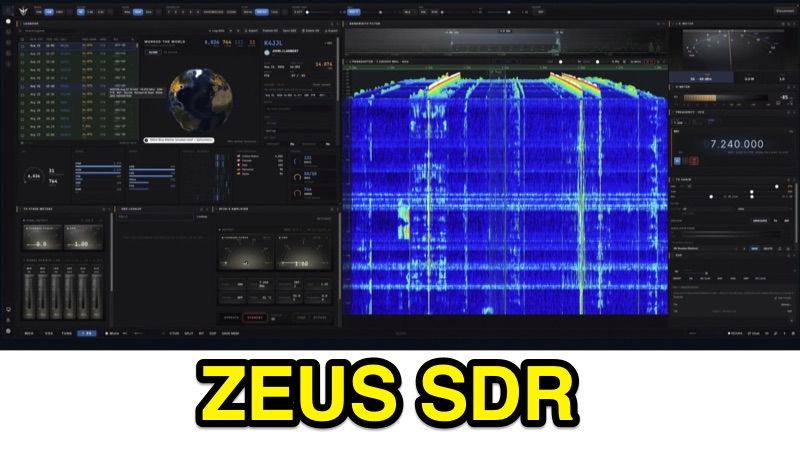 Demonstrates ZeusSDR, a WebGL-native station console for _OpenHPSDR_ radios, including Hermes-Lite 2 and ANAN-class transceivers. The software integrates a 2D and 3D WebGL/WebGPU panadapter with click-to-tune functionality, alongside native FT8/FT4 and FreeDV digital voice modes, eliminating the need for external software like WSJT-X or virtual audio cables. It features a protected transmit chain with SWR-trip and TX-timeout, and supports _PureSignal_ linearization on Protocol 2 for enhanced signal quality. The console incorporates a broadcast TX chain with a noise gate, 10-band EQ, compressor, exciter, bass, reverb, and VST3/Audio Unit hosting for advanced audio processing. A comprehensive logbook is included, offering contact history, a 3D NASA globe, DX radar, and analytics for DXCC/WAS/grids, with ADIF and LoTW integration. Amplifier panels for RF2K-S, KPA500, and SPE Taurus are also provided. ZeusSDR supports both OpenHPSDR protocols (P1 + P2) and utilizes WDSP from Thetis. It is available for Windows, macOS, and Linux, with a public listening feature allowing others to view live waterfalls and use virtual receivers with Zeus DSP, including NR, NB, ANF, AGC, and filters. The software is open-engine, following the PowerSDR–OpenHPSDR–Thetis lineage.