Search results
Query: Swiss Quad
Links: 4 | Categories: 0
-
 Based on HB9CV, F6ITV decribes how build a swiss quand antenna for 28 and 50 Mhz.
-
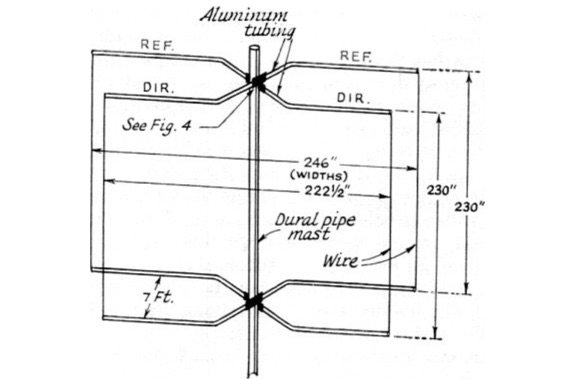 Rotatable Antenna with Phased Elements based on the orignal design concept of HB9CV antennas, is considered to have an higher gain than standard quad antennas. The Swiss Quad Antenna does not need any spreader or boom.
-
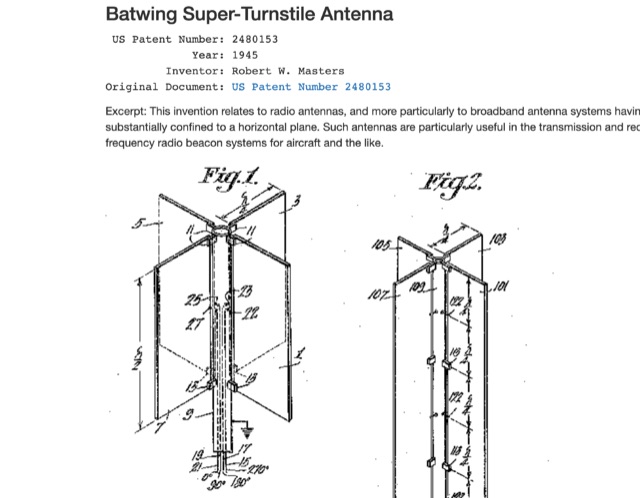 Patents of most popular antenna models including Zeppelin Antenna, Beverage Antenna , Franklin Antenna , Yagi-Uda Antenna , Sterba Antenna , Rhombic Antenna , Turnstile Antenna , Folded Dipole Antenna , Coaxial Antenna , Slot Antenna , Discone Antenna , Quad Antenna Element , Log Periodic Antenna , Swiss Quad Antenna
-
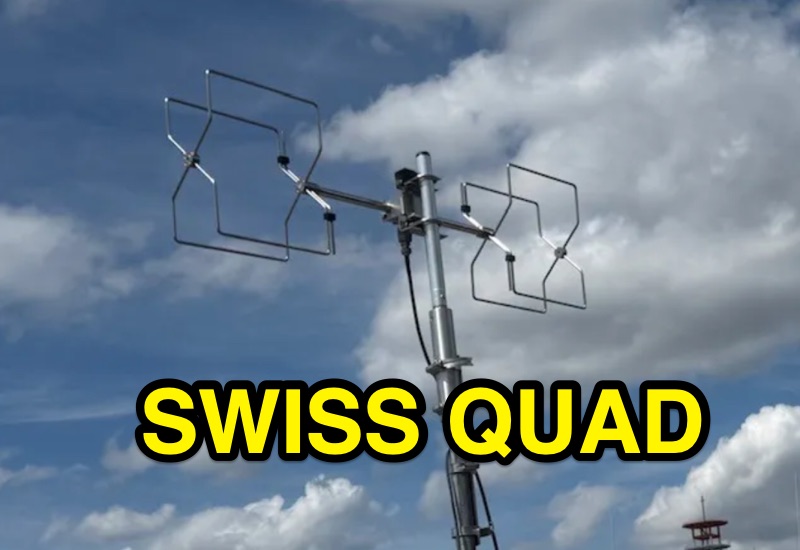 PD0G recounts the journey of building a 70cm Swiss Quad antenna, inspired by a vintage 2-meter version acquired for study. The author meticulously examines the original design, noting its distinctive curved metal elements and mechanical structure, which deviates significantly from traditional cubical quads requiring spreaders and wire. Historical context is provided, tracing the Swiss Quad's origins to R.A. Baumgartner (HB9CV) and its appearance in publications like the RSGB Bulletin in 1964 and QST in 1967, while also distinguishing it from other HB9CV designs. The project details the scaling process for 70cm, utilizing a calculation chart from F6ITV for initial dimensions and an existing MMANA-GAL model for 6 meters, scaled down to 433 MHz. Emphasis is placed on the critical gamma-match adjustment, with custom-machined POM parts for precise positioning and electrical isolation. Initial construction with 5mm aluminum elements and a 15mm boom led to practical challenges in bending and achieving target dimensions, necessitating adjustable element sections to fine-tune resonance. Measurements with a CAA-500 and SV4401A VNA confirmed a good match at 432.500 MHz with an SWR of 1.022 and LogMag of -39.46 dB. The author highlights that while a good SWR is achieved, further field testing is required to assess actual gain, directivity, and front-to-back ratio, especially when comparing single versus double element configurations. The article concludes by advocating for revisiting older, less common antenna designs, emphasizing the learning and satisfaction derived from hands-on experimentation.