Search results
Query: dBm to watt
Links: 5 | Categories: 0
-
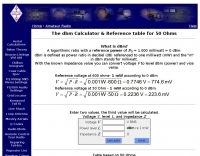 Understanding power measurements in RF systems is crucial for amateur radio operators, particularly when evaluating antenna performance or transmitter output. This online resource provides a _dBm calculator_ and a comprehensive reference table specifically tailored for 50 Ohm impedance environments. The calculator allows users to convert between dBm, milliwatts (mW), and volts (V), facilitating quick power level assessments. It clarifies that dBm represents a logarithmic ratio with a reference power of **1.000 milliwatt**, equating to 0 dBm. The accompanying reference table extends this utility by presenting a range of pre-calculated values, which can be particularly useful for field operations or rapid design checks without needing to perform manual calculations. The resource distinctly focuses on the practical application of dBm in amateur radio contexts.
-
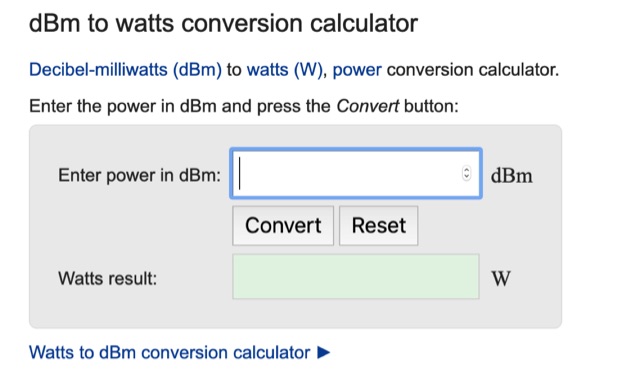 dBm to watts conversion calculator and explaination on how to convert dBm to watts, including dBm to watts conversion table
-
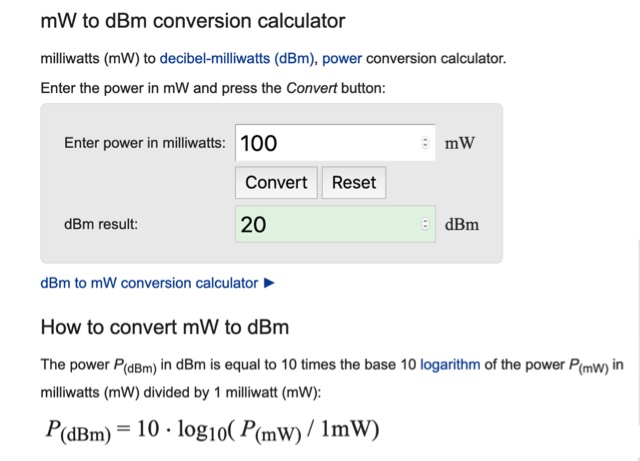 Online calculator that will convert power entered in milliwatts to dBm. Includes a quick mW to dBm conversion table
-
 The page features a spreadsheet that calculates power in watt and dBm based on voltage and impedance, power in dBm with a given power and impedance, voltage in millivolts with a given power and impedance, and more. It also converts between millivolt, microvolt, volt, watt, and milliwatt. Useful for hams looking to accurately calculate power and voltage values for radio equipment. Last updated in December 2014.
-
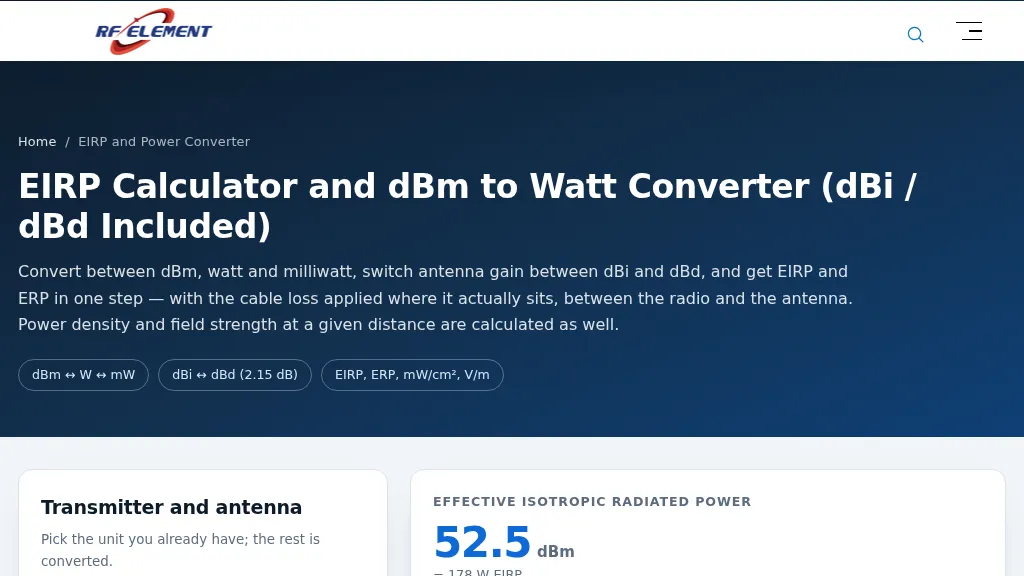 Demonstrates an online calculator for determining _Effective Isotropic Radiated Power_ (EIRP) and Effective Radiated Power (ERP) in radio and antenna systems. Users input transmit power in dBm, antenna gain in dBi or dBd, and feeder loss in dB, with the tool converting between dBm, watts, and milliwatts. It also calculates power density in µW/cm² and equivalent field strength in V/m at a specified distance, applying feeder loss before the EIRP calculation. The resource provides a quick reference table for common dBm to watt conversions, such as **30 dBm** equaling 1 W, and clarifies that 3 dB of loss halves radiated power. The calculator distinguishes between EIRP and ERP, noting that ERP is always **2.15 dB** lower than EIRP due to its half-wave dipole reference. It explains the importance of understanding the difference between dBi and dBd, as a 30 dBi antenna is not the same as a 30 dBd antenna, with the latter being 2.15 dB stronger. The page includes a table of typical EIRP limits for various bands and regions, such as 36 dBm for 2.4 GHz ISM US, FCC Part 15.247, and offers insights into regulatory considerations and the limitations of power density figures for safety compliance.