Antenna Gain
Understanding antenna gain and its calculation process

Antenna gain is a critical parameter for ham radio operators, describing how effectively an antenna converts input power into radio waves in a specific direction, or vice-versa for reception. Understanding gain helps hams optimize their stations for DX, contests, or local QSOs, ensuring maximum signal strength where it matters most. It's not just about raw power; a high-gain antenna can make a low-power transceiver perform like a much stronger one in the desired direction.
This category provides explanations and practical insights into antenna gain, covering various antenna types from simple wire antennas to complex beam arrays. Operators can find detailed articles on topics like the gain of helix antennas, how height affects gain for 40-meter wire antennas, and the principles behind G/T simulations for stacked arrays. Resources also include tools and methods for measuring and comparing antenna gain, such as those used by the CSVHFS Antenna Gain Measurements project, helping hams evaluate both commercial and homebrew antenna projects.
Related Categories
-
 This article clarifies antenna gain concepts, distinguishing between dBD and dBi, and explaining how antennas focus RF energy.
-
 This article explains antenna directivity and gain, detailing polar diagrams, beamwidth, and the difference between dBd and dBi measurements.
-
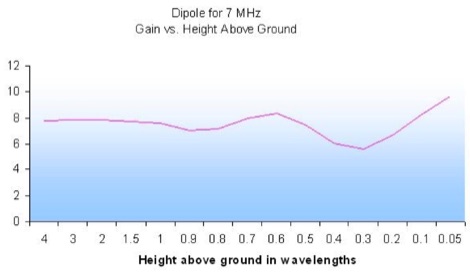 This guide analyzes **dipole antenna** performance, illustrating how height above ground impacts gain and radiation angle. It converts AA3RL's study data
-
 A real-time antenna gain comparator system by IK0BDO for optimizing homebrew V/UHF antennas, comparing two antennas simultaneously in dB.
-
 This Wikipedia article defines antenna gain as a critical performance metric, combining directivity and radiation efficiency for transmitting and
-
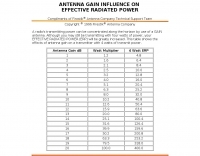 This page explains how antenna gain influences Effective Radiated Power (ERP) using a table that demonstrates ERP for a 4-watt transmitter.
-
 This guide clarifies antenna gain calculations, distinguishing between theoretical, 'ham radio,' and 'CB' gain, with practical examples.
-
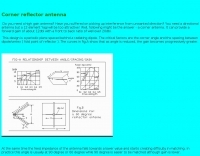 Explores corner reflector antenna design, detailing gain, front-to-back ratio, critical angles, and construction for VHF/UHF operation.
-
 Comprehensive guide to decibels (dB), dBA, dBC, dBV, dBm, and dBi, explaining their definitions, applications, and relationships.
-
 A comprehensive list of G/T simulations for 2-meter and 6-meter Yagi antennas, compiled by VE7BQH, with data from various designers.
-
 Examines the axial-mode helical antenna's gain through extensive NEC-2 numerical modeling, comparing results with published theory and experiments.
-
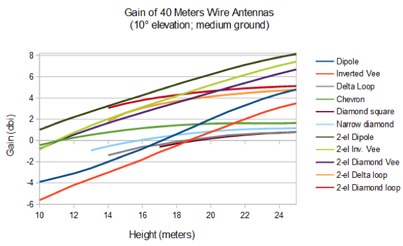 An in-depth analysis of 40-meter wire antenna performance, comparing gain and radiation patterns at various heights above ground.
-
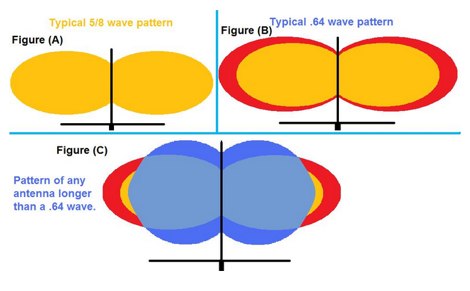 This article explores the .64 wavelength antenna, detailing its design for maximum gain and comparing its performance to 5/8 wave elements.
-
 In the long history of beam aerials there has persistently existed the claim that certain types of aerials perform better than yagis.
-
 W4RNL explains his preference for using dBi in antenna modeling, differentiating it from dBd and its various interpretations.
-
 Discussion at eham about wire size used in wire antennas, and how it affects the gain of the antenna
-
 Online calculator and reference table for dBm values in 50 Ohm systems, defining dBm as a power ratio referenced to one milliwatt.
-
 Gain we can expect of a parabolic antenna by F4DAY
-
 Explores HF multi-band antenna systems, debunking common myths about SWR, reflected power, and non-resonant antennas. Focuses on practical applications of
-
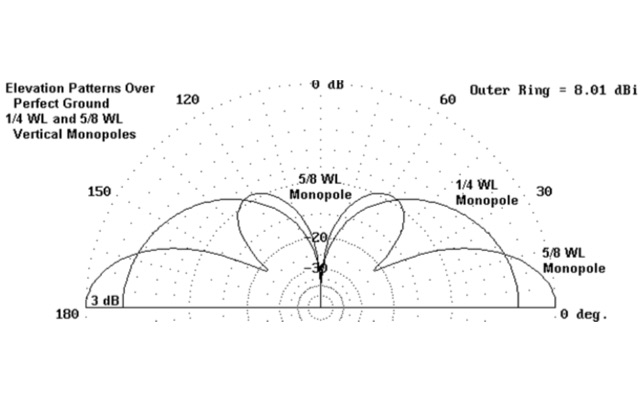 This article explains the theoretical advantages of a 5/8-wavelength vertical antenna over a 1/4-wavelength design for DX.