Search results
Query: ftdi
Links: 3 | Categories: 0
-
 RT Systems provides programming software for Windows operating systems, supporting a wide range of amateur radio transceivers, scanners, and receivers from manufacturers like Icom, Yaesu, and Kenwood. The software facilitates memory management and radio settings configuration, often surpassing OEM software in user-friendliness and functionality. Their **USB programming cables**, featuring **FTDI chipsets**, are noted for reliable operation, even in virtualized environments like Windows ARM on a Mac, where OEM cables might fail. Users report that RT Systems software simplifies the often complex process of radio programming, making it less arduous than manual entry. The availability of integrated frequency databases is a significant advantage. The software and cables are frequently cited for their long-term reliability, effective customer support, and thoughtful hardware design, which collectively address common real-world programming challenges for various radio models, including the Icom ID-880H and Anytone 878.
-
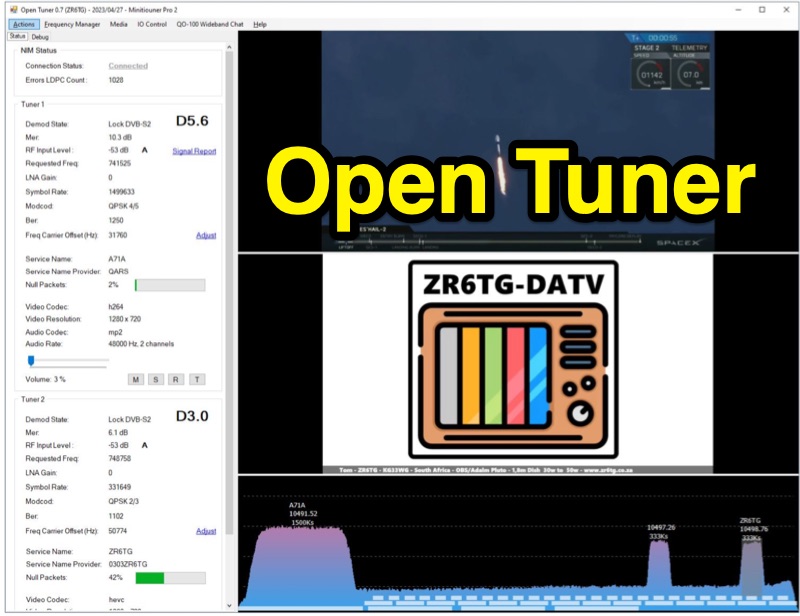 Version 0.7 of Open Tuner, released on April 27, 2023, marked a significant milestone by introducing proof-of-concept dual tuner functionality for the BATC Minitiouner. This C# client, inspired by Heather Lomond's _Longmynd_ project, aims to leverage both tuners and demodulators within the NIM module, a capability crucial for advanced Digital Amateur Television (DATV) operations on QO-100 and terrestrial links. My own experience with DATV often involves juggling multiple receive paths, so a unified client like this simplifies the workflow considerably. Further enhancing its utility, version 0.9 (February 11, 2024) integrated support for the Raspberry Pico, utilizing Colin (G4EML)'s _PicoTuner_ firmware. This offers a more accessible and cost-effective alternative to the traditional FTDI module, streamlining dual tuner setups with a single USB cable. The project's evolution reflects a practical approach to overcoming hardware availability challenges. The software is developed using Visual Studio 2019/2022 and .NET Framework 4.7.2, requiring specific Nuget packages like VLC/Websocket and an ffmpeg folder for full operation. It's an active, community-driven effort, with the source code openly available on GitHub for contributions and bug reporting, embodying the collaborative spirit of amateur radio development.
-
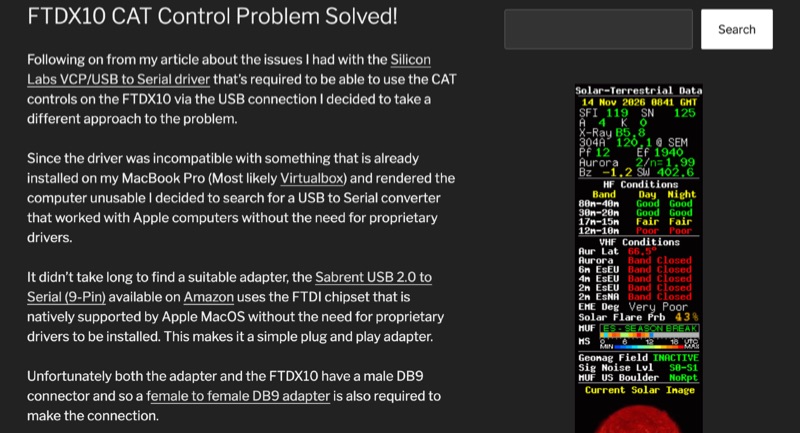 This resource details a solution for establishing CAT control and digital mode operation for the _Yaesu FTDX10_ transceiver on Apple macOS systems. The methodology focuses on bypassing Silicon Labs VCP/USB to Serial drivers, which caused system instability on a MacBook Pro. The author utilized a Sabrent USB 2.0 to Serial (9-Pin) adapter, featuring an FTDI chipset, which provides native driver support within macOS. This setup enables direct control of the FTDX10 via a USB connection without proprietary driver installations. The article specifies the use of a female-to-female DB9 adapter to connect the Sabrent unit to the FTDX10. Configuration details include setting the RS232 port to **38400** baud on the radio and within WSJT-X software. Audio routing for digital modes is achieved by connecting a standard USB lead from the FTDX10 to a second USB port on the MacBook, leveraging the transceiver's integrated sound card, which is natively supported by macOS 11.6.2 (Big Sur). The configuration was validated using FT8 on the 30-meter band.