Digital Amateur Television Software for DATV Operations
DATV Reception & Transmission Tools

This category provides specialized software for Digital Amateur Television (DATV) , enabling amateur radio operators to transmit and receive digital video signals. These applications facilitate various DATV operations, from decoding DVB-S/S2 signals to managing full-duplex communications via satellites like QO-100 . Users can find tools for signal analysis, video encoding/decoding, and interfacing with specific hardware for a complete DATV station setup. The software supports modern x86 computers and integrates with SDR platforms. Key software includes SDR Television for DVB-S2/AAC/H264/H265 on QO-100, utilizing SDR Console DLLs for Pluto/LibreSDR.TV control. MiniTioune by F6DZP offers Windows-based DATV reception with MiniTiouner hardware. Open Tuner is an open-source C# client for BATC MiniTiouner, supporting QO-100 and terrestrial DATV experiments.
Related Categories
-
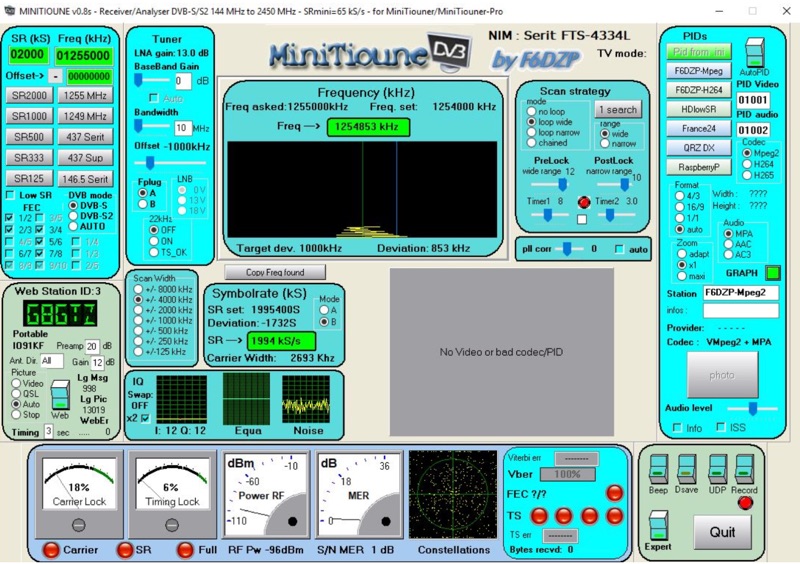 Details the MiniTioune software for Digital Amateur Television (DATV) reception on Windows. Covers setup, hardware connection, testing, and customization.
 -
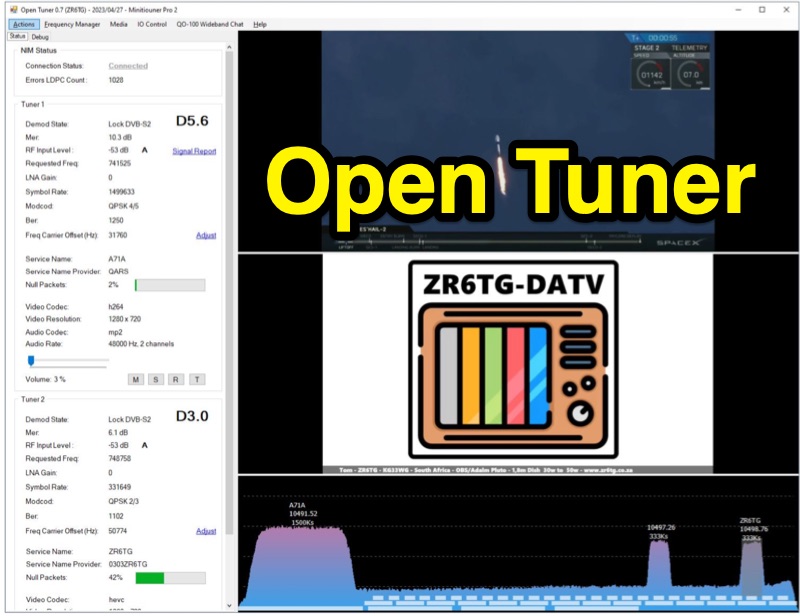 Open Tuner is an open-source Windows client for BATC Minitiouner DATV, developed in C#. It enables dual tuner functionality for QO-100 and terrestrial
 -
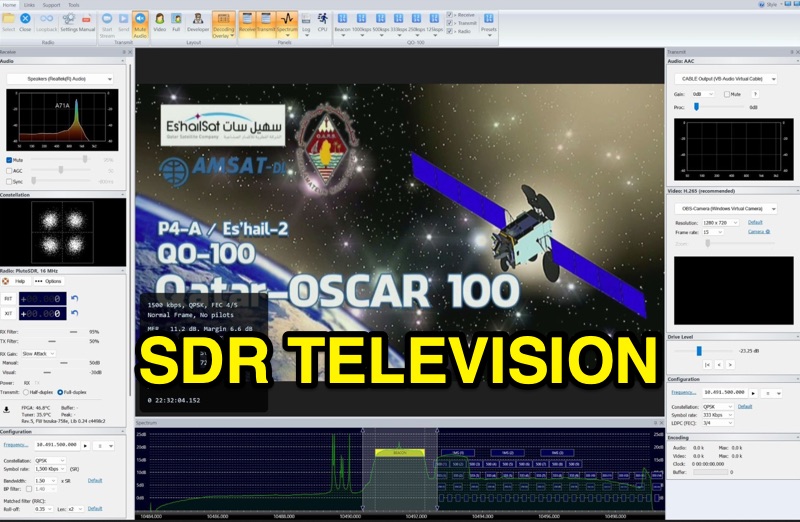 SDR Television is a DVB-S2 / AAC / H264 / H265 software for QO-100 DATV, offering full-duplex operation on Windows 10/11 x86 systems.
 -
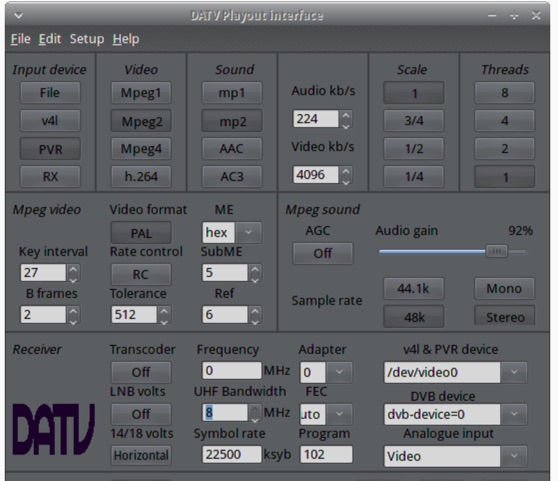 ZL1WTT details a software-defined Digital Amateur Television (DATV) system, multiplexing multiple SD/HD channels using h264 compression.
Frequently Asked Questions
What kind of software tools are available for receiving Digital Amateur Television (DATV) signals?
There is a range of software dedicated to DATV reception, often including applications for decoding various digital modulation schemes used in amateur television. These tools typically interface with SDR (Software Defined Radio) hardware or dedicated DATV receivers to process the incoming signals, allowing users to view the transmitted video and audio. Some software might also offer features like spectrum analysis specific to DATV frequencies.
Are there specific software solutions for transmitting Digital Amateur Television (DATV) signals?
Yes, for transmitting DATV, software tools are available that handle the encoding and modulation of video and audio streams into a format suitable for amateur radio transmission. These programs often work in conjunction with dedicated DATV modulators or SDR transmitters. They allow operators to prepare their multimedia content for broadcast, ensuring it meets the technical specifications for various DATV standards.
Can I use general-purpose SDR software for DATV reception, or do I need specialized DATV tools?
While general-purpose SDR software can often tune to the frequencies used for DATV, specialized DATV reception tools are usually necessary for full decoding and viewing of the video and audio. These dedicated applications contain the specific codecs and demodulators required to process the complex digital television signals. Without them, you might only see raw data or a spectrum display, not the actual transmitted program.
How do DATV software tools integrate with amateur radio hardware for transmission and reception?
DATV software tools integrate with amateur radio hardware in various ways, depending on whether it's for transmission or reception. For reception, they often interface with SDR dongles, dedicated DATV receivers, or even sound cards to process the baseband signals. For transmission, they typically connect to DATV modulators, SDR transceivers, or video capture cards to take multimedia input, encode it, and prepare it for RF output. This integration allows for a complete digital television station setup.