Search results
Query: operator shifts
Links: 6 | Categories: 0
-
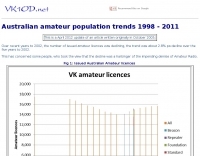 Approximately 2.8% annual decline in Australian amateur radio licenses was observed over the five years leading up to 2002, a trend that prompted further analysis of the country's amateur population. This resource examines licensing statistics and demographic shifts within the Australian amateur radio community between 1998 and 2007, utilizing available data to identify patterns in license issuance and renewal. The study focuses on **population trends** and the underlying factors contributing to changes in the number of active **amateur radio operators**. It provides insights into the health and growth trajectory of the hobby in Australia during this specific period. Understanding these demographic shifts is crucial for clubs, regulatory bodies, and equipment manufacturers to adapt strategies and foster engagement.
-
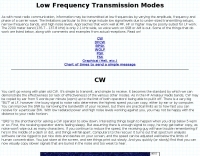 The 2200-meter band (135.7-137.8 kHz) presents unique challenges for amateur radio operators due to its narrow 2.1 kHz bandwidth, low signal levels, and high noise. W1TAG explores various transmission modes suited for this demanding environment, highlighting that traditional voice modes like SSB and AM are impractical. Plain old CW serves as the baseline, demonstrating effectiveness across different modes, though signal-to-noise ratio (SNR) significantly limits practical speeds. The article notes that reducing CW speed below 5 WPM can improve copy, especially with computer-aided spectrum analysis software capable of decoding signals too weak for human ear reception. QRSS, or "CW sent slowly enough that speeds are best expressed in seconds per dot," is a key mode for LF work, with examples ranging from 3 seconds/dot to extreme 240 seconds/dot transmissions. _Argo_ by I2PHD is mentioned as a simple program for QRSS, enabling reception of signals like BRO, a Part 15 beacon, at a distance of **1100 miles**. Other modes discussed include Dual Frequency CW (DFCW), which uses frequency shifts to distinguish dots and dashes, and Binary Phase Shift Keying (BPSK), a phase modulation technique employing 0 to 180-degree phase flips. WOLF (Weak-signal Operation on Low Frequency), a specialized BPSK form by KK7KA, encodes 15-character messages into 960-bit packages, taking 96 seconds to transmit, and has demonstrated successful reception over **672 seconds** for a message from a 1-watt beacon. Further modes include PSK, FSK variations like JASON and MSK, and graphical modes such as Hellschreiber and Chirped Hell. The article concludes with a practical chart comparing the time required to send a simple message like "WD2XES FN42CH " across these diverse LF modes, offering valuable insights for operators planning contacts on the low bands.
-
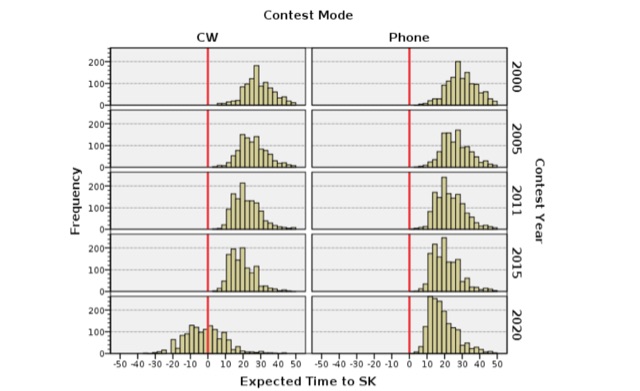 Examining the demographic shifts within amateur radio, particularly concerning **radiosport** participation, this resource analyzes survey data from the National Contest Journal (NCJ) and two regional ARRL surveys. It focuses on the relationship between age and engagement in contesting, presenting findings that suggest older amateur radio operators tend to participate in more contests annually. The author, a spatial demographer, details the methodology, including data consolidation, georeferencing, and statistical analysis performed in collaboration with Dr. Scott Wright K0MD, covering ARRL November Sweepstakes participants from 2000 to 2020. The analysis also addresses the limitations inherent in using voluntary response samples rather than random samples, which may influence the generalizability of the results. Furthermore, the resource investigates the preferred sources of contest information among different age groups, noting that older contesters frequently rely on traditional publications like the NCJ, while younger participants show a preference for online platforms. This demographic review provides insights into the evolving landscape of **amateur radio contesting** and the generational differences in information consumption.
-
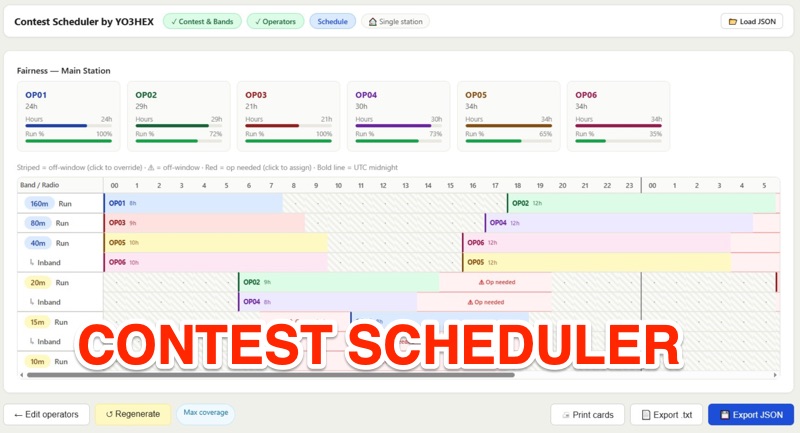 This online tool is a specialized web-based utility for orchestrating multi-operator HF contest and DXpedition activities. This tool, _Rig2Cast_, assists station managers in meticulously planning operator shifts, ensuring adequate rest periods, and crucially, preventing operational conflicts such as assigning a single operator to multiple radios concurrently. It integrates support for SO2R operations and offers real-time simulation of operator requirements, a feature I've found invaluable in pre-event planning. The scheduling engine incorporates five distinct algorithms: greedy fairness balancing, round robin, maximum coverage, simulated annealing, and a fatigue-aware model. These algorithms enforce critical constraints like minimum/maximum shift durations and mandatory rest times across all radios, which directly impacts operator performance over long events. My field experience confirms that such robust constraint management is essential for maintaining peak efficiency during intense operations. Key features include distributed multi-station support, printable per-operator cards, flexible band activity windows, and real-time editable operator slots. The drag-and-drop shift management, coupled with full cross-radio swap support and smart constraint feedback (valid targets in green, invalid in red), streamlines complex scheduling tasks. The system's design ensures user data privacy, as no information is stored on the server; schedules are saved and reloaded locally.
-
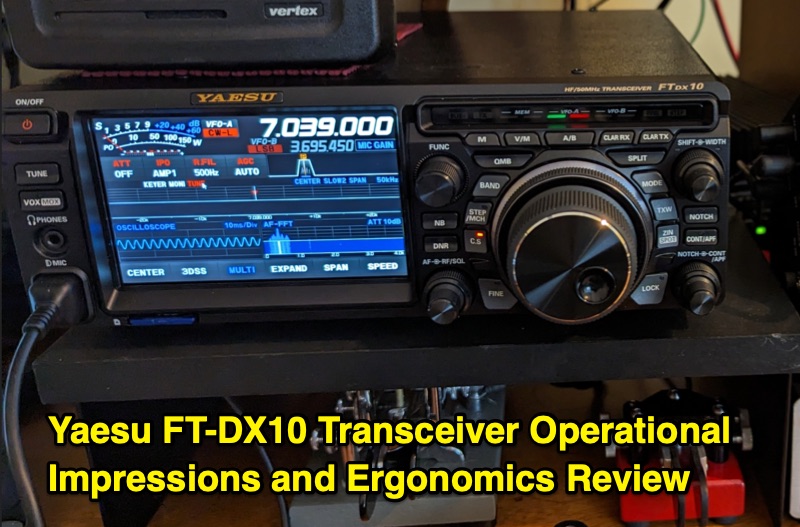 Evaluating a new HF transceiver, AA4OO shares his initial operational impressions of the Yaesu FT-DX10, contrasting its physical design and performance against his prior experiences with the Elecraft KX3 and Ten-Tec Eagle. He notes the FT-DX10's superior fit and finish but finds the front panel controls, particularly the AF/RF knob, to be cramped, leading to accidental VFO shifts. The review details the radio's audio characteristics, describing acceptable SSB performance but "muddy" CW audio at 450Hz, which he attributes to cabinet acoustics, necessitating an external speaker for clearer CW reception. The author also discusses the effectiveness of the FT-DX10's Digital Noise Reduction (DNR) for CW, finding it significantly better than the NR on the Eagle or KX3. He appreciates the MPVD (Multi-Purpose-VFO-Outer-Dial) for reducing menu reliance during QSOs, a feature he finds more intuitive than the dual-use buttons on his Ten-Tec Eagle. However, he expresses disappointment with the noisy T/R relay during full QSK operation and a loud internal fan, which detracts from his preference for a quiet operating environment. Further observations include the 800x640 resolution of the external display connector, which he considers outdated, and the CW decode function, which he finds less practical than the KX3's due to its display of "paragraphs" of text rather than a quick assist. Despite these "nits," the review provides a balanced perspective on the FT-DX10's strengths and weaknesses from a seasoned CW operator's viewpoint, concluding that it's a "mixed bag" compared to his other rigs.
-
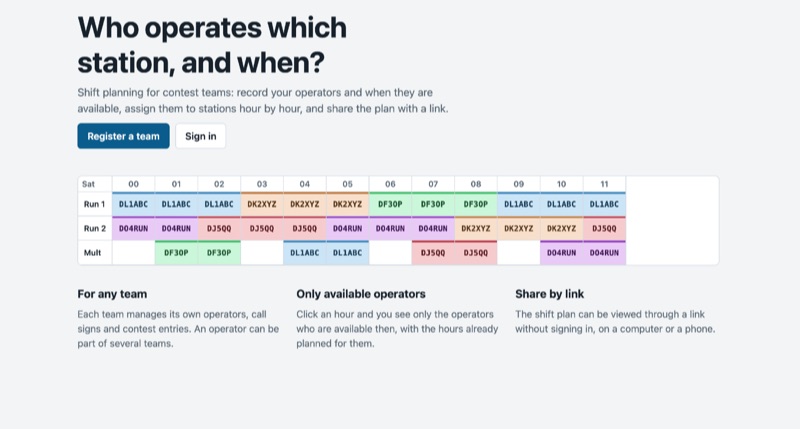 Hamcloud Contestplaner provides a web-based utility for amateur radio contest teams to organize operator schedules. The platform enables teams to input operator availability and then assign these operators to specific contest stations on an hour-by-hour basis. It demonstrates a grid-like interface for visualizing operator assignments across a 24-hour period, with examples showing callsigns like DL1ABC, DK2XYZ, and DF3OP assigned to "Run 1" and "Run 2" stations. The system facilitates team management by allowing each team to control its own operators, call signs, and contest entries, while also permitting operators to be part of multiple teams. A key feature is the ability to filter available operators by hour, displaying their already planned shifts. The tool generates a shareable link, allowing team members to view the shift plan on various devices without requiring a login.