Search results
Query: thunderstorm effects
Links: 2 | Categories: 0
-
 Examines the long-standing debate among radio amateurs and scientists regarding the correlation between thunderstorm activity and _sporadic E_ propagation on VHF bands, particularly 144 MHz. The authors, including DF5AI, initially approached the subject with skepticism, believing that the significant vertical separation between thunderstorms and the E-layer made a direct link improbable. Their project, initiated in 2004, involved comparing 144 MHz DX reports from hams with meteorological sferic observations, aiming to definitively disprove the theory. While their initial data analysis for the 2004 sporadic E season did not yield clear evidence for thunderstorm-triggered events, the team found compelling reasons to reconsider a "maybe" stance. They cite scientific discussions on thunderstorm effects on the ionosphere, impressive statistical correlations from the _GPS/MET radio occultation experiment_ linking convection to E-region irregularities, and OH nightglow measurements showing severe thunderstorm impact at 85 km altitude. These findings suggest that current data analysis methods might be insufficient, prompting a call for further investigation. The paper delves into the geophysical background, explaining neutral, ion, and electron interactions in the ionosphere, the wind shear theory for sporadic E formation, and various atmospheric wave phenomena, including convectively generated gravity waves. It proposes a model where gravity waves, originating from intense convection, propagate upwards to create wind shears that contribute to sporadic E layers, documenting their current understanding and encouraging fellow amateurs to conduct their own studies.
-
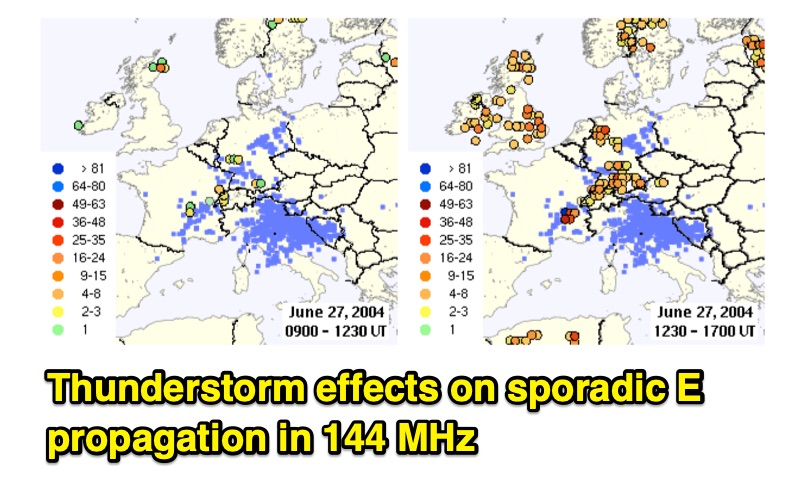 The paper examines the potential effects of thunderstorms on ionospheric _sporadic E_ propagation at **144 MHz**. It addresses community skepticism by considering scientific investigations into travelling ionospheric disturbances and spread-F irregularities, suggesting that thunderstorm effects on the ionosphere cannot be generally excluded. A model is presented where thunderstorm-triggered gravity waves travel from the troposphere and stratosphere into the ionosphere, potentially causing wind shears at E region level, which are considered a cause of mid-latitude sporadic E layers. The _GPS/MET radio occultation experiment_ and OH nightglow measurements support this model by showing a correlation between convectively generated gravity waves and electron density irregularities in the E region. A ham radio project analyzed the spatiotemporal correlation between 144 MHz sporadic E long-distance communication and VLF radio emissions from lightnings (sferics). The June 27, 2004 event showed a correlation between sferic and sporadic E scatterer positions, motivating further analysis. The paper proposes a data analysis method for amateur radio propagation studies, contingent on scientific observatories providing raw data.