


FT8 “Franke-Taylor design, 8-FSK modulation” is an Amateur Radio Digital Mode that belongs to the family of weak-signals communication protocols, developed and promoted by K1JT Joe Taylor.
The FT8 protocol is implemented in several application programs including the popular weak signals software WSJT-X , JTDX and the Chat FT8-based software JS8Call that implement a different modulation and can be found in different ft8 frequencies
FT8 should be used in the following amateur radio frequencies:
| Band | Frequency MHz | Notes | |
| 160m | 1.840 | ||
| 160m | 1.842 | JS8Call | |
| 80m | 3.573 | ||
| 60m | 5.357 | ||
| 40m | 7.056 | Region 1 | |
| 40m | 7.071 | ||
| 40m | 7.074 | ||
| 40m | 7.078 | JS8Call | |
| 30m | 10.130 | JS8Call | |
| 30m | 10.132 | Region 1 | |
| 30m | 10.133 | ||
| 30m | 10.136 | ||
| 20m | 14.071 | ||
| 20m | 14.074 | ||
| 20m | 14.078 | JS8Call | |
| 20m | 14.090 | Region 1 | |
| 17m | 18.100 | ||
| 17m | 18.104 | JS8Call | |
| 15m | 21.074 | ||
| 15m | 21.078 | JS8Call | |
| 15m | 21.091 | ||
| 12m | 24.915 | ||
| 10m | 28.074 | ||
| 10m | 28.078 | JS8Call | |
| 6m | 50.310 | ||
| 6m | 50.313 | ||
| 6m | 50.328 | JS8Call | |
| 6m | 50.323 | Intercontinental DX | |
| 4m | 70.100 | ||
| 2m | 144.174 | ||
| 1.25m | 222.065 | ||
| 70cm | 432.065 |
Sources:
- WSJT-X and JTDX application’s settings
- JS8Call web site
- UK Six Meter Group
If you want to contribute to this article, make corrections or just need to discuss about FT8 Frequencies, just leave a comment here below.
FT8 Software
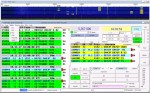
JTDX is an open-source software application for amateur radio weak-signal digital communication. It supports digital modes including FT8 and JT9. The software operates on _Windows_, _Linux_, and _macOS_ platforms. JTDX is designed for improved decoding of weak signals, a function also performed by WSJT-X and MSHV. The software facilitates weak signal decoding and transmission. It integrates with logging systems for QSO management and can automate tasks such as call management and remote RTX control. JTDX is utilized in contexts such as DXing and contests. DXZone Focus: FT8 | JT9 | Weak Signal | Multi-platform

Facilitates reliable two-way communication under challenging propagation conditions, WSJT-X provides a suite of digital modes optimized for weak-signal operation across the amateur bands. These modes, including FT8, FT4, and Q65, are designed to decode signals significantly below the noise floor, enabling DX contacts, EME (Earth-Moon-Earth), and meteor scatter QSOs with modest station setups. The software supports various T/R sequence lengths and tone spacings, tailored for specific propagation phenomena and band characteristics, such as JT9 for MF/HF with **2 dB** greater sensitivity than JT65, and MSK144 for VHF meteor scatter. WSJT-X also integrates specialized tools like _MAP65_ for wideband EME reception with polarization matching to counter _Faraday rotation_, and QMAP for wideband Q65 reception with Earth-Moon-Earth Doppler correction. These companion programs extend the software's capabilities for advanced weak-signal work, particularly on VHF, UHF, and microwave frequencies. The project, maintained by Joe Taylor, K1JT, and the WSJT Development Team, is the official home and reference implementation for these weak-signal digital communication protocols. Recent releases, such as _WSJT-X 3.0.2_, introduce enhancements like the QMAP program, Q65 Pileup, and SuperFox mode, which offers approximately **+10 dB** system gain for Fox-and-Hound operations.

Js8Call is communication software designed for keyboard-to-keyboard message passing. Based on the WSJT-X application and implementing the FT8 protocol techniques, it's a separate project run on Linux, Windows and MacOS
With WSJT-X 2.2.0 rc2 has been introduced also 7.071, 10.133, 14.071, and 50.310 MHz.


50.323MHz is ONLY FOR CONTINENTAL QSO.
The history of this proposal is here.
http://www.asahi-net.or.jp/~vj5y-tkur/6m/new_qrg.html
Starting January 1st 2023, the 70MHz Band is open to HB9-Amateurs in Switzerland. Unfortunately, the frequency range is as follows: 70.0000-70.0375, 70.1125-70.5000. Meaning the FT8-frequency is not legal in Switzerland.
Can we eventually change this to 70.1740? (proposal)
Who could define it?
How could we inform the community / the software developers?
Problem solved:
FT8 on 70.154
MSK144 on 70.174
SSB on 70.200
see you on 4m…