Search results
Query: Contest
Links: 758 | Categories: 35
Categories
- DX Resources > Contest
- DX Resources > Contest Calendars
- Ham Radio > Clubs > Contest Clubs
- Radio Equipment > Contest Hardware
- DX Resources > Contest > Contest Results
- DX Resources > Contest > Contest Rules
- DX Resources > Contest > Contest Stations
- Software > Contesting
- Ham Radio > Clubs > ARRL
- Ham Radio > Clubs > Europe > Belgium
- DX Resources > Clubs
- DX Resources > DX Calendars
- Ham Radio > Clubs > Europe
- Ham Radio > Clubs > Europe > Germany
- Ham Radio > Clubs > North America > USA > Kentucky
- Software > Linux
- Software > Log Analysis
- DX Resources > Log Analysis
- Operating Aids > Log Formats
- Operating Aids > Logbook
- DX Resources > Newsletters
- DX Resources > Prefixes
- DX Resources > Contest > Resources
- Operating Modes > RTTY
- DX Resources > Contest > Contest Rules > RTTY
- DX Resources > Shack Rental
- DX Resources > Contest > SO2R
- Internet and Radio > Sounds
- DX Resources > Contest > Sponsors
- Ham Radio > Blogs > Europe > UK
-
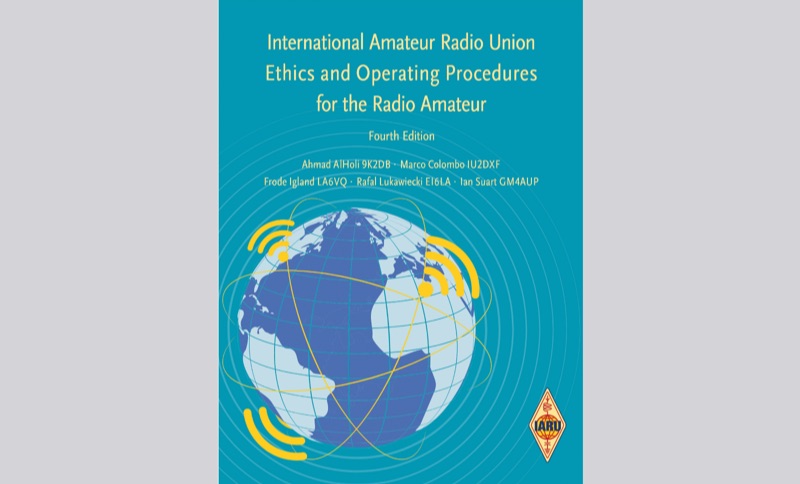 Presents the 4th edition of the IARU Region 1 Ethics and Operating Procedures for the Radio Amateur, a fully rewritten guide published in July 2026. It establishes a shared basis for respectful and effective communication within the amateur radio community, building upon over fifteen years of prior work. The document details the purposes of amateur radio, principles of non-interference, electromagnetic compatibility, and station safety. It specifies operating procedures, including listening practices, adherence to IARU and national band plans, appropriate transmission content, use of Q-codes, and the phonetic alphabet. The guide provides instructions for conducting QSOs across phone, CW, and various digital modes. Specific sections address managing pileups, participating in contesting, engaging in DX and DXpedition operations, operating portable or mobile, and conducting station testing. Further sections cover VHF and UHF operating considerations, ensuring a comprehensive resource for both experienced operators and those new to the hobby.
-
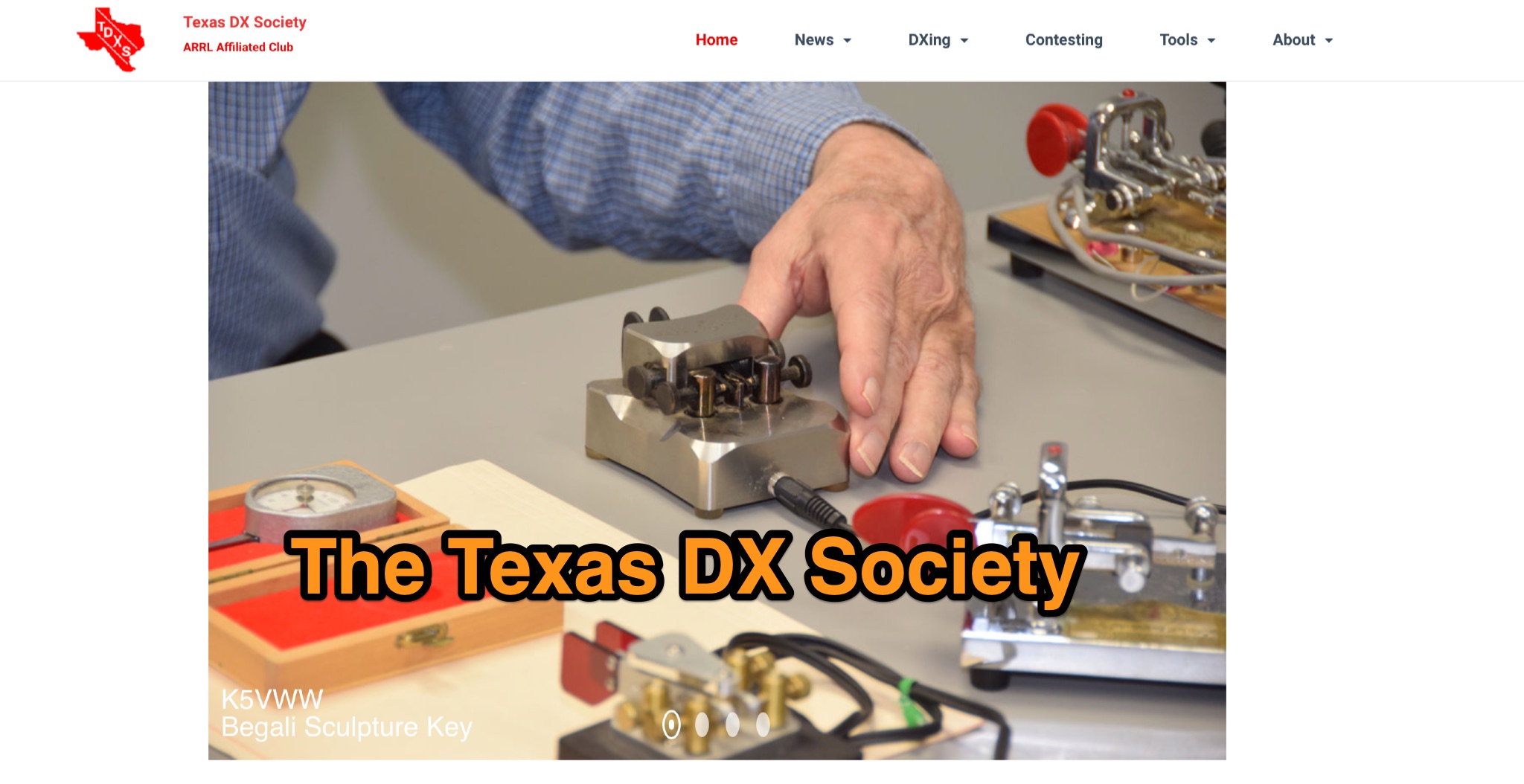 The Texas DX Society, founded in 1970, is a non-profit organization of radio amateurs in Houston, Texas who have a primary interest in DX chasing and contest operating on HF, VHF, and UHF.
-
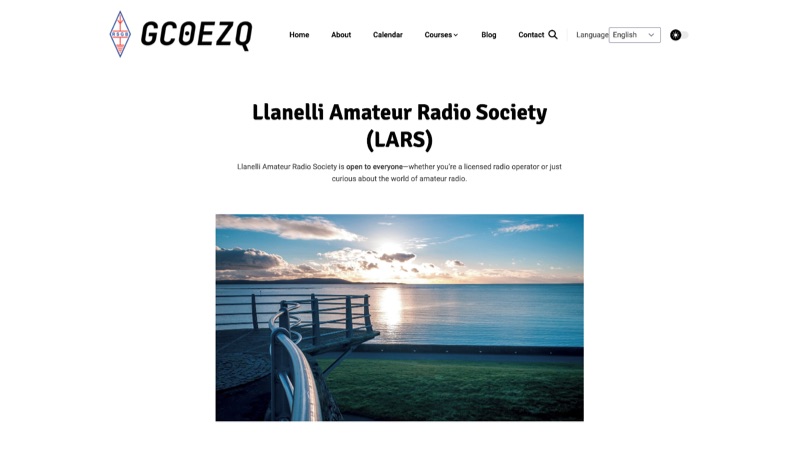 The Llanelli Amateur Radio Society (LARS) website details the club's offerings for both licensed operators and those new to amateur radio, including shortwave listeners and individuals pursuing Foundation, Intermediate, or Full licenses. It highlights opportunities to learn radio techniques, explore digital modes such as C4FM, D-Star, DMR, and FreeDV, and participate in contests and social events. The club aims to foster a supportive environment for experimentation and knowledge sharing among its members. Member testimonials illustrate practical applications, such as a new licensee making a 1000km contact via a repeater after being inspired by space exploration, and another quickly passing the RSGB Foundation exam. The site also features accounts of members progressing to Intermediate and Full licenses, with one Full license holder continuing to learn new modes like CW and digital, and engaging in activities like Parks on the Air (POTA).
-
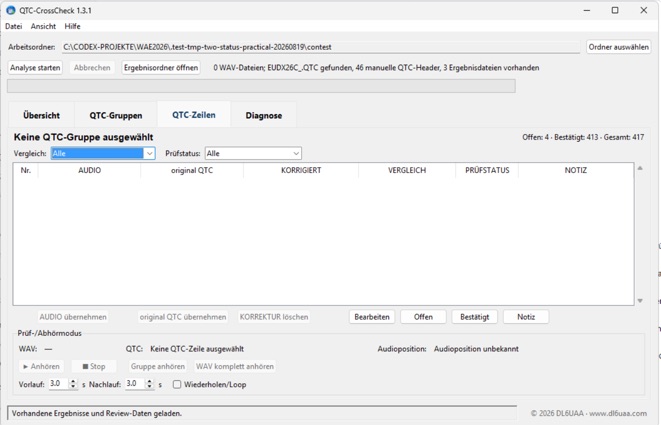 QTC-CrossCheck 1.5.0 is a free offline Windows tool for reviewing WAEDC CW QTC traffic. It analyzes QTC groups from local WAV recordings and supports comparison with UCXLog QTC data. Integrated audio playback helps verify individual QTC rows and resolve discrepancies. The portable application requires no installation or internet connection. Download the Windows ZIP archive and extract it fully before running QTC-CrossCheck.exe. A SHA-256 checksum is provided for download verification.
-
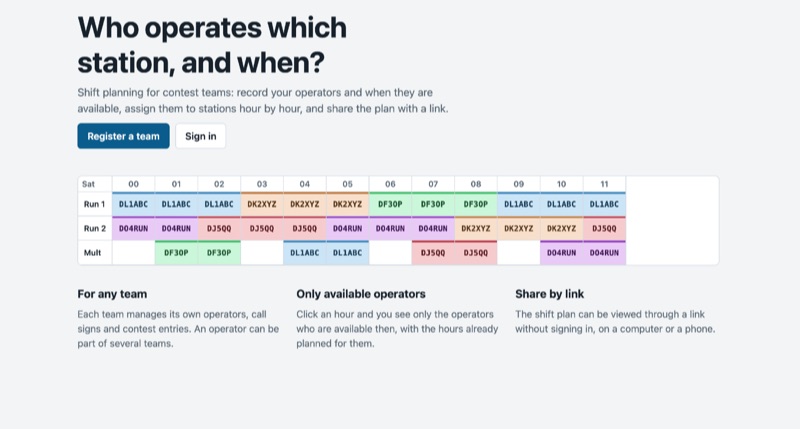 Hamcloud Contestplaner provides a web-based utility for amateur radio contest teams to organize operator schedules. The platform enables teams to input operator availability and then assign these operators to specific contest stations on an hour-by-hour basis. It demonstrates a grid-like interface for visualizing operator assignments across a 24-hour period, with examples showing callsigns like DL1ABC, DK2XYZ, and DF3OP assigned to "Run 1" and "Run 2" stations. The system facilitates team management by allowing each team to control its own operators, call signs, and contest entries, while also permitting operators to be part of multiple teams. A key feature is the ability to filter available operators by hour, displaying their already planned shifts. The tool generates a shareable link, allowing team members to view the shift plan on various devices without requiring a login.
-
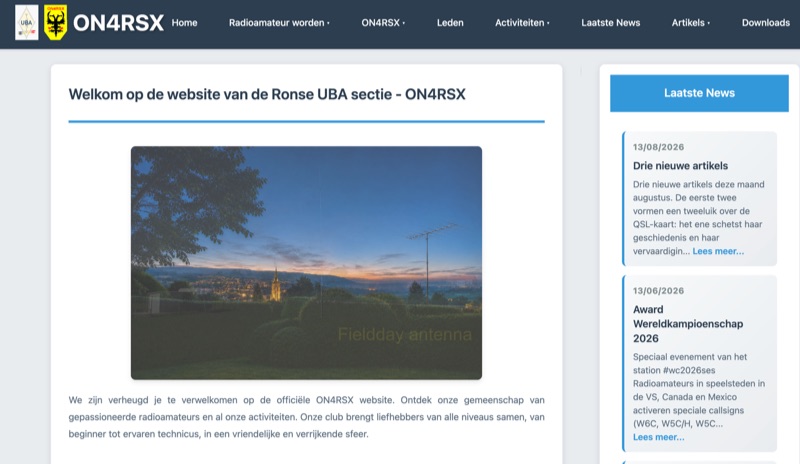 The ON4RSX website serves as the official online presence for the UBA Ronse/Renaix amateur radio club, providing information on its community and activities. It outlines the club's engagement across various amateur radio facets, including **HF**, VHF, UHF, digital modes, antenna construction, propagation studies, and general electronics. The site highlights past DXpeditions, such as the _OJ0V Market Reef_ operation, and mentions participation in contests, offering insights into the club's operational focus and technical interests. The resource details the club's commitment to fostering a welcoming environment for operators of all experience levels, from beginners to seasoned technicians. It implicitly compares the breadth of activities available to members, covering both theoretical knowledge development and practical application in areas like antenna building. The site's content structure suggests it functions as a central hub for club news, event announcements, and potentially educational materials, supporting members in expanding their radio knowledge and sharing their passion.
-
 The State QSO Party Challenge is an annual program recognizing amateur radio operators' participation in U.S. State and Canadian Province QSO parties. To qualify for the SQP Challenge, participants must make at least two QSOs in a minimum of two SQP Approved QP contests and submit their scores to 3830Scores.com. The site details the SQP Mobile/Portable Challenge, an overlay competition encouraging mobile/portable operations, with scoring identical to the main SQP Challenge: (Number of QPs entered) x (Number of QSOs) = Score. Eligibility for the Mobile/Portable Challenge requires prior qualification for the SQP Challenge. The website also mentions a State QSO Party Club Challenge and provides contact information for questions. The 2026 SQP Challenge will be dedicated to Stan Zawrotny, K4SBZ, a key team member instrumental in the program's development. Participants are recognized for reaching five levels of achievement: Bronze, Silver, Gold, Platinum, and Diamond. Scores are calculated by totaling reported contacts and multiplying by the number of SQPs entered year-to-date, encouraging more entries and longer operating times. The Worked All QSO Parties (WAQP) program, sponsored by Icom America, offers certificates for participating in at least 50% of approved contests, with a goal of participating in all. WAQP requires submitting a log with at least two valid contacts to the contest manager, in addition to the 3830scores.com submission.
-
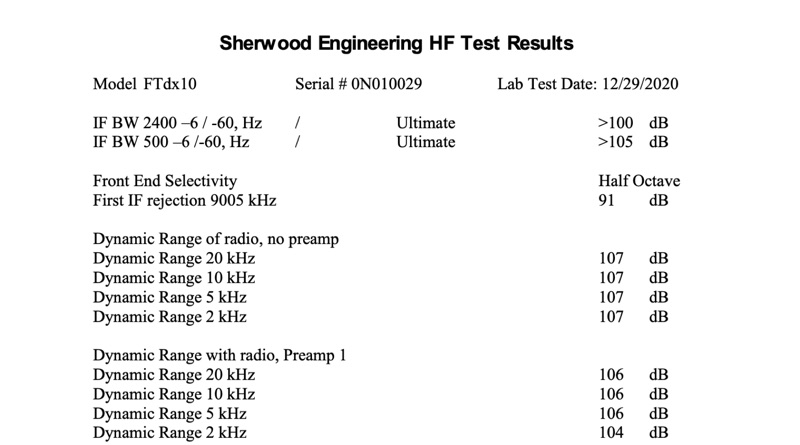 The Yaesu FTdx10 HF transceiver underwent comprehensive laboratory testing by Sherwood Engineering, with results documented on December 29, 2020. Key receiver performance metrics include IF bandwidth measurements at -6 dB and -60 dB for 2400 Hz and 500 Hz filters, showing ultimate rejection exceeding 100 dB and 105 dB respectively. Front-end selectivity and first IF rejection at 9005 kHz were measured at 91 dB. Receiver dynamic range, both with and without preamps, was consistently 107 dB at 20 kHz, 10 kHz, 5 kHz, and 2 kHz spacings without preamplification, and 106 dB with Preamp 1 at 20 kHz. Blocking performance reached 141 dB at 100 kHz offset with a 1uV signal. Phase noise was normalized across offsets from 2.5 kHz to 500 kHz, with a value of -145 dBc/Hz at 2.5 kHz and -155 dBc/Hz at 500 kHz. Reciprocal Mixing Dynamic Range (RMDR) peaked at 128 dB at 500 kHz spacing. Noise floor measurements for SSB and 500 Hz bandwidths at 14 MHz and 50.125 MHz showed -133 dBm with Preamp 2 at 14 MHz SSB. Sensitivity figures and S-meter accuracy were also documented, with one S unit equating to 3 dB from S3 to S9. Transmitter composite noise was measured at 100 watts and 30 watts, with values like -123 dBc/Hz at 2 kHz offset for 100 watts. Operational observations from the January 2021 CQWW 160m CW contest highlighted ergonomic issues, such as VFO knob placement and small buttons. A significant firmware limitation noted was the band scope and waterfall data being erased upon transmission, which severely reduces its utility for search and pounce operations.