Search results
Query: arduino beacon
Links: 9 | Categories: 0
-
 Unified Microsystems presents a range of amateur radio products, notably the **XT-4 MK2 CW Memory Keyer**, a battery-powered iambic keyer designed for portable operations like Field Day, POTA, SOTA, and DXpeditions. It features four non-volatile memories, each storing approximately 240 Morse characters, and operates at speeds from 8-45 WPM. The XT-4 MK2 also includes an auto power save function and paddle reverse, making it adaptable for multi-operator setups. Beyond the XT-4 MK2, the site details the **W9XT Contest Card**, a PC plug-in board offering DVK and CW interface capabilities, allowing operators to record and playback CQs and contest exchanges. Other offerings include the BevFlex-4X RX Antenna System, RAS-4 RX Antenna Switch, VK-64 Voice CW Keyer, and various USB interfaces. Additional products cover electronic development, such as the ATS-1 Terminal Shield for Arduino™ and VR-X Power Supply Voltage Regulators, demonstrating a broader scope beyond just operating accessories. The XT-4Beacon MK2 / CW IDer is also highlighted for beacon projects, capable of storing messages up to 5 minutes at 25 WPM.
 -
 A multi-mode QRP radio beacon built around the Arduino. This radio propagation beacon transmitter project is presented by M0XPD
 -
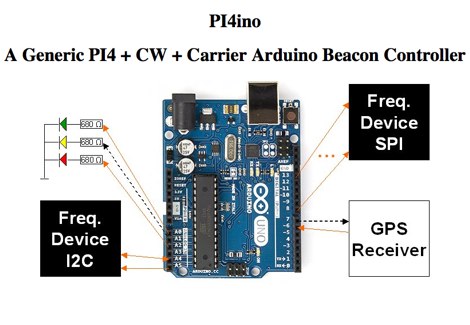 Generic PI4 + CW + Carrier Arduino Beacon Controller with interfacing to Analog Devices AD9833 DDS AD9850 DDS, AD9851 DDS, AD9912 DDS , AD9913 DDS, ADF4350 and ADF4351 synthesizers, ADF5355 synthesizer, ADF5356 synthesizer, Radio modulated by an audio soft-DDS Reverse DDS, RDDS microwave unit, Silicon Labs Si5351A programmable clock generator, Silicon Labs Si570 programmable XO/VCXO, Texas Instruments LMX2541 synthesizer
 -
 An example of how to control a Yaesu FT-817 with an Arduino to make a multi-band CW beacon.
 -
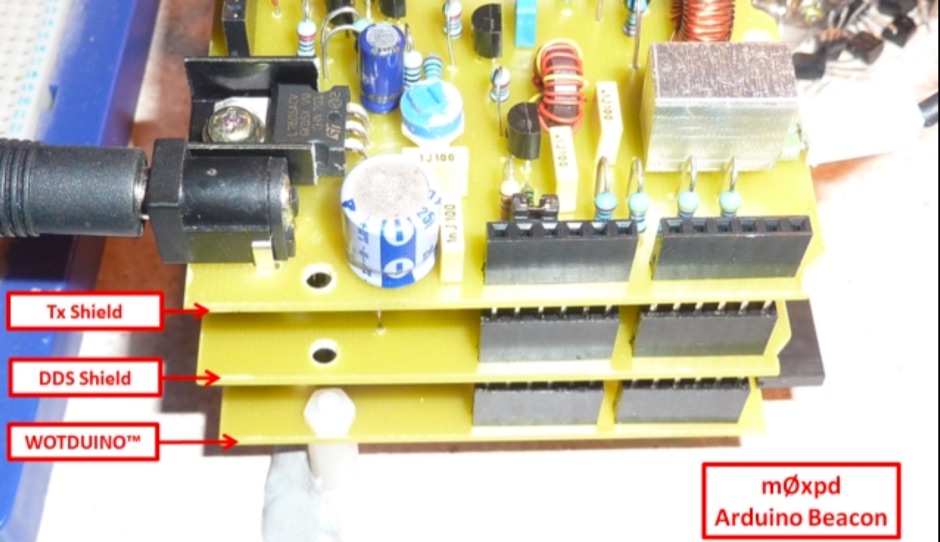 A new multi-mode QRP radio beacon built around the Arduino. The beacon started with the usual lash-up on the bench, hooking the previously reported Wotduino and DDS Shield up to a driver and a transmitter module, as previously used for the Raspberry Pi beacon
 -
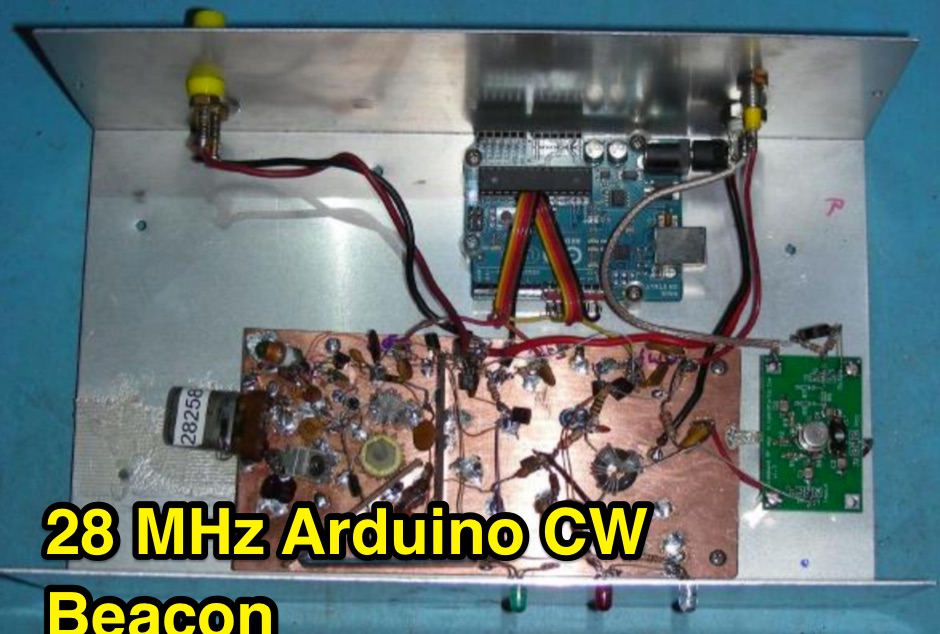 This project involves the construction of a 5 Watt Morse code beacon transmitter that operates in the 28.200 to 28.300 section of the 10 Meter Amateur Radio band. The beacon controller uses an Arduino Uno microprocessor board to produce the three signals that control the transmitter.
 -
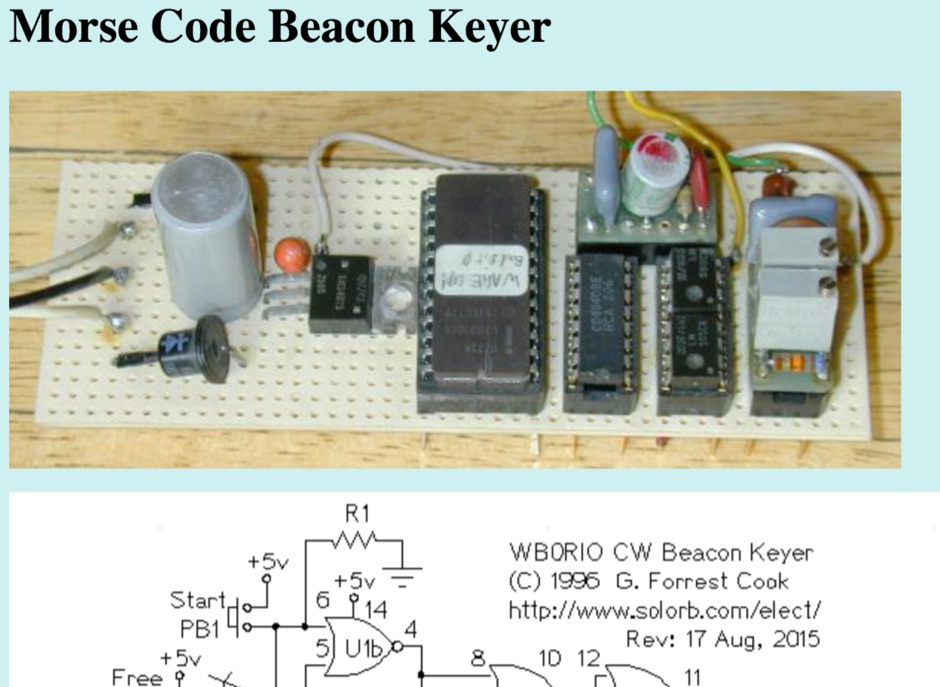 This circuit stores a morse code message as bits in an EPROM chip, the message controls a relay that keys a CW morse code transmitter. An Arduino processor can also be used in place of this circuit, that eliminates the need to build the circuit and program an EPROM.
 -
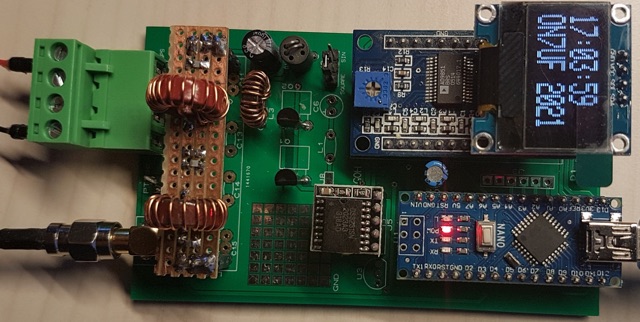 A WSPR beacon project based on Arduino nano (atmega328P) based microcontroller
 -
 This article introduces an Arduino-based QRP CW Transceiver designed for lower HF bands. The journey begins with the Wotduino, evolving from a keyer to a multi-mode beacon. The development includes a QRP transmitter and culminates in a receiver inspired by Roy Lewallen design. The transceiver, controlled through a control bus features a signal path, modulation, filtering, and adjustable frequency settings. Despite initial testing intentions, successful QSOs on 80 and 40 meters showcase its functional capabilities.