Search results
Query: auxiliary radio
Links: 7 | Categories: 0
-
 RSCW demonstrates a Linux/Unix command-line utility engineered for **Morse code** decoding via a computer's sound card. It specifically targets the extraction of weak CW signals from noise, operating on 8-bit, 8000 samples/second audio input, typically from `/dev/dsp`. The program outputs decoded characters to `stdout`, supporting user-specified speeds in words per minute (WPM) and carrier frequencies. While effective for machine-sent signals, it exhibits a 2-second decoding lag and requires manual speed input, making it less suitable for general-purpose, real-time contest operation. The resource details the program's components, including `rscw` (the main decoder), `rscwx` (an X11 graphical auxiliary for spectrum and internal signal visualization), `rs12tlmdec` (a specialized decoder for RS-12 amateur radio satellite telemetry), and `noisycw` (a utility for generating noisy Morse signals for testing). Installation instructions involve downloading a `.tgz` file, compiling with `Make`, and requiring the FFTW library (and GTK 2.0 for `rscwx`). Performance is illustrated with a .wav file example of a 12 WPM, 800 Hz CW signal at 12 dB Eb/N0, showcasing RSCW's near-error-free decoding of a test message. The site provides command-line examples utilizing `sox` for audio conversion and `noisycw` for signal generation, inviting comparisons with other decoding software and human operators, particularly for weak signal conditions.
 -
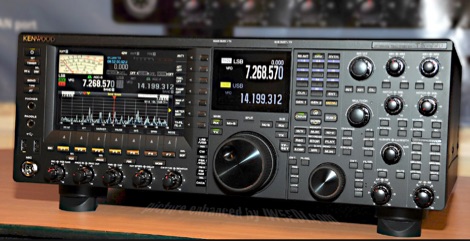 Kenwood TS 990S, Military Auxiliary Radio System modification
 -
 Over 100 trained amateur radio operators comprise the New York City Amateur Radio Emergency Communications Service (_NYC-ARECS_), an auxiliary communications service dedicated to providing vital radio links during local, regional, or national civil emergencies. This organization supports governments, civil-preparedness, and relief agencies in situations such as power failures, explosions, fires, floods, earthquakes, or terrorist activities. Their operational readiness is critical for maintaining communications when conventional infrastructure fails, leveraging the resilience and adaptability of amateur radio. NYC-ARECS actively participates in the NYC Office of Emergency Management (_OEM_) Partners in Preparedness program and is a member of DHS FEMA's National Preparedness Coalition, demonstrating its integration into broader emergency response frameworks. The group's activities include regular training, maintaining operational readiness, and deploying communication assets across the five boroughs of New York City. Their efforts ensure robust, independent communication channels are available to support disaster relief and public safety operations.
 -
 Fostering community spirit and recognizing contributions within amateur radio clubs often involves tangible tokens of appreciation. **Challenge coins** have emerged as a popular and effective method for achieving these goals, providing a unique way for clubs to acknowledge member participation and milestones. These custom-designed coins can reflect a club's specific identity and achievements, serving as a physical representation of membership and dedication. Clubs can utilize these coins for various purposes, including recognizing membership renewals, commemorating event participation like Field Day, or even as a fundraising mechanism to support club activities and repeater funds. The customization options extend to plating and color, allowing for different tiers of recognition, such as bronze for general membership, silver for life members, or gold for special awards presented by club officers. This flexibility makes them a versatile tool for enhancing engagement. Beyond traditional amateur radio clubs, organizations like the **Military Auxiliary Radio System (MARS)** also benefit significantly from challenge coins, reinforcing their connection to the broader military and amateur radio communities. The production process is simplified with artwork assistance, ensuring clubs can easily bring their unique designs to fruition.
 -
-
 The document delineates the operational framework for the Auxiliary Communications Service (ACS) and the Amateur Radio Emergency Service (ARES), specifically detailing their integration into the National Incident Management System (NIMS) for emergency communications. It explains NIMS as a standardized, comprehensive national approach to incident management, emphasizing its applicability across all jurisdictional levels and functional disciplines to enhance coordination among responding agencies. The resource highlights that ACS/ARES operates within this NIMS structure for all events, emergencies, and disasters, aligning with federal requirements for emergency preparedness grants. Specific sections address the dual management structures typical in emergency response: an administrative management structure for day-to-day operations and an emergency management structure activated during specific disasters. It illustrates how ARES provides the administrative framework, while the ACS emergency management structure adopts the NIMS/Incident Command System (ICS) model when activated by entities like the Ventura County Office of Emergency Services. The content further breaks down the ARES organizational hierarchy from national ARRL divisions down to local Ventura County districts and areas, identifying roles such as Section Emergency Coordinator (SEC) and District Emergency Coordinator (DEC). Each of the eight Ventura County administrative areas, such as Simi and Thousand Oaks, is shown to have its own Emergency Coordinator and specific communication plans, all coordinated under a broader District Emergency Communications Plan.
 -
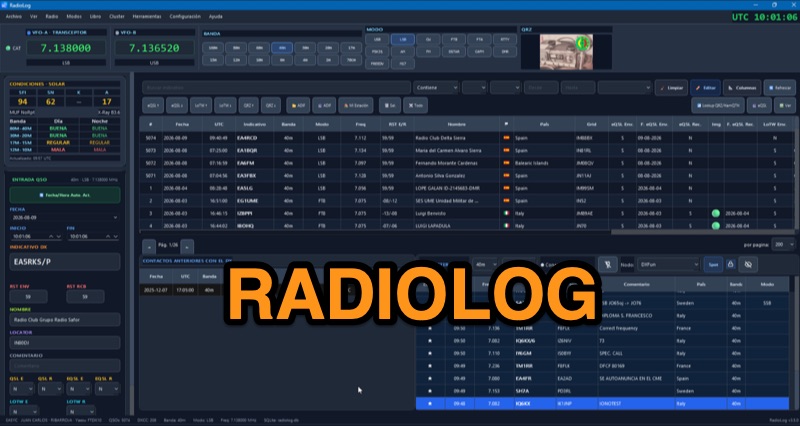 RadioLog is a free amateur radio logbook software for Windows 10/11 (x64) that integrates QSO logging with real-time DX Cluster spots and _RigControl_ capabilities. It supports ADIF, eQSL, and LoTW for logging and export, along with specific modules for contest operation, including automatic scoring and _Cabrillo_/EDI export for HF and VHF contests. The software also features a dedicated portable mode for SOTA, POTA, WWFF, and CB/11m activations, offering a distinct logbook for these activities. The application includes an integrated _RTL-SDR_ auxiliary monitor for visual and audio support during operation, and offers three CAT connection methods: direct RadioLog control, Hamlib managed by RadioLog, or an external rigctld server. Recent updates, such as those in v4.0.2, focus on interface polish, consistent dark theme application, and layout bug fixes, including VFO frequency display with thousands separators. The software also provides reciprocal synchronization with QRZ.com Logbook, allowing both upload and download of QSOs, and supports various digital voice modes like DMR, C4FM, D-STAR, FreeDV, and M17.