Search results
Query: call books
Links: 13 | Categories: 1
Categories
-
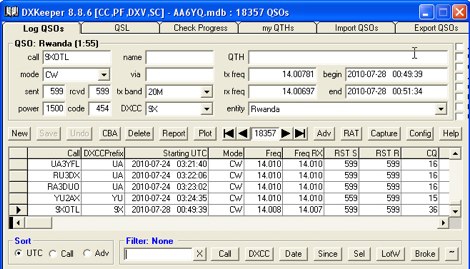 DXKeeper is a free application that logs QSOs, tracks award status, generates QSL cards & labels, addresses envelopes, uploads QSOs to eQSL.cc and LotW, and downloads progress info from eQSL.cc and LotW. It can reference the RAC, Hamcall, and QRZ callbooks as well as the QRZ.com web site to fill in data when logging, or to update already-logged QSOs. DXKeeper automatically interoperates with all members of the freeware DXLab Suite, including Commander (transceiver control and bandspread for Alinco, Elecraft, FlexRadio, Icom, Kachina, Kenwood, TenTec, Yaesu), DXView (world map, rotator control), WinWarbler (PSK, RTTY, CW, Phone) and SpotCollector (DX and WWV spots). It also interoperates with MMTTY, MMVARI, MMSSTV, MultiPSK, MixW, DX Atlas, and Ham Radio Deluxe.
 -
 The Bundesnetzagentur's online tool provides a direct interface for searching **German amateur radio callsigns**, enabling users to retrieve specific details associated with licensed operators. The system utilizes a web-based form where users input a callsign to query the official German amateur radio database. This resource is built on Microsoft Visual Studio .NET 7.1 with Visual Basic .NET 7.1, indicating a mature and stable backend for data retrieval. This callsign lookup service facilitates rapid verification of German stations, which is particularly useful for **DXers** confirming contacts or for contesters needing to cross-reference logs. Unlike broader international callbooks, its focused scope on German licensees ensures high accuracy and direct access to official data. The tool's simplicity and direct functionality make it an efficient utility for any amateur radio operator interacting with German stations.
 -
 The CQ Callbook makes it easy to find QSL information from web-accessible sources like address and manager databases and country-specific callbooks. The search procedure is quite easy: just enter Callsign and click on the Search buttons.
 -
 Produce QSL & post cards, stickers, ID cards, calendars, certificates, awards, membership applications, log and call-books, rubber stamps,T-shirts, brochures, advertising materials.
 -
 Windows logging program by wa0h. US and Canadian callbooks are built into the cd version of the program.
 -
 Operating in the Nordic region often requires specific call sign lookup tools, and this resource offers a dedicated search service for Swedish amateur radio operators. Users can query the database by entering a call sign, a family name, or a city, facilitating the identification of hams within Sweden. This functionality is particularly useful for DXers attempting to confirm contacts or for local hams seeking to connect with others in their area, leveraging the official data provided by the Swedish Amateur Radio Society (_SSA_). Such a lookup service streamlines the process of verifying contacts for awards like _DXCC_ or for general QSLing purposes. While many global callbooks exist, a national service like this often provides more granular and up-to-date information for its specific region. The ability to search by city can be especially beneficial for local rag-chewing or for coordinating activities within a specific geographic area, offering a practical complement to broader international databases.
 -
 For radio amateurs seeking to verify contacts or identify stations from Tajikistan, the _Tajikistan EY Callbook_ serves as a dedicated online resource. This callbook, compiled and maintained by Irage M. Tursoon-Zadeh, _EY8WW_, offers a focused database of callsigns within the EY prefix region. It provides a practical utility for DXers and contesters aiming to confirm QSLs or prepare for operations involving stations in this specific geographic area, streamlining the process of identifying active hams. The resource's utility is particularly evident for those engaged in award programs like _DXCC_ or _WAZ_ where accurate callsign verification is crucial for credit. Unlike broader, worldwide callbooks, this specialized listing ensures high relevance and accuracy for its target region, reflecting the local expertise of EY8WW. Its direct focus on Tajikistan makes it a valuable, albeit niche, tool for operators with specific interest in Central Asian DX.
 -
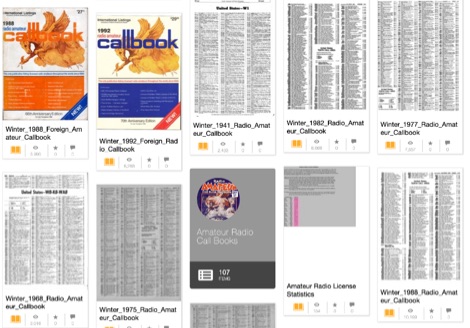 Indexes over 100 digitized amateur radio callbooks, primarily from the early to mid-20th century, providing a historical record of callsign assignments and licensee data. The collection facilitates research into past amateur radio operations, tracing callsign lineage, and identifying operators from specific eras. Each entry typically includes the callsign, licensee name, and geographic location as published in the original printed volumes. Users can browse the collection by publication date or utilize the search function to locate specific callsigns or names within the archived documents. The resource serves as a valuable repository for historical amateur radio data, supporting genealogical and operational research. Access to these scanned documents is provided directly through the Internet Archive platform, ensuring long-term preservation and availability of these historical amateur radio records.
 -
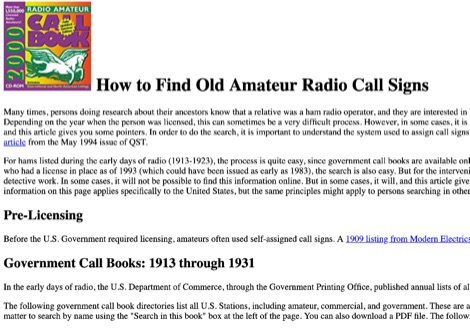 The W0IS resource outlines methods for finding historical US amateur radio call signs, particularly for genealogical research. It highlights the comprehensive collection of digitized call books from 1906-1996 available at leehite.org, stored as searchable PDF files. These resources significantly simplify what was previously a laborious manual search through physical call books, which were typically indexed by call sign rather than name. The guide details specific search techniques for various eras. For early radio days (1913-1923), government call books are readily available and searchable online via Google Books and hathitrust.org. For the period between the 1930s and 1980s, when private publishers like "Radio Amateur Call Book Magazine" dominated, the resource points to archive.org for scanned editions (1938, 1940, 1948, 1972) that support full-text OCR searches, despite potential scanning errors requiring flexible search terms. It also provides strategies for navigating Google Books' "snippet view" for the 1952 call book, including searching by name or address and interpreting often illegible snippets. The resource suggests cross-referencing findings with hamcall.net for call sign verification from 1921, 1954, 1960, 1969, and 1983 onwards. Additionally, it lists physical call book collections at institutions like the Pavek Museum of Broadcasting and individuals like W3HF, offering avenues for deeper research when digital methods fall short.
 -
 Radio Astronomy Supplies astronomy products since 1994 including radio telescopes, LNA's, noise callibration source, books, videos.
 -
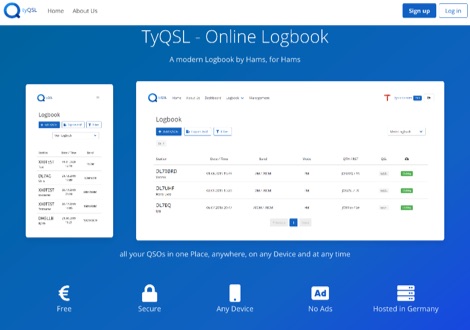 TyQSL is a modern Logbook by Hams, for Hams. A Place for other hams to take a look at your QSO statistics as well as search for QSOs in your Logbook that you made public. Just click onto your name in the Menu Bar when you are logged in to get to your public profile. Soma features includes Shows the users Valid Callsigns Look at QSO Statistics, Search Public Logbooks, Filters are avaliable to find QSOs fast Just share the Link on Social Media, QRZ, or Similar with other
 -
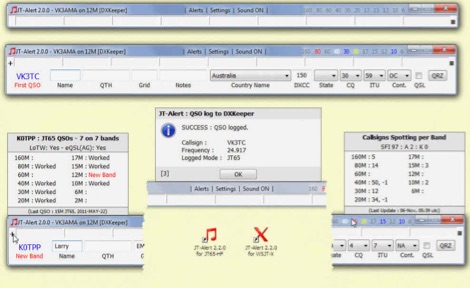 JTAlert provides several audio and Visual alerts for WSJT-X & JTDX software. JTAlert generate audio and visual alerts for several alert conditions, logs automatically to several ham radio log books software like hrd dxkeeper,log4om, interoperates with web services and it supports dxlab suite.
 -
 Shortwave and Amateur Radio Log (SWLog) is a modern suite of applications that provide logging and remote control for amateur radio and shortwave, utility, and broadcast listening. SWLog has been continuously improved and expanded since it was first released in 1988. SWLog is a suite of products that provides logging, radio control, GPS synchronization, QSL management, reporting, and propagation prediction. Program schedules from HFCC, ILGRadio, AOKI, ADDX, SWSkeds, EiBi, and others are leveraged for broadcast reception. Call sign lookups and remote logbooks are integrated with ClubLog, eQSL, QRZ, Ham365, HamQTH, and LoTW. SWLog provides Android and iOS applications for logging on the go as well as web servers for logging and remote control from anywhere. SWLog works on Windows, Linux, iOS and Android