Search results
Query: country numbers
Links: 4 | Categories: 0
-
 This program extracts statistics from a dx.dat file to show numbers of spots for each country on each band
-
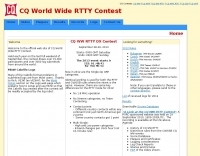 Rules of CQ World Wide RTTY Contest. The CQ World Wide RTTY DX Contest take place last full week-end of September, inviting amateur radio operators globally to connect across various CQ zones and countries. Participants will operate on five designated bands: 3.5, 7, 14, 21, and 28 MHz, exchanging RST reports and zone numbers. Scoring is based on QSO points multiplied by zone, country, and QTH multipliers. The contest encourages innovation in operating strategies while adhering to established rules to ensure fair competition among entrants.
-
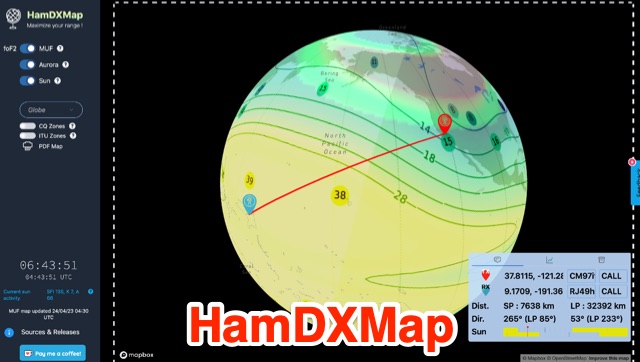 _HamDXMap_ provides propagation analysis and operational aids, integrating real-time data with historical logging capabilities. The platform displays Maximum Usable Frequency (MUF) and foF2 response curves, with a horizontal bar indicating live VFO frequency from _Win-Test_ via Gateway software. It supports _VOACAP_ 24-hour propagation predictions for Short Path (SP) and Long Path (LP) tabs, factoring in monthly smoothed sunspot numbers. The minimum bounce altitude for propagation calculations is **50 km**. The tool features a _ClubLog_-sourced DXCC Most Wanted ranking in voice, telegraphy, and digital categories, displayed in callsign pop-ups and DXpedition lists. Users can import contest logs in ADIF format, visualizing QSOs on the map with adjustable line and point parameters. A playback function allows contest replay at speeds from **1x to 100x**. An _IOTA_ (Islands on the Air) layer displays island group definitions and confirmation percentages, indicating RSGB activation evidence requirements. _HamDXMap_ integrates over 1100 online SDR receivers from three networks, updated daily, with access links and a favorites function. It tracks current and future DXpeditions planned over the next 45 days, sourced from _The Daily DX_, _DX 425 News_, _DX World_, _Les Nouvelles DX_, and _NG3K_. Real-time weather information, including temperature, wind, and pressure, is displayed in DXCC country and RX/TX position pop-ups.
-
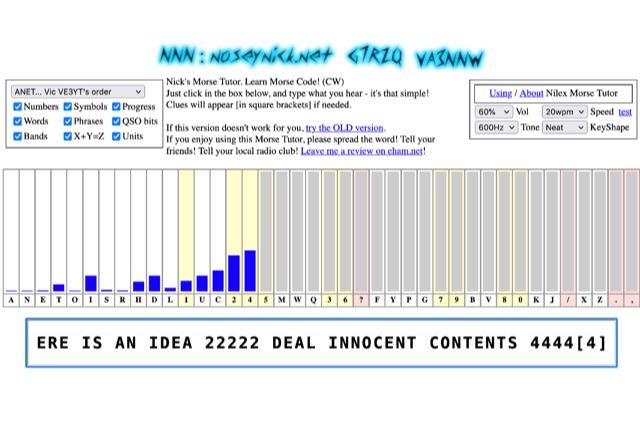 The **Nilex Morse Tutor** is an HTML5 web application designed to teach Morse code reception, adapting to user proficiency by adding new characters as readiness is detected. It prioritizes practice on less familiar letters, numbers, symbols, words, and phrases, while minimizing repetition of already mastered elements. The program offers multiple learning orders, including "Q7ZG..." (Ward/Jim's), "KMRS..." (PU5EPX/Koch), "KMUR..." (lcwo.net), "AENT..." (CWops CW Academy), "TEAN..." (Stephen C Phillips), "ANET..." (Vic VE3YT), and "ETI5..." (Ham Whisperer), alongside an alphabetical option. Users can customize the learning experience by enabling or disabling automatic progression, and selecting specific content categories such as numbers, symbols, words, phrases, QSO bits, Ham Radio Bands, X+Y=Z math, and units. Audio settings are adjustable for volume, speed (WPM), tone frequency, and keyshape/keying envelope, allowing for a personalized auditory environment. The interface provides visual feedback with blue bars indicating practice emphasis and gray bars for reserved characters, with clickable bars for manual character selection. Developed by "Nosey" Nick Waterman, VA3NNW, this tutor is based on earlier versions by Jim Wilson and a 1977 QST article. A significant October 2019 rewrite incorporated a new WebAudio sound library by AwesomeAidenW, improving offline functionality and mobile support. The content library was expanded to include 3000 top Google words, 2284+ General Service List words, ISO country codes, capital cities, US states, Canadian provinces, UK counties, common names, periodic table elements, quotes, Q-codes, electronic components, ham abbreviations, and example call signs. The software is distributed under the GNU GPL V2 license.