Search results
Query: mixer diodes
Links: 2 | Categories: 0
-
 Constructing a functional spectrum analyzer for the 0-100 MHz range presents a significant challenge for radio amateurs, often requiring specialized components and careful calibration. This project details a homebrew spectrum analyzer design utilizing common integrated circuits like the _SA605D_ FM receiver IC and _MAR-6_ MMIC amplifiers, aiming for a cost-effective solution. The design incorporates a low-pass filter, RF amplification, a voltage-controlled oscillator (VCO) for downconversion, and multiple IF stages at 150 MHz and 10.7 MHz, with a resolution bandwidth (RBW) of 15 kHz. Critical components such as the _SBL-1_ mixer and varicap diodes are specified, alongside instructions for winding inductors and tuning filters. The analyzer's performance is discussed in terms of input level limitations, specifically the 1dB-compression point and third-order intercept point, to ensure accurate measurements and prevent component damage. The _SA605D_'s logarithmic Received Signal Strength Indicator (RSSI) output serves as the detector, driving the Y-input of an oscilloscope, while a _TL084_ op-amp generates the sweep signal for the X-input. Potential enhancements include adding a step attenuator, improving front-end filtering, and implementing switchable IF filters for variable RBW, allowing for greater versatility in analyzing RF signals.
-
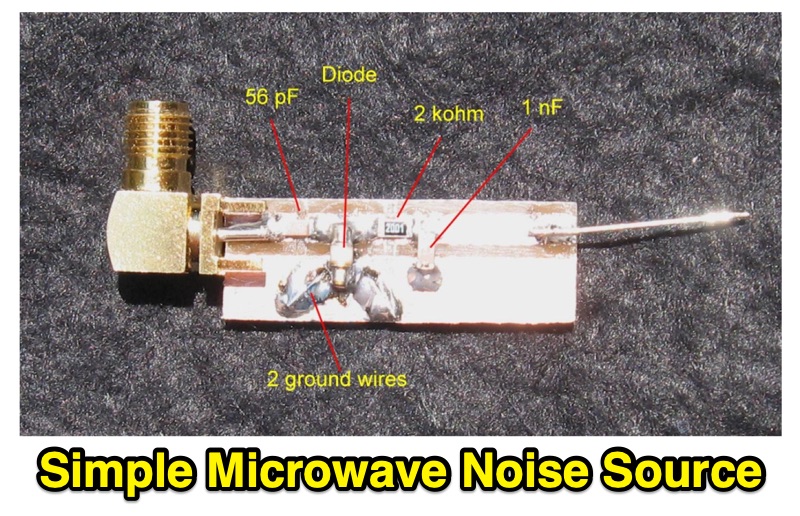 This document outlines the construction of a simple microwave noise source, leveraging mixer diodes, potentially from _John Watson, VE3EZP_'s collection. The design provides a basic schematic for a noise generator, primarily intended for go/no-go receiver sensitivity checks and comparative noise figure assessments. It produces noise levels approximately 20 dB above thermal noise, making it suitable for AM/SSB/CW receivers, but it is not calibrated for absolute noise figure measurements. The construction utilizes surface-mount components on 1/16 inch FR4 PC board, demonstrating functionality up to at least 10 GHz. An alternative version incorporating a _1N21_ diode is noted to operate effectively up to 5.76 GHz. The resource specifies that any microwave detector diode with a reverse breakdown voltage of a few volts is suitable for this application, providing practical guidance for replication.