Search results
Query: neural network
Links: 3 | Categories: 0
-
 PilotMORSE is a great home solution for private pilots or aspiring professionals who want to hone their Morse code skills used to identify VORTACs, localizers, and marker beacons. PilotMORSE takes you through the alphabet with an advanced neural network algorithm that adjusts the pace of presentation based on your responses.
 -
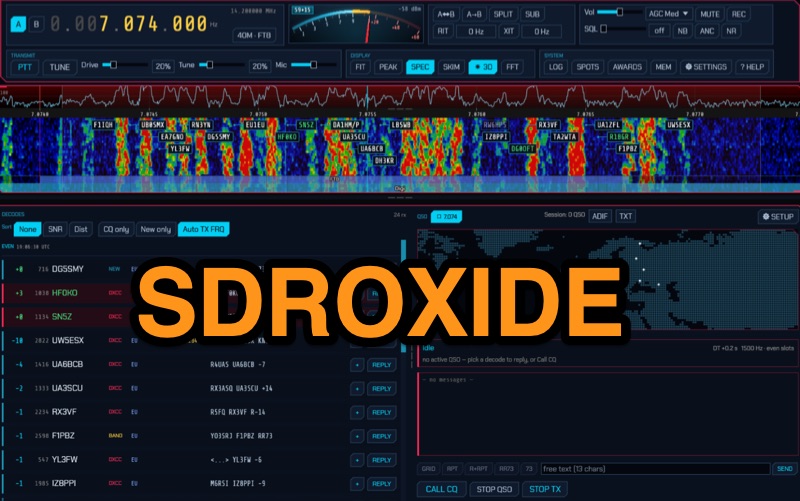 Operates as a universal client for Software Defined Radios, SDRoxide provides a robust platform for amateur radio operators to engage in diverse modes and activities. It integrates a **GPU panadapter** for real-time spectrum visualization, dual VFOs for flexible tuning, and advanced neural noise reduction to enhance weak-signal reception. The software supports a comprehensive suite of digital modes, including FT8, JS8, RTTY, and PSK, alongside built-in skimmers for automated signal detection. Its capabilities extend to Winlink radio email, 868 MHz ISM sensor decoding, and hands-free satellite operation with continuous Doppler correction and Hamlib rotator tracking. The client offers native drivers for popular SDR hardware like RTL-SDR, RX-888, and HackRF One, covering a wide frequency range from 1 MHz to 6 GHz. It also interfaces with CAT-controlled transceivers via Hamlib and Flrig, allowing a second SDR to function as a panadapter. Network dongles, SpyServer, KiwiSDR, and OpenHPSDR Ethernet SDRs are also supported, providing flexibility for remote and local operations. Beyond core radio functions, SDRoxide incorporates a live 3D space-weather globe with aurora and lightning displays, real-time satellite tracking with TLE updates, and a measured propagation heat map. It includes a full-featured logbook with DX cluster spots, award tracking for **DXCC** and WAS, and direct QSL upload integration with services like eQSL and Club Log, streamlining post-QSO management.
 -
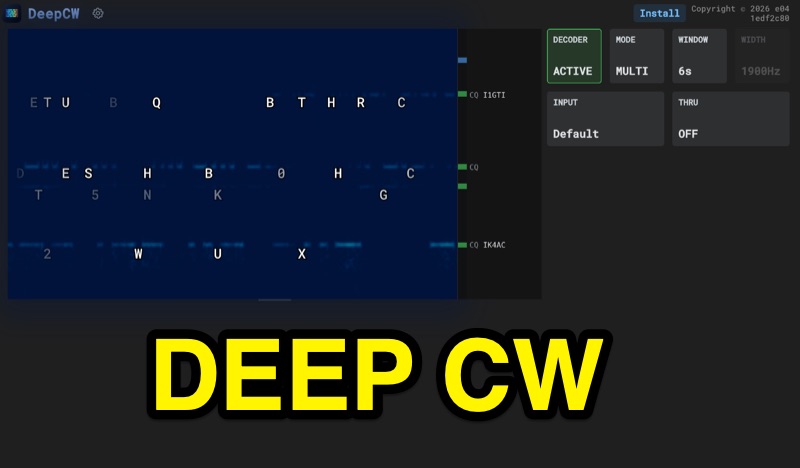 Operating in challenging RF environments, DeepCW provides real-time Morse code decoding capabilities through a neural network model. The software excels at robustly interpreting weak signals, mitigating the effects of QSB, and performing effectively in noisy conditions, a common issue for CW operators. It also supports multi-channel decoding, allowing for the simultaneous interpretation of multiple CW signals present in the audio stream. The application integrates audio pass-through functionality, enhanced with deep-learning-based noise reduction to clean up the incoming audio before decoding. Benchmarking data indicates a 0.00% error rate from 0 to -4 dB SNR, with errors remaining below 1.5% at -8 dB SNR and under 8% at -10 dB SNR across the full range of CW speeds. The project provides comparative analyses against established decoders such as _CW Skimmer_, _fldigi_, and _ggmorse_, utilizing publicly available CW QSO videos from YouTube to demonstrate its performance. DeepCW is designed for cross-platform deployment, supporting Windows, macOS, Android, and iOS operating systems. The core _DeepCW Engine_, which houses the decoding model and a reference implementation, is available separately, offering Python and Node.js examples for decoding from WAV audio files.