Search results
Query: vna projects
Links: 4 | Categories: 0
-
 A synthesized 2.3 GHz Amateur Television (ATV) transmitter design, conceived by Ian G6TVJ, is presented, targeting broadcast-quality video performance on the 13cm band and extending up to 2.6 GHz. The core of the design utilizes a commercial Z-comm Voltage Controlled Oscillator (VCO) that tunes from 2.2-2.7 GHz, providing a +10 dBm output and simplifying RF alignment. This VCO's stability, originally intended for narrowband applications, readily accepts high-frequency video modulation, contributing to the transmitter's robust performance. The exciter stage, incorporating a Mini Circuits VNA 25 MMIC amplifier, boosts the signal to +16dBm, while a Plessey SP4982 prescaler divides the output frequency for the synthesizer. The synthesizer employs a Motorola MC145151 CMOS parallel IC, favored over the common Plessey SP5060 for its superior video modulation characteristics and ease of programming without microprocessors. This choice addresses issues like LF tilt and distorted field syncs often seen with SP5060 designs, particularly when operating through repeaters or over long distances. The MC145151 divides the signal further, enabling precise frequency stepping, with programming handled by EPROMs for channel selection and LED display. The loop filter network, critical for video integrity, was developed through experimentation to prevent the PLL from reacting to video modulation, ensuring a clean transmitted picture. The transmitter incorporates a Down East Microwave commercial power amplifier module, delivering approximately 1.6W output, driven by the exciter through a 3dB attenuator. Construction involves surface-mount SHF components on micro-strip lines etched onto double-sided fiberglass board, housed within a tinplate box. The design boasts no AC coupling in the video path, preserving low-frequency response, a common failing in other ATV transmitters. Performance tests with a 50Hz square wave revealed no LF distortion, and a calibrated "Pulse & Bar" signal showed a near 100% HF response, demonstrating its capability for high-quality ATV transmissions.
-
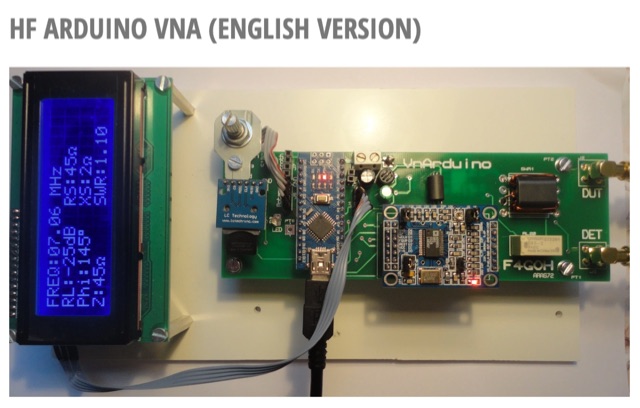 An home made VNA made with Arduino Nano. This project features an LCD display 4x20 works from 1 MHz to 60MHz, can use bluetooth connection with Blue VNA android app.
-
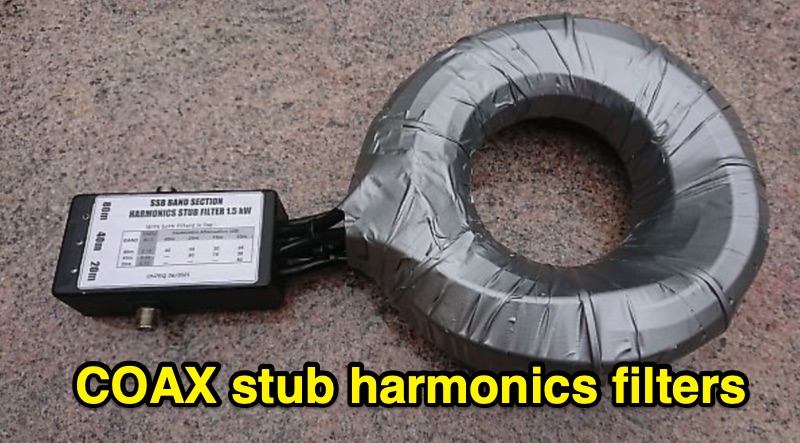 For multi-station contest operations, particularly when operating on lower bands, **coaxial stub filters** are presented as an effective solution to mitigate harmonic interference and prevent receiver overload in adjacent stations. The resource explains that two filters, one optimized for the CW portion and another for the SSB portion, should be connected in series to achieve comprehensive band coverage. Each filter typically provides around 25 dB of attenuation on the second harmonic (2f), with a series configuration yielding approximately 40 dB. The author notes that by carefully selecting the coaxial cable length (multiples of **lambda/4**) between the power amplifier and the filters, total harmonic attenuation can be significantly enhanced, potentially reaching up to 75 dB. Measurement results, obtained using a Keysight Fieldfox VNA, illustrate the performance of these filters across the 80m, 40m, and 20m bands. The data includes SWR plots and specific attenuation figures for the 2nd, 3rd, 4th, and 5th harmonics, demonstrating the practical effectiveness of the design in reducing inter-station interference. For instance, the 40m 2nd harmonic attenuation on the 20m band is highlighted as "very effective and useful," while the 40m 3rd harmonic attenuation on 15m is described as "extremely effective and useful," validating the design's utility in real-world contest scenarios.
-
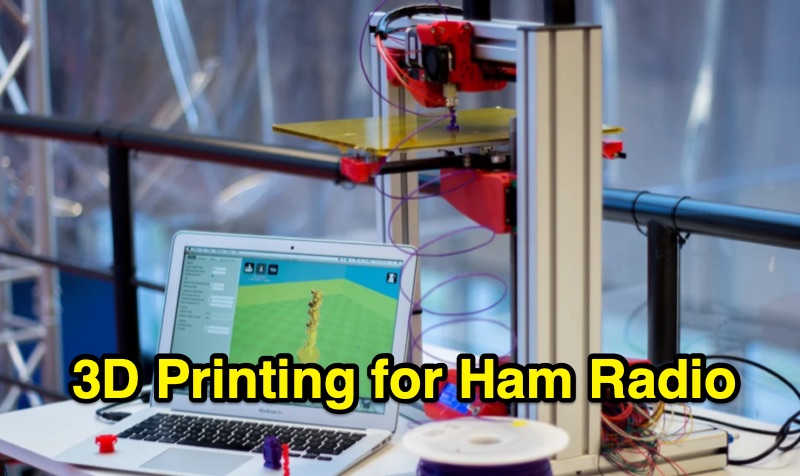 Fabricating custom components for amateur radio operations often requires specialized parts that are difficult to source commercially. This article provides a practical guide to utilizing **3D printing** technology to create bespoke enclosures, antenna mounts, and other accessories. It details suitable materials such as **PLA**, PETG, and ASA filaments, outlining their respective properties for indoor and outdoor applications, including UV resistance and heat tolerance. Specific examples include custom enclosures for NanoVNA units and ESP32 projects, as well as practical antenna components like EFHW winders and mast brackets. The resource addresses common concerns regarding the impact of printed plastics on RF characteristics, noting that materials like PLA, PETG, and ASA generally have low loss factors comparable to commercial insulators, making them suitable for most ham radio frequencies. It cautions against using carbon fiber reinforced filaments for RF parts due to their conductivity and advises careful consideration for high-Q antennas or frequencies above 1 GHz. The article also recommends various sources for STL files, CAD software for beginners, and entry-level FDM 3D printers, empowering radio amateurs to design and produce their own custom parts.