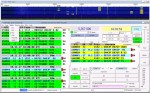
The FT4 mode is the new digital mode born and thought for fast contacts such as QSOs done during contests and DX-Peditions.
Announced in April 2019 as experimental digital mode protocol for fast radio communications, and like the FT8 mode implements fixed length and structured message sequences, but with a total duration of 4.48 seconds, approximately 2.5 x faster than FT8. In contest, the speed is similar to RTTY, but FT4 permit to make contact with signals 10dB weaker then the ones needed for RTTY, with a reduced bandwidth.
FT4 can be used with the WSJT-X or JTDX software capable to run on most popular operating systems, from Windows to Linux and also MacOSx
JTDX is an open-source software application for amateur radio weak-signal digital communication. It supports digital modes including FT8 and JT9. The software operates on _Windows_, _Linux_, and _macOS_ platforms. JTDX is designed for improved decoding of weak signals, a function also performed by WSJT-X and MSHV. The software facilitates weak signal decoding and transmission. It integrates with logging systems for QSO management and can automate tasks such as call management and remote RTX control. JTDX is utilized in contexts such as DXing and contests. DXZone Focus: FT8 | JT9 | Weak Signal | Multi-platform
Facilitates reliable two-way communication under challenging propagation conditions, WSJT-X provides a suite of digital modes optimized for weak-signal operation across the amateur bands. These modes, including FT8, FT4, and Q65, are designed to decode signals significantly below the noise floor, enabling DX contacts, EME (Earth-Moon-Earth), and meteor scatter QSOs with modest station setups. The software supports various T/R sequence lengths and tone spacings, tailored for specific propagation phenomena and band characteristics, such as JT9 for MF/HF with **2 dB** greater sensitivity than JT65, and MSK144 for VHF meteor scatter. WSJT-X also integrates specialized tools like _MAP65_ for wideband EME reception with polarization matching to counter _Faraday rotation_, and QMAP for wideband Q65 reception with Earth-Moon-Earth Doppler correction. These companion programs extend the software's capabilities for advanced weak-signal work, particularly on VHF, UHF, and microwave frequencies. The project, maintained by Joe Taylor, K1JT, and the WSJT Development Team, is the official home and reference implementation for these weak-signal digital communication protocols. Recent releases, such as _WSJT-X 3.0.2_, introduce enhancements like the QMAP program, Q65 Pileup, and SuperFox mode, which offers approximately **+10 dB** system gain for Fox-and-Hound operations.
MSHV is a free windows and linux multimode software that support weak signal digital modes like MSK144 MSKMS JTMS FSK441 FSK315 ISCAT JT6M FT8 FT4 JT65 PI4 amateur radio modes. MSHV features several interesting features including the Multi Answering Auto Seq Protocol, allowing multiple signal transmissions to be used during dx peditions.
How to add FT4 frequencies to WSJT-X
If you have upgraded WSJT-X from earlier version, you may be missing the predefined FT4 frequency values in the drop down menu. In this case you may need to reset the frequencies to the default values. Simply, go on Preferences->Frequencies right click on frequency table and click on Reset. The new frequency values will now be available.
FT4 is designed for contesting, particularly on the HF bands. Compared with FT8 it is 3.5 dB less sensitive and requires 1.6 times the bandwidth, but it offers the potential for twice the QSO rate. FT4 is not recommended for everyday use. FT8 Frequencies are different from the ones dedicated to FT4
If you want to add notes or just make corrections to the list of FT4 Frequencies write a comment here below.