Thunderstorm Effects on Sporadic E Propagation
Description
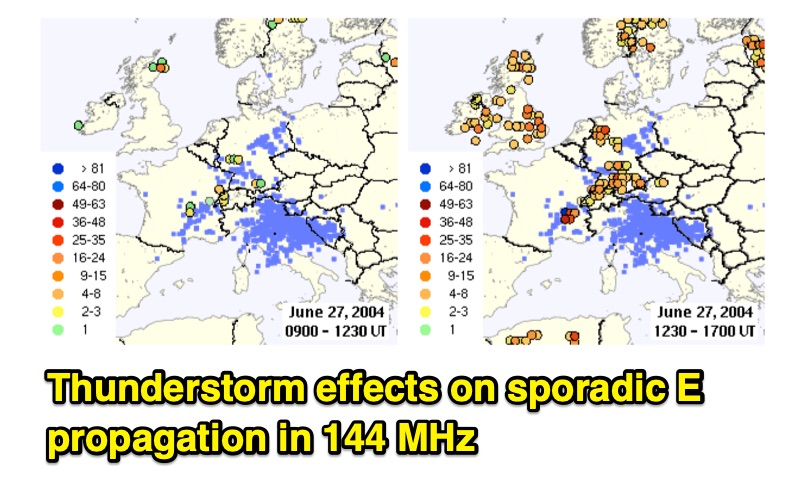
This paper discusses the potential effects of thunderstorms on ionospheric sporadic E radio propagation on very high frequencies. It addresses the skepticism within the ham community regarding this correlation due to a lack of convincing evidence. The paper considers scientific resources, including investigations on travelling ionospheric disturbances and spread-F irregularities, suggesting that thunderstorm effects on the ionosphere cannot be generally excluded. It presents a model where thunderstorm-triggered gravity waves travel from the troposphere and stratosphere into the ionosphere, potentially causing wind shears at E region level, which are considered a cause of mid-latitude sporadic E layers. The GPS/MET radio occultation experiment and OH nightglow measurements are cited as supporting this model. A ham radio project is introduced, which analyzes the spatiotemporal correlation between 144 MHz sporadic E long-distance communication and VLF radio emissions from lightnings (sferics). The June 27, 2004 event is presented as showing a correlation between sferic and sporadic E scatterer positions. The paper proposes a data analysis method for amateur radio propagation studies, contingent on scientific observatories providing raw data.