Search results
Query: decode cw
Links: 61 | Categories: 1
Categories
-
 Details the history and evolution of **Continuous Wave (CW)** radiotelegraphy, tracing its origins from 1800s railroad telegraphy using Samuel F.B. Morse's electrical code pulses to its exclusive use with spark-gap transmitters in early radio. Explains how vacuum tube oscillators enabled pure, efficient CW signals, forming the backbone for modern digital communication modes. The resource emphasizes that Morse code remains relevant in amateur radio, valued for its ability to penetrate adverse atmospheric conditions and its role in QRP operations. It outlines effective Morse code learning methodologies, specifically endorsing the **Koch** and **Farnsworth** methods, which prioritize learning by sound at higher character speeds (e.g., 20 WPM) with extended inter-character spacing (e.g., 5 WPM). The content stresses the importance of mastering individual characters with 90% accuracy before progressing. It also provides an extensive overview of CW key types, including the Straight Key, Side-Swiper (Cootie), Semi-Automatic Key (Bug), Dual-Lever Paddle (Iambic), and Single-Lever Paddle, detailing their operational characteristics, typical sending speeds (e.g., 20-100+ WPM), and construction considerations. Furthermore, the page presents several homebrew projects, such as a $10 Cootie key, an ultra-simple code oscillator, an Arduino-based CW decoder capable of 70 WPM, and a 4-stage CW audio filter. It also highlights QRP rig builds like the SW+40 and portable setups for POTA/SOTA, and lists prominent CW clubs like the Straight Key Century Club (SKCC) and the American QRP CW Club (NAQCC).
-
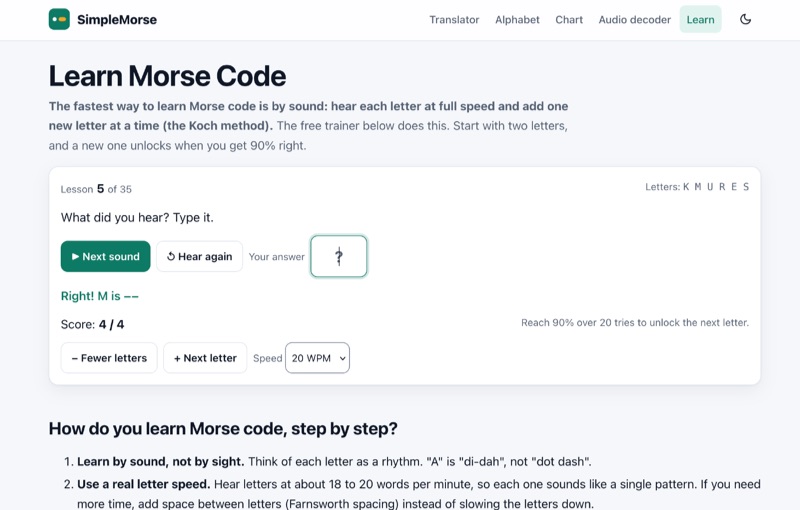 For radio amateurs seeking to master Morse code, this online resource provides a structured learning environment centered on the _Koch method_. It introduces characters sequentially, requiring a **90% accuracy** threshold over 20 attempts to advance to the next character. The platform emphasizes learning by sound, not visual memorization, allowing users to adjust character speed from 15 WPM up to **25 WPM**, with a recommendation for 18 to 20 WPM character speed utilizing _Farnsworth spacing_ for overall slower reception. The resource outlines a practical four-week practice regimen, guiding learners through the 35 lessons and progressing to decoding short words. It integrates supplementary tools such as a Morse translator with a tap key, an audio decoder for microphone input or files, and a printable alphabet chart. User progress is saved locally in the browser, facilitating consistent daily practice sessions of 10 to 20 minutes.
-
 M2 CW decoder Kit, is an Arduino based morse code decoder, kit produced and delivered by WB7FHC
-
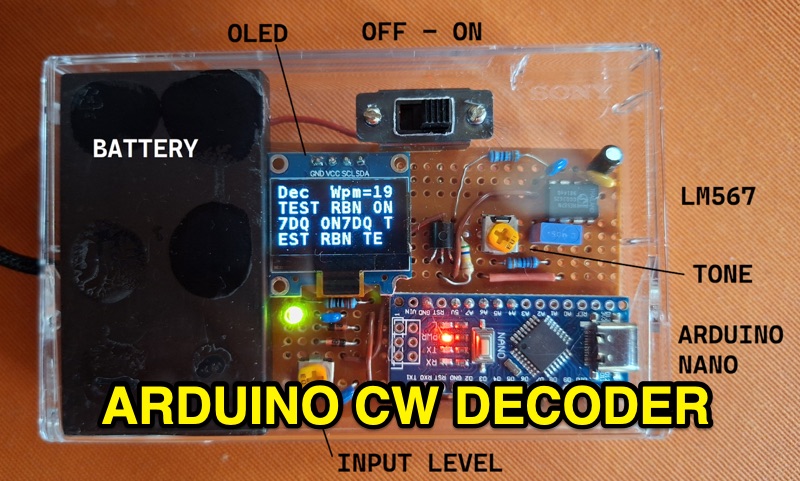 The project details the construction of a small, portable **CW decoder** built around an Arduino Nano and an LM567 tone decoder circuit. It integrates an OLED display for output and is powered by a 1200 mAh Li-Po battery. The Arduino Nano is programmed with a modified version of the OST Morse Box firmware, originally based on Budd, WB7FHC's work, provided as a HEX file for flashing. The LM567 output connects to Arduino pin D2, while pins A6 and A7 are grounded due to the absence of potentiometers, simplifying the circuit. Standard I2C connections are used for the OLED: SDA to A4 and SCL to A5. The entire assembly, including the Arduino, OLED, and decoder circuit, is mounted on a perfboard to fit precisely within an old cassette tape box. This design emphasizes portability and compact form factor. Parameters for the decoder can be adjusted using a dedicated Windows Control program, offering flexibility in operation. The resource provides practical insights into adapting existing firmware for specific hardware constraints and achieving a self-contained, battery-powered **Morse code** decoding solution.
-
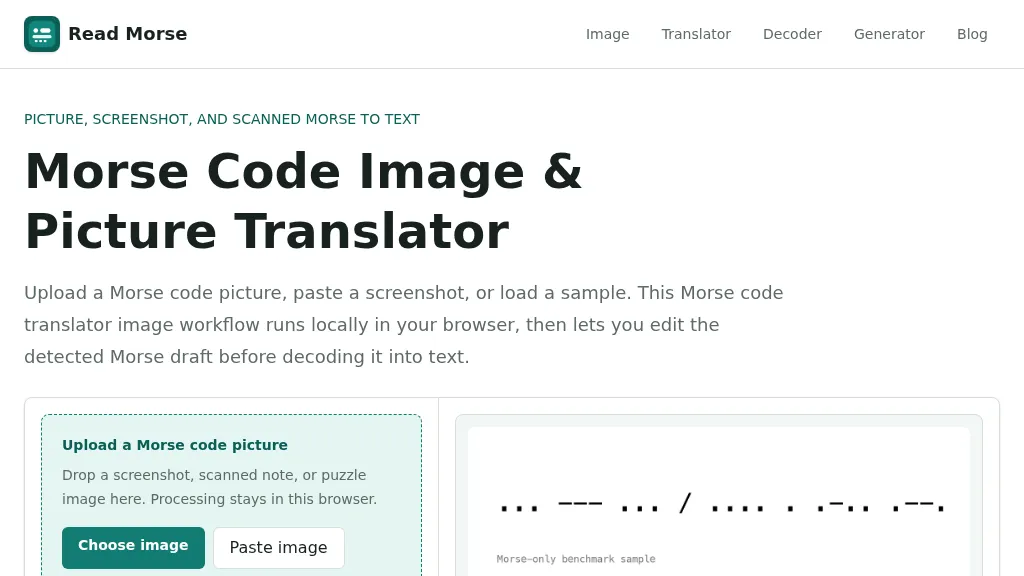 Decoding Morse code from visual sources like screenshots, scanned documents, or photographs presents unique challenges compared to audio-based reception. This web-based utility addresses these by allowing users to upload or paste images containing Morse code, which is then processed entirely within the user's browser, ensuring privacy. The tool identifies individual marks, classifying them as dots or dashes, and estimates letter and word spacing to generate an editable Morse draft. Users can refine the detection by utilizing controls for cropping, rotation, contrast boosting, and manual threshold adjustment, which are crucial for overcoming issues like low contrast, skewed baselines, or extraneous graphics. After the initial detection, the generated Morse draft, such as _... --- ... / .... . .-.. .--?_, can be manually corrected before being translated into plain text. The system provides confidence indicators and warnings to highlight potential ambiguities in the decoded output, prompting users to review and make necessary edits. This specialized approach differs from general OCR engines by focusing on the distinct patterns of Morse marks and gaps, rather than attempting to read standard alphanumeric characters. The tool supports common image formats like PNG, JPG, JPEG, and WebP, and includes sample images for benchmarking its performance, demonstrating its capability to handle various image qualities and complexities.
-
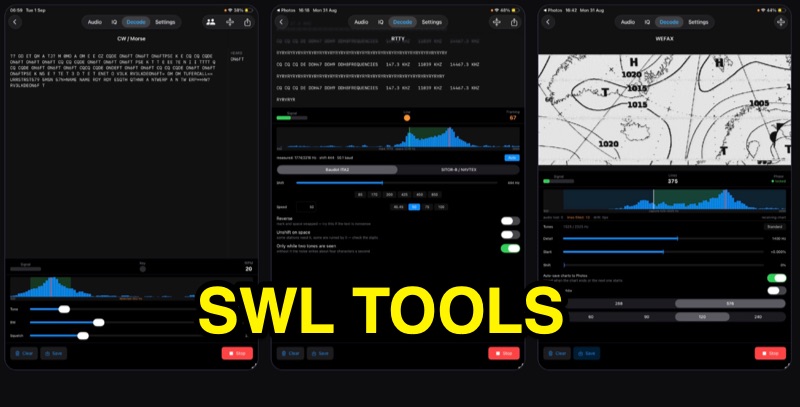 SWLTools, an iOS application for iPhone and iPad running iOS 17+, provides real-time decoding of various digital modes. It automatically locks onto CW tones, measures sending speed, and collects callsigns, distinguishing valid entries from misreads for a reliable log. For RTTY and SITOR-B, the app allows users to set shift and speed, then automatically tunes to the two tones for text reception, supporting marine bulletins, press agencies, and NAVTEX. The application also decodes WEFAX, building charts line by line for direct saving to the photo library, and processes ACARS aircraft messages, including CRC checks for data integrity and mapping of position reports. Beyond decoding, SWLTools integrates a GPU-accelerated FFT spectrum analyzer, a scrolling waterfall display with frequency cursors, and an adjustable FIR bandpass filter to isolate signals. It supports IQ signal analysis from receivers via two-channel audio interfaces, correcting mirror images. Flexible audio input options include the built-in microphone, USB audio dongles, and Bluetooth sources, with diagnostics for audio routing and buffer status. The app records audio, plays it back, and converts recordings into shareable videos, while decoded texts and charts are also savable and shareable, with all timestamps in UTC.
-
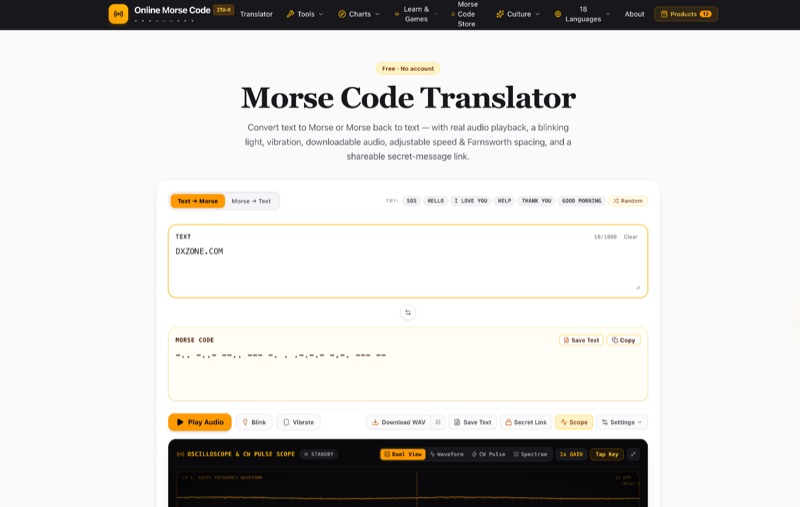 The Online Morse Code Translator provides real-time conversion of plain text to Morse code and Morse code back to text, strictly adhering to the ITU-R M.1677-1 international standard. Users can adjust the audio playback speed up to 30+ WPM, customize the tone pitch from 300 Hz to 1,000 Hz, and utilize Farnsworth spacing for effective learning. The platform offers versatile output options, including authentic sine tone or telegraph sounder audio, visual light-flash simulation, and tactile vibration for mobile devices, expanding its utility beyond basic translation. Beyond direct text-to-Morse and Morse-to-text functions, the tool integrates specialized decoders for analyzing Morse code from audio recordings and images. It also allows users to download generated Morse audio as WAV files for offline practice or create shareable secret-message links. The resource details the translator's client-side mechanism, operational modes, and fundamental principles of Morse code. Comprehensive sections cover Morse code history, various international and historical code variants like American Morse and Wabun Code, and real-world applications in amateur radio, aviation, and assistive technology. An extensive FAQ addresses common queries regarding timing rules (e.g., dot = 1 unit, dash = 3 units), emergency signaling (SOS), and learning methodologies.
-
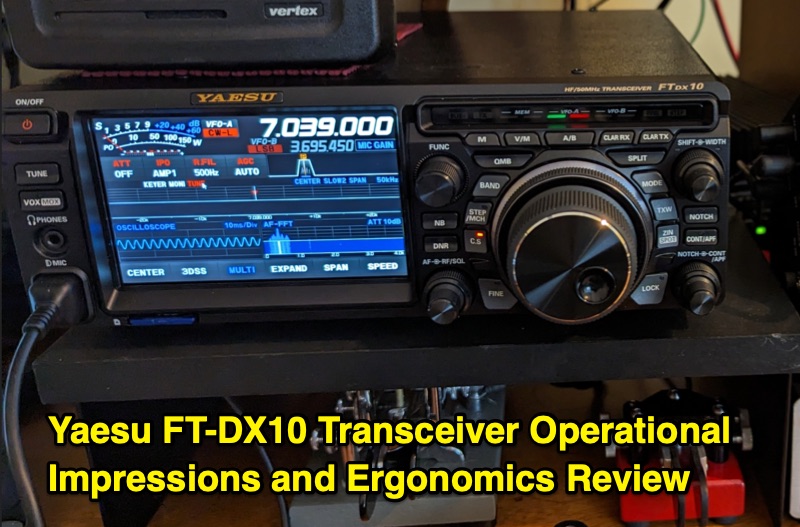 Evaluating a new HF transceiver, AA4OO shares his initial operational impressions of the Yaesu FT-DX10, contrasting its physical design and performance against his prior experiences with the Elecraft KX3 and Ten-Tec Eagle. He notes the FT-DX10's superior fit and finish but finds the front panel controls, particularly the AF/RF knob, to be cramped, leading to accidental VFO shifts. The review details the radio's audio characteristics, describing acceptable SSB performance but "muddy" CW audio at 450Hz, which he attributes to cabinet acoustics, necessitating an external speaker for clearer CW reception. The author also discusses the effectiveness of the FT-DX10's Digital Noise Reduction (DNR) for CW, finding it significantly better than the NR on the Eagle or KX3. He appreciates the MPVD (Multi-Purpose-VFO-Outer-Dial) for reducing menu reliance during QSOs, a feature he finds more intuitive than the dual-use buttons on his Ten-Tec Eagle. However, he expresses disappointment with the noisy T/R relay during full QSK operation and a loud internal fan, which detracts from his preference for a quiet operating environment. Further observations include the 800x640 resolution of the external display connector, which he considers outdated, and the CW decode function, which he finds less practical than the KX3's due to its display of "paragraphs" of text rather than a quick assist. Despite these "nits," the review provides a balanced perspective on the FT-DX10's strengths and weaknesses from a seasoned CW operator's viewpoint, concluding that it's a "mixed bag" compared to his other rigs.
-
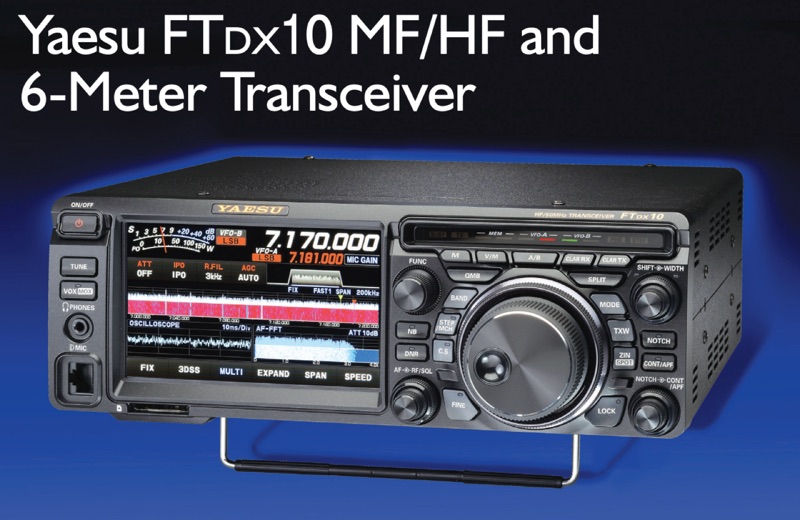 The Yaesu FTDX10 MF/HF and 6-meter transceiver, a 100-watt rig, is designed to bring high-performance receiver architecture to the intermediate-price class. It offers continuous receive coverage from 30 kHz to 75 MHz and transmit capabilities across all amateur bands from 160 through 6 meters, including five preset CW and SSB channels on 60 meters. The transceiver supports AM, FM, SSB, CW, and digital modes, with integrated decoders for CW, RTTY, and PSK31, making it a versatile station for various operating preferences. Physically, the FTDX10 measures 3½ × 10½ × 10½ inches and weighs 13 pounds, requiring a 20–25 A DC power supply for full 100 W output. Its front panel features a 5-inch TFT color touchscreen and a large VFO knob, complemented by an SD memory card slot for recording audio and saving settings. Rear panel connectivity includes a single SO-239 antenna port, multiple USB ports for CAT control and peripherals, and DIN jacks for external digital mode hardware and linear amplifiers, though it lacks a dedicated low-noise receive antenna provision. ARRL Lab tests confirm excellent receiver performance, with blocking dynamic range exceeding 137 dB at 2 kHz spacing and robust IMD dynamic range figures. The hybrid receiver design incorporates selectable roofing filters at 500 Hz, 3 kHz, and 12 kHz, along with two preamplifiers and various attenuation levels, allowing operators to tailor reception characteristics to challenging band conditions. Transmitter performance is also rated very good, with low transmit phase noise.
-
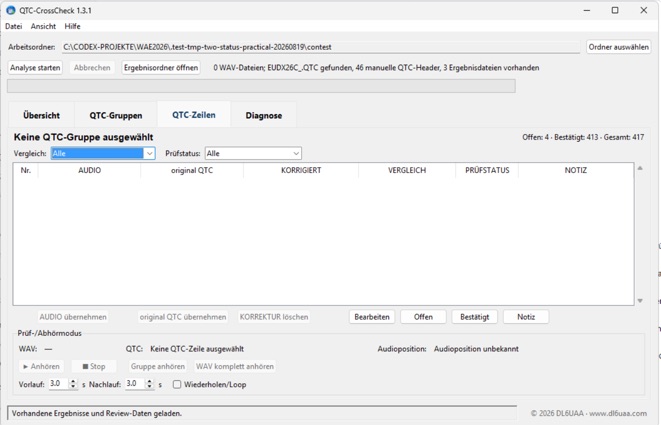 QTC-CrossCheck 1.5.0 is a free offline Windows tool for reviewing WAEDC CW QTC traffic. It analyzes QTC groups from local WAV recordings and supports comparison with UCXLog QTC data. Integrated audio playback helps verify individual QTC rows and resolve discrepancies. The portable application requires no installation or internet connection. Download the Windows ZIP archive and extract it fully before running QTC-CrossCheck.exe. A SHA-256 checksum is provided for download verification.
-
 Eight specific user interface limitations are identified in the Yaesu FTdx10 transceiver's firmware, drawing on the author's extensive software engineering background and experience with Icom IC-705 and IC-7300 interfaces. The analysis highlights issues such as the main dial Lock button disabling the RX/TX Clarifier, which impedes net control and pile-up operations. It also points out the FTdx10's spectrum scope display modes lack a "Scroll-F" equivalent for efficient band scanning, a feature common in Icom radios. Further points address the inability to access screen-based settings during transmit, the need for improved antenna tuner behavior with an option to reset settings and intelligent segment recall, and limitations when using an external mouse, such as the scroll wheel not functioning as the main dial or function knob. The author also notes the lack of automatic power reduction when using external LDG tuners and the CW decoder's all-caps display, which hinders readability. These observations aim to guide Yaesu in enhancing the FTdx10's user experience, leveraging its strong receiver performance and advanced features.