Search results
Query: japan ham radio
Links: 17 | Categories: 2
-
 Alinco's factory in Toyama, Japan, holds ISO9002/140001 certification, underscoring its commitment to quality manufacturing processes for amateur radio equipment. The company produces a diverse range of products, including HF transceivers, mobile VHF/UHF radios, handhelds, and scanners, serving both new and experienced operators within the ham radio community. Their product line extends beyond transceivers to encompass essential accessories such as antenna tuners and power supplies, which are crucial for complete station setups. These offerings support various operating environments, from portable field operations to fixed home stations, ensuring versatility for radio amateurs. Alinco, Inc. Electronics Division is headquartered at Yodoyabashi Dai-Bldg 13F, 4-4-9 Koraibashi, Chuo-ku, Osaka 541-0043 Japan, maintaining a global presence in the amateur radio market.
 -
 Over 65 years of radio manufacturing experience underpins Icom's extensive product line, ranging from handheld VHF/UHF transceivers to sophisticated HF base stations. The company's global website serves as a central hub for product information, technical specifications, and support resources for its diverse range of communication equipment. Hams can explore detailed specifications for popular models like the _IC-7300_ and the _IC-9700_, alongside commercial and marine radio offerings. The site provides access to product catalogs, firmware updates, and user manuals, ensuring operators have the necessary documentation for their Icom gear. Information on new product releases and technological advancements in radio communication is regularly updated, reflecting the company's ongoing commitment to innovation in the amateur radio market. Icom's presence extends across various radio segments, including D-STAR digital voice, marine, avionics, and land mobile, demonstrating a broad engineering capability beyond just amateur radio.
 -
 MMVARI is a multi-Mode SoundCard Ham (Amateur) Radio program for receiving and transmitting the RTTY-PSK-FSK-MFSK modes. The program was written to experiment with the efficiency of transmitting Japanese and East Asian languages (HL/BV/BY) using the VARICODE
 -
 Presents the product lines and corporate information for Japan Radio Company (JRC), a long-standing manufacturer of radio communication equipment. The company's offerings span various sectors, including marine, land, and aviation communication systems, alongside their historical contributions to amateur radio with notable **HF transceivers** and **shortwave receivers**. JRC emphasizes its technological expertise in areas such as radar, satellite communication, and network solutions, contributing to global safety and security infrastructure. The resource details JRC's commitment to leveraging its accumulated knowledge and experience in information and communication technology. While the primary focus has shifted towards commercial and governmental solutions, the legacy of JRC's amateur radio products, such as the JRC JST-245 transceiver and the NRD-525 receiver, remains significant within the ham radio community, known for their robust build quality and performance.
 -
-
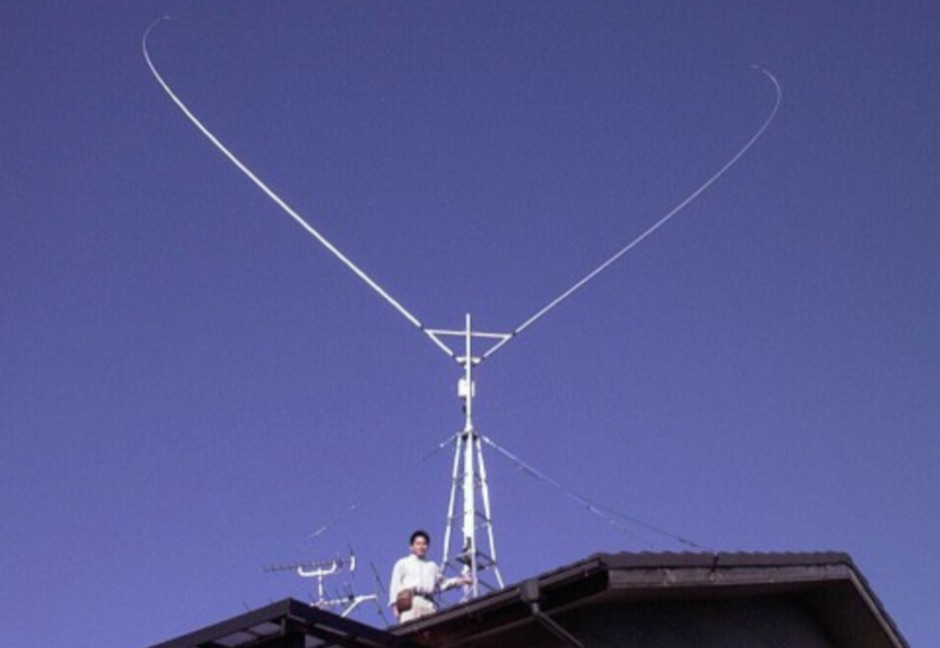 JJ0DRC's HF multi-band delta loop antenna project, initially conceived during the waning peak of Cycle 23, addresses the common challenge of achieving effective DX operation from a small residential lot in Japan. Dissatisfied with a ground plane antenna's performance in SSB pile-ups, the author sought a beam-like solution without a tower, drawing inspiration from a JJ1VKL article in CQ Ham Radio Sep. 2000. The antenna, constructed in October 2000, employs two 7.2-meter fishing rods (37% carbon fiber, reinforced with cyano-acrylate glue and aluminum tape) and 1mm enameled wire, fed by an Icom AH-4 external antenna tuner. While the exact beam pattern remains unmeasured, JJ0DRC observed a significantly higher callback rate compared to dipole antennas, particularly on higher bands. The system's circumference length of 15-20m is crucial for maintaining a good beam pattern across HF bands, though performance on lower bands like 80m, 40m, and 30m becomes less directional as the length deviates from a full wavelength. Ongoing maintenance addressed degradation issues, including aluminum tape cracking and wire breakage at connection points due to strong winds (often exceeding 10-15m/s in winter). The author reinforced rod connections with IRECTOR PIPE SYSTEM components and INSU-ROCK ties, and improved wire attachment methods using Cremona rope and epoxy bond to enhance durability.
 -
 A copper pipe Hentenna for 144 MHz. The Hentenna, a compact, high-gain loop antenna developed in Japan in the 1970s, offers approximately 5.1 dBd gain, comparable to a three-element Yagi. Adapted for 2 meters, it is crafted from copper pipe for simplicity, affordability, and broadband performance. Requiring no feed-point tuning, its construction involves soldering standard copper fittings. Installation demands non-conductive materials to minimize signal disruption. Versatile for vertical or horizontal polarization, it is ideal for FM, repeater, SSB, or CW applications. This design emphasizes practicality and performance for amateur radio enthusiasts
 -
 Over two decades of historical DX spots and news are archived on this Japanese resource, providing a retrospective look at amateur radio propagation and activity across various bands. The content is organized chronologically, with separate sections for _50MHz_, _HF DX_, _144MHz_, _EME_, and Satellite clusters, detailing spot data from as early as 1996 through 2014. This extensive archive serves as a valuable historical record for analyzing long-term propagation trends and significant DXpeditions from a Japanese perspective, offering insights into band openings and rare entity activations. The resource also includes links to other DX news sites like _425 DX News_ and _Ohio/Penn DX Bulletin_, along with QSL manager lookups and callbook services, enhancing its utility as a comprehensive DX information hub. While the primary cluster data is historical, the compilation of external links points to active resources for current DX operations. This makes it a useful reference for contesters and DXers researching past conditions or seeking information on specific DX entities and their QSL routes.
 -
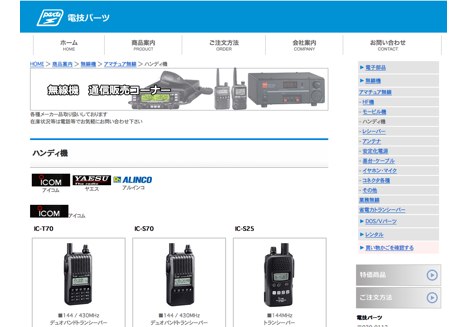 Amateur radio delaer for major ham radio brands in Japan
 -
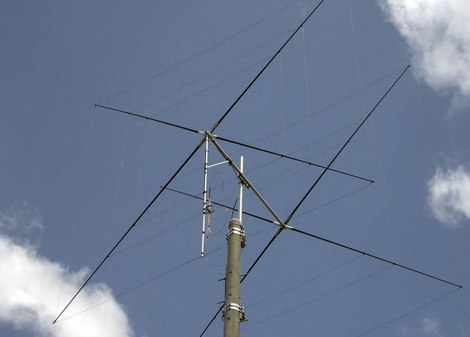 Perfect Quad Co,Ltd japanese ham radio quad antenna manufacturer
 -
 Information on establishing an amateur radio station in japan
 -

-
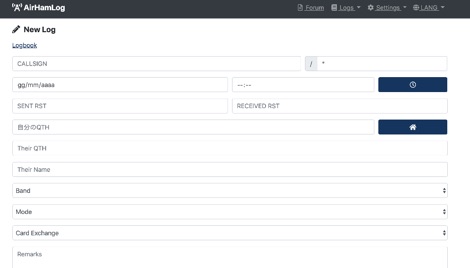 Facilitates logging of amateur radio contacts directly within a web browser, enabling seamless operation across various devices including Windows, macOS, Linux, iOS, and Android. This web-based application stores all log data securely in the cloud, providing accessibility from any internet-connected location. It supports importing existing log data via CSV files, with future plans for _ADIF_ file import, and offers a robust QSL card generation feature, producing print-ready PDF files in standard 148mm x 100mm dimensions. The platform integrates with Japanese government databases to automatically populate callsign-related information such as station location and license issue dates, streamlining data entry. It also assists with JCC/JCG searches for accurate QTH logging. The service leverages SSL encryption for all communications and benefits from security oversight by certified information security professionals. Users can register using email/password or existing Facebook/Google accounts, and the beta version is currently available for free. The system has processed over **5,297,881** logs, with **28,369** logs recorded in the past 24 hours.
 -
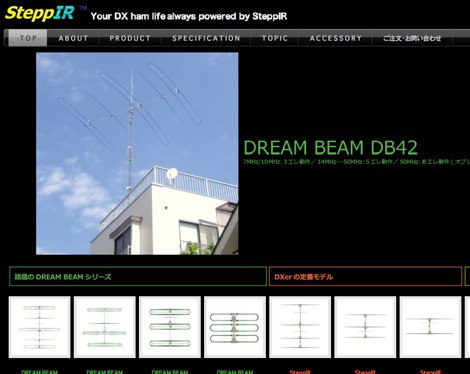 Presents _Beam Quest_, the official Japanese distributor for _SteppIR_ antennas, detailing their product lineup and services. The site showcases various _SteppIR_ Yagi models, including the _Dream Beam_ series (DB42, DB36, DB18E, DB11) with configurations from two to four elements, alongside the _Big IR_ and _Small IR_ vertical antennas. It also lists accessories such as TX/RX and PC interfaces, essential for integrating these advanced antenna systems into a ham shack. Operators often seek out _SteppIR_ antennas for their dynamically adjustable element lengths, which allow for optimization across multiple bands, a significant advantage for DXing and contesting. This adaptability contrasts sharply with fixed-element Yagis, providing a distinct edge in varying band conditions. The resource provides contact information, including email and phone numbers, for inquiries and support regarding _SteppIR_ products within Japan, serving as a direct point of contact for sales and technical assistance.
 -
 Procedure for foreign ham radio licensees to establish a station in Japan
 -
 CQ ham radio, Japanese monthly ham radio magazine publieshed since 1946 by CQ Publishing Co., Ltd. It has no relation with CQ Amateur Radio US magazine.
 -
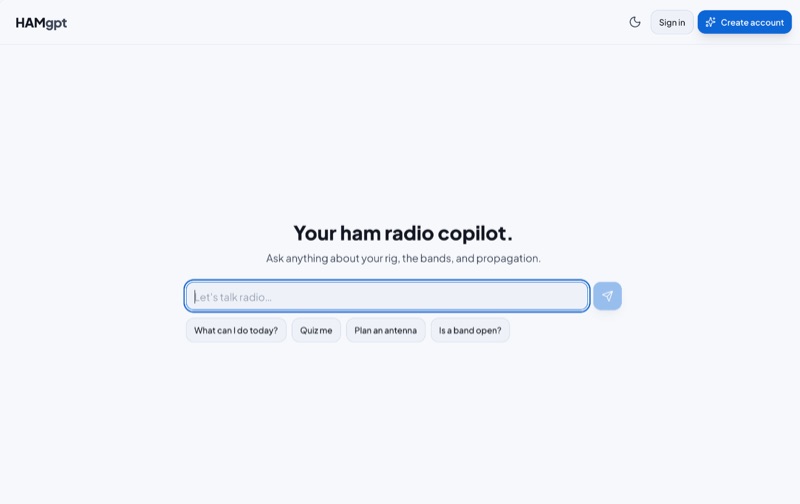 HAMgpt offers a personalized amateur radio experience, leveraging AI to provide real-time operational guidance. It integrates live propagation data, current band conditions, and operator-specific context, including callsign, QTH, license class, and station equipment, to deliver relevant answers. The system can identify open HF, VHF, and UHF bands, suggest workable DXpeditions and POTA/SOTA activations, and provide accurate repeater offsets and CTCSS/DCS tones for local repeaters. Unlike general-purpose chatbots, HAMgpt avoids fabricating frequencies or license privileges, instead relying on actual data for its responses. It supports antenna design calculations for various types like Yagi, dipole, vertical, and magnetic loop antennas, offering to-scale dimensions. The platform also assists with license exam preparation and provides satellite pass predictions tailored to the user's location. It supports multiple countries, including the United States (FCC Technician, General, Extra), Canada, the United Kingdom, Australia, Japan, and Argentina, incorporating their specific band plans and power limits.