Search results
Query: machine learning
Links: 5 | Categories: 0
-
 MorseMaker is an up-to-date replacement for the Morse Machine shown further down this page. It has been re-written using a different programming language and is now entirely 'stand-alone' requiring no run-time support files. This version also works with Windows XP and can use the soundcard but please note that, unlike its predecessor, it does not split the alphabet into smaller 'learning' blocks and does not incorporate the Morse reader.
-
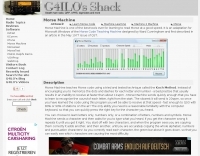 Morse Machine is a tool for learning to read Morse at a good speed, based on the Koch Method
-
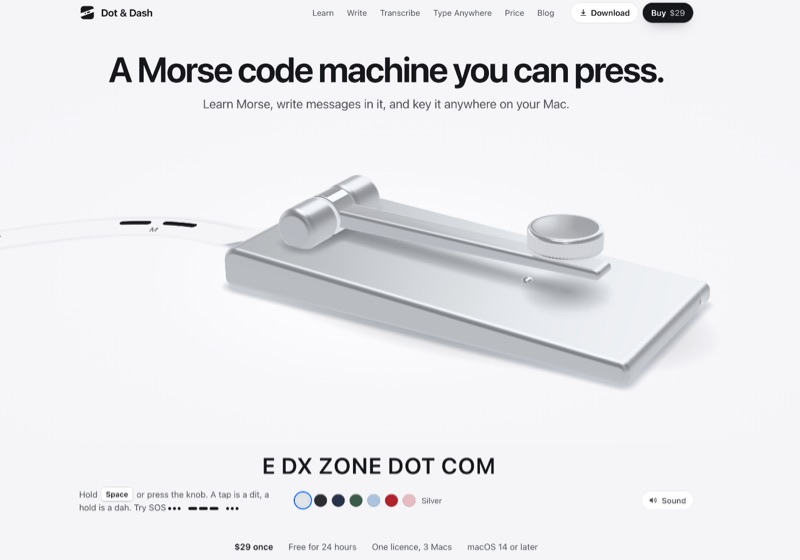 Dot & Dash is a macOS application for learning and practicing Morse code, providing an interactive environment for aspiring CW operators. The software features **twenty short chapters** that guide users from basic characters like E and T to the full alphabet, figures, punctuation, and common _prosigns_. Users learn by keying characters and words, with a daily five-minute review system to reinforce learning. The application allows users to compose messages, which the virtual machine then sends, or to key messages themselves and observe real-time decoding. It supports various input methods, including holding the Space bar, using a virtual knob, or connecting a USB key/keyer that emulates keyboard input. Operators can adjust sending speeds from **5 to 40 WPM** and apply _Farnsworth spacing_. Further capabilities include converting Morse code to text and vice-versa, and a "Type Anywhere" feature that enables keying Morse directly into other Mac applications. The software operates offline and offers a 24-hour free trial before requiring a one-time purchase for full functionality.
-
 Demonstrates _FreeDV RADE_, an open-source digital voice mode for HF, which combines machine learning with classical Digital Signal Processing (DSP) to achieve improved speech quality and spectral efficiency. Released in June 2025 by ARDC grantee FreeDV, RADE operates at Signal-to-Noise Ratios (SNRs) as low as -2 dB and occupies approximately 1.5 kHz of bandwidth, half that of a typical SSB signal, while transmitting about 8 kHz of voice audio. The mode also features an optimized Peak-to-Average Power Ratio (PAPR) for efficient power amplifier use, reducing heat and consumption. Users, such as _VK3TPM_, report significantly improved listening ease compared to analog modes, particularly in high HF noise environments, making it easier to conduct nets across various Australian states. The mode's integration into popular radios like the _FlexRadio 6000_ series allows direct operation without external computers. A C library for RADE is available, facilitating broader integration into other radios and SDR programs, with development continuing on FreeDV RADE v2 to further narrow bandwidth below 1 kHz.
-
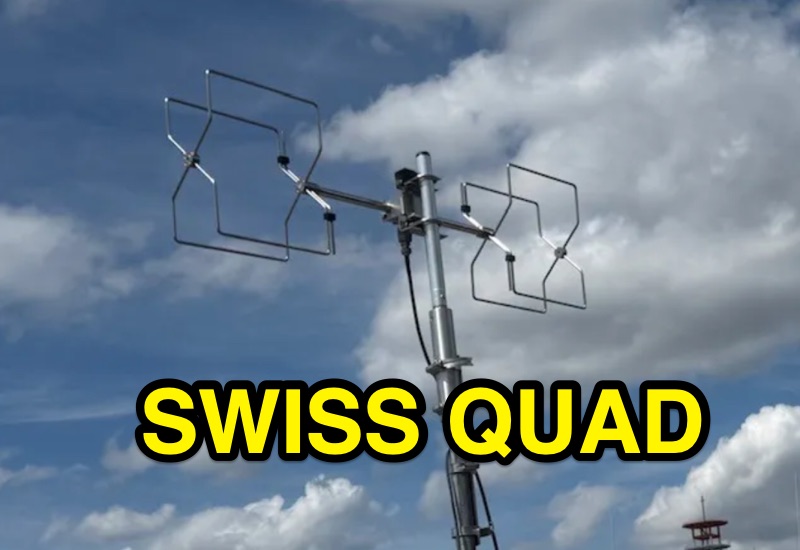 PD0G recounts the journey of building a 70cm Swiss Quad antenna, inspired by a vintage 2-meter version acquired for study. The author meticulously examines the original design, noting its distinctive curved metal elements and mechanical structure, which deviates significantly from traditional cubical quads requiring spreaders and wire. Historical context is provided, tracing the Swiss Quad's origins to R.A. Baumgartner (HB9CV) and its appearance in publications like the RSGB Bulletin in 1964 and QST in 1967, while also distinguishing it from other HB9CV designs. The project details the scaling process for 70cm, utilizing a calculation chart from F6ITV for initial dimensions and an existing MMANA-GAL model for 6 meters, scaled down to 433 MHz. Emphasis is placed on the critical gamma-match adjustment, with custom-machined POM parts for precise positioning and electrical isolation. Initial construction with 5mm aluminum elements and a 15mm boom led to practical challenges in bending and achieving target dimensions, necessitating adjustable element sections to fine-tune resonance. Measurements with a CAA-500 and SV4401A VNA confirmed a good match at 432.500 MHz with an SWR of 1.022 and LogMag of -39.46 dB. The author highlights that while a good SWR is achieved, further field testing is required to assess actual gain, directivity, and front-to-back ratio, especially when comparing single versus double element configurations. The article concludes by advocating for revisiting older, less common antenna designs, emphasizing the learning and satisfaction derived from hands-on experimentation.