Search results
Query: sstv mac
Links: 5 | Categories: 0
-
 Digital modes decoding software for the macintosh. Decodes CW, RTTY, WEFAX, SATFAX, ACARS, DTMF, SSTV
-
 SSTV software is now available for the Macintosh computers, for the first time.
-
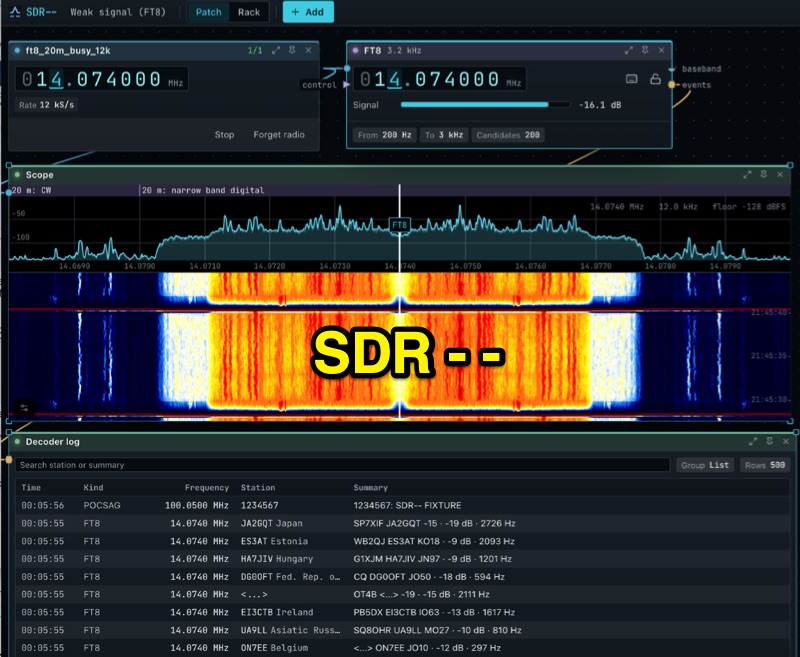 Boasting an FM demodulation rate of **1,235 Msps** and a DMR speed of **369x realtime**, SDR-- is a software-defined radio application designed for patching together radio components across macOS, Windows, and Linux platforms. It facilitates connecting a receiver to various channels, which then feed into speakers, maps, or recorders. The software supports a wide array of audio modes including AM, NFM, SSB, CW, FM stereo, RDS, DMR, FreeDV, D-STAR, Fusion, NXDNP, P25, and dPMR, alongside decoding numerous events and messages such as ADS-B, ACARS, VDL2, HFDLA, AIS, NAVTEX, DSC, POCSAG, FLEX, ERMES, FT8, FT4, WSPR, APRS, RTTY, PSK, ISM sensors, and time signals. Beyond audio and data, SDR-- also handles video modes like SSTV, ATVDVB-S, and DVB-S2. It provides comprehensive displays including spectrum, waterfall, constellation, and map views, all integrated with decoded messages. Advanced features include scanning, signal identification, satellite tracking, direction finding, and passive radar capabilities. The application offers remote control options via REST, WebSocket, MCP, and event forwarding, allowing integration with external tools. It can operate on a desktop computer or be deployed on a server, such as a _Raspberry Pi_, for remote access, providing flexibility for shack setups or antenna-side installations.
-
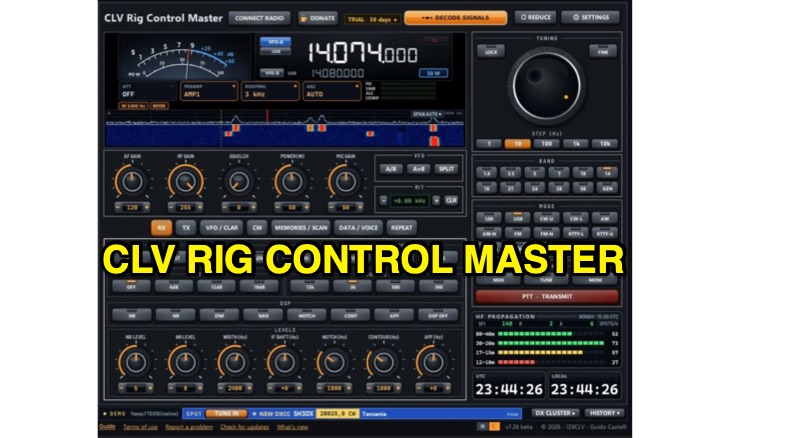 CLV Rig Control Master is a freeware Windows application providing comprehensive **CAT control** for amateur radio transceivers. It directly supports the Yaesu FTDX10 via its Enhanced COM Port and integrates with hundreds of other rigs through **Hamlib**. The software functions as a master, sharing the radio's CAT port with multiple logging and digital mode applications like N1MM Logger+, Log4OM, WSJT-X, and JTDX, thereby eliminating port conflicts. Key features include a large frequency display, analog-style S-meter, PO, SWR, ALC, and COMP bar graphs, along with spectrum and waterfall displays derived from USB audio. It also incorporates decoders for CW, RTTY, PSK31/63, NAVTEX, SSTV, and WEFAX, featuring automatic mode detection and a dedicated CLV-SSTV window supporting 12 SSTV modes. The application provides detailed control over FTDX10 receive and transmit settings, memory channels, and audio/TX profiles. For other radios, it adapts the panel to supported controls, maintaining stable connections even with slower CAT interfaces such as the FT-817. The DX Cluster window includes band and mode filters, Club Log Most Wanted integration, and new DXCC tracking from ADIF logs. Contest features encompass F1-F8 message macros, CW and RTTY transmission from the PC, and ADIF QSO logging. It also displays UTC and local time, alongside HF propagation data sourced from N0NBH, and is compatible with Windows 10 and 11.
-
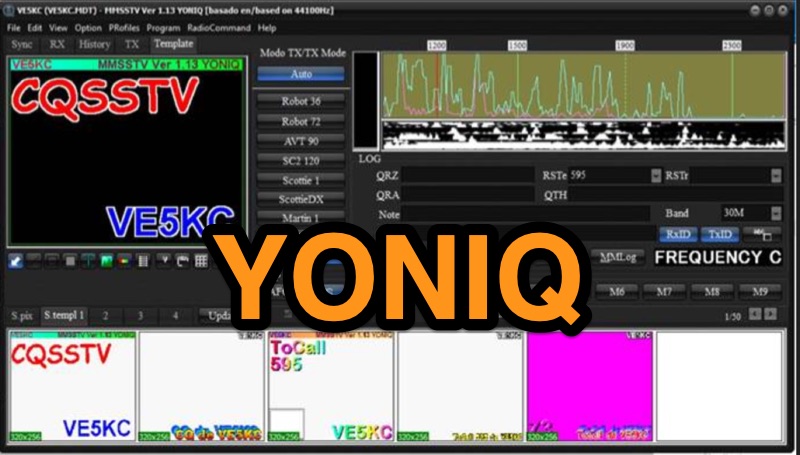 Operating Slow Scan Television (SSTV) often requires specialized software to encode and decode images for transmission over amateur radio frequencies. The _MMSSTV_YONIQ_ project provides an updated iteration of the widely used _MMSSTV_ software, originally developed by JE3HHT, incorporating modern functionalities requested by the SSTV community. This version integrates the _Omni-Rig_ system for seamless transceiver control, supports both Spanish and English interfaces, and enables direct data downloads from QRZ.com, streamlining logging and contact management for operators. The software also includes practical enhancements such as frequency memory storage, compatibility with various digital logbooks, and a visual indicator for image transmission and reception progress. Significant improvements have been made to image reception settings, allowing for more effective decoding even on systems with limited PC resources, though it can be configured for higher performance on modern machines. The development involved new code and modifications to existing source code, released under a GNU license. Installation instructions are provided, noting that the initial setup defaults to Spanish but can be easily switched to English. The project emphasizes its role as a continuation of JE3HHT's original work, aiming to keep SSTV operations current with 21st-century amateur radio practices. Support for new features is available through the MMSSTV forum on Groups.io.