Build Your Own 6 Meter J-Pole Antennas for 50 MHz
Find plans and guides for constructing J-Pole antennas specifically designed for the 6-meter amateur radio band.

The 6-meter band, often called the "Magic Band," offers exciting DX opportunities and local QSOs, especially during sporadic E openings. Many operators choose the J-Pole antenna for its simplicity and effectiveness on 50 MHz. This antenna design is popular for its omnidirectional pattern and does not require a ground plane, making it a versatile choice for portable operations or fixed stations.
Hams looking to build a 6-meter J-Pole will find numerous construction guides and schematics, often featuring common materials like copper pipe or ladder line. Resources include detailed plans for single-band 50 MHz J-Poles, such as those based on the DK7ZB design, and even dual-band versions for 6 and 2 meters. Operators can also find information on optimizing feed points and using chokes to reduce common mode current, ensuring efficient power transfer to the antenna.
Related Categories
-
 Need a general purpose antenna on the magic band? The J-Pole is an easy-to-build and inexpensive device that provides an omni-directional vertically polarised antenna without the need for a ground plane. In technical terms, it is an end fed vertical 1/2 wave which is fed via a 1/4 wave matching stub.
 -
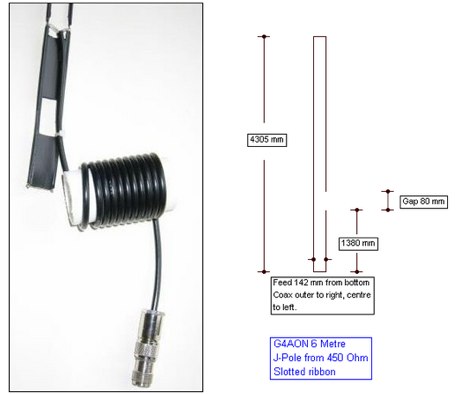 Based on original G2BCX design this J-Pole antenna for the six meter band is made with a homemade ribbon cable. The antenna shown in this article includes a coaxial cable choke feed to remove RF currents from flowing on the outer of the cable.
 -
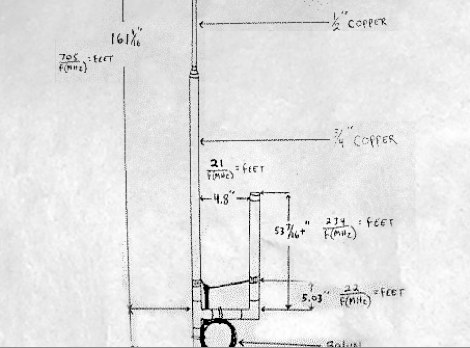 A home made J-Pole antenna for 50 MHz. This article describes how to build a J-Pole antenna for the 6-meter amateur radio band. It's a good choice for those who want an antenna with better performance than a simple wire dipole, but at a lower cost than buying a commercial antenna. The project requires soldering copper pipes and some specific materials, but can be built in a day
 -
 A J-pole antenna plan for 50 MHz based on the DK7ZB design
 -
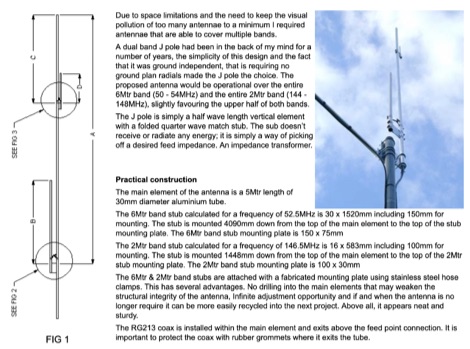 Dual band J pole operational over the entire 6Mtr band (50 - 54MHz) and the entire 2Mtr band (144 - 148MHz), slightly favouring the upper half of both bands by VK6YSF
 -
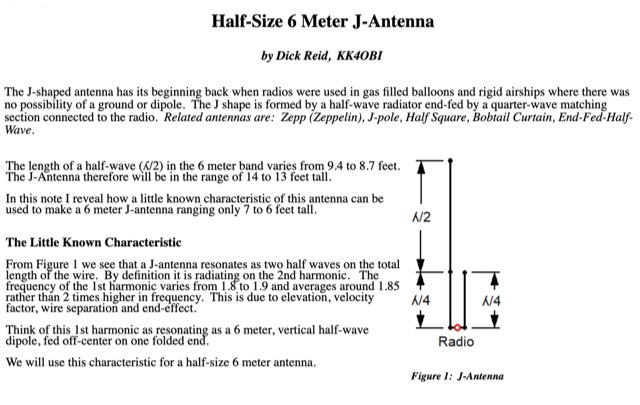 How to use a little known J-antenna characteristic to reduce a conventional 14 foot antenna to 7 feet. Perfect 50 Ohm match, same gain, no radials.
 -
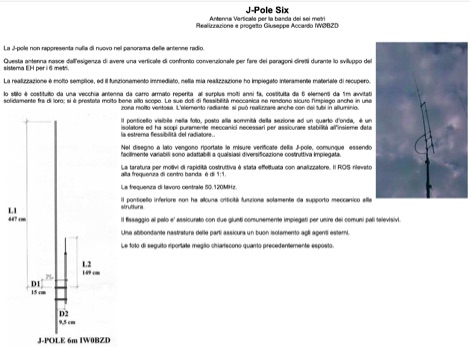 Homebrewed jpole antenna for 50 mhz by IW0BZD, include pictures and schematics, in italian.
 -
 Yo5ofh j-pole antenna plans for 2 and 6 meters
 -
 J-pole designs, for 50 to 450 MHz by WA6ESC
 -
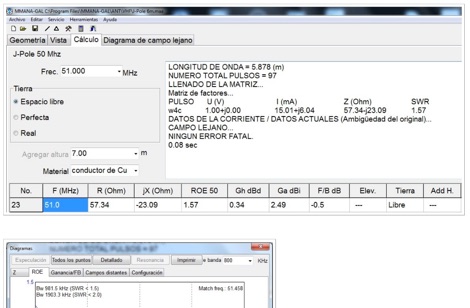 The page provides information on a simple 50MHz J-Pole Antenna project based on the DK7ZB design. It explains the principle of the Wireman-J-Pole, the feeding process, practical mounting, and simulation results using MMANA GAL. The content aims to guide amateur radio operators in building their own J-Pole antennas for the 6-meter band.
 -
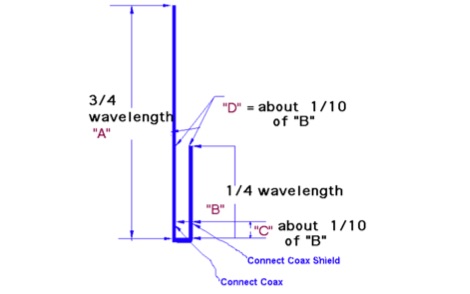 Essentially, a J-pole is a 1/2 wave resonant antenna connected to a quarter wave matching stub. The feedline is connected at a point on the matching stub that is at the feedline's characteristic impedance. The result is 3/4 of a wavelength on one side and 1/4 wavelength on the other side.
 -
 A j-pole antenna plan with drawings and dimensions that can help you on building your own j-pole antenna for the six meters band
 -
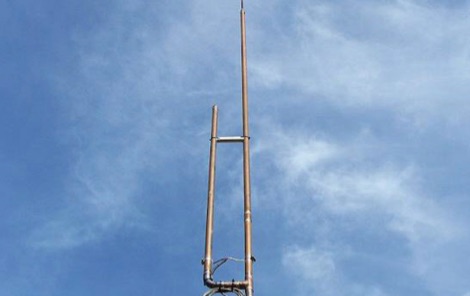 A homemade j-pole antenna for six meters band, designed to work on local repeaters, and working on the 52-53 MHz. Includes a list of needed materials and detailed description on assembling the copper tubes used to build this antenna.
 -
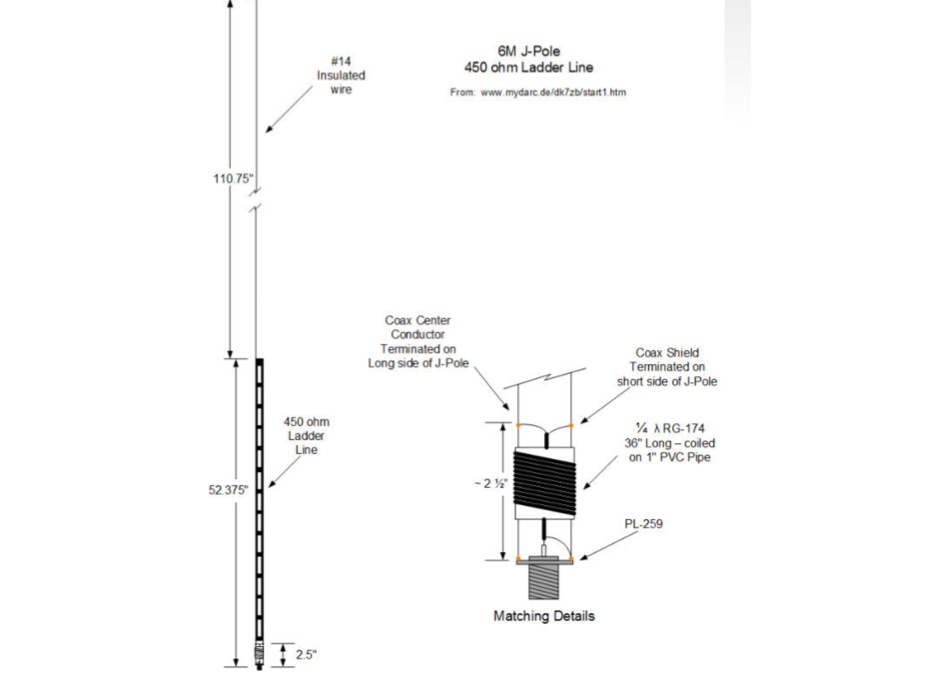
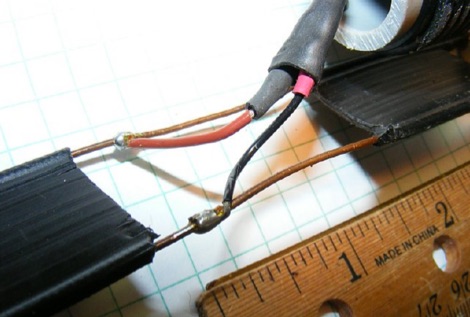 6 Meter J-Pole from 450 Ohm Ladder Line a quickie project
 -
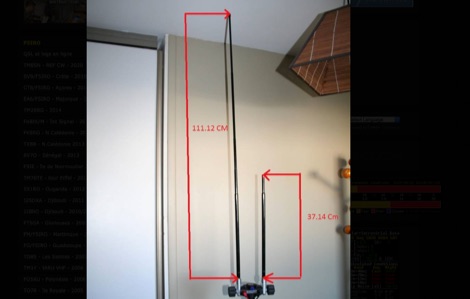 How to setup and configure the buddipole antenna in the J-Pole mode for the six meter band
 -
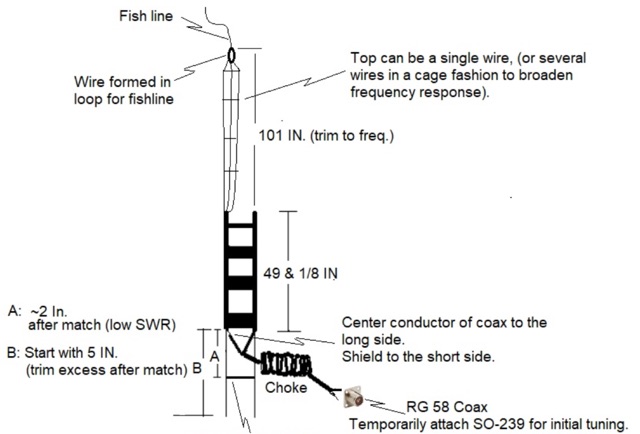 This article provides details on building a 6 Meter J-Pole antenna using PVC pipe for an enclosure.
 -
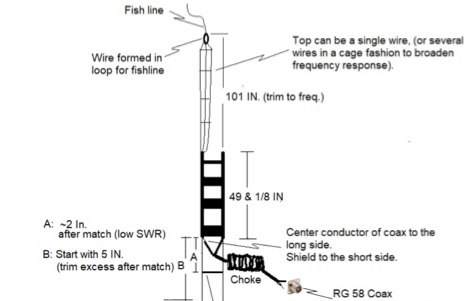 This article provides details on building a 6 Meter J-Pole antenna using PVC pipe for an enclosure. This antenna uses flat 450 ohm Window Line for the tuning stub.
 -
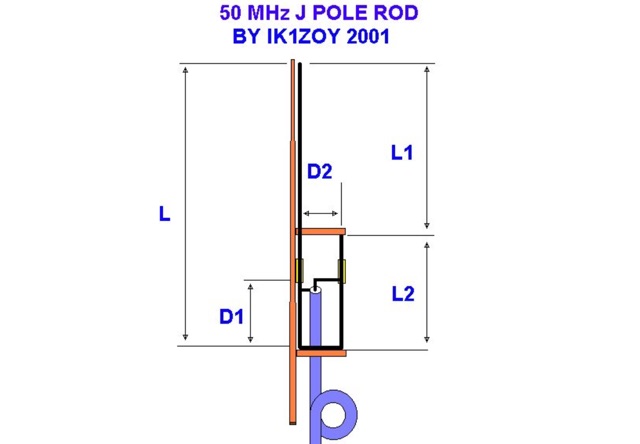
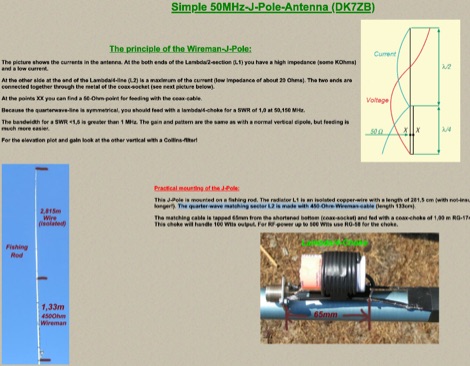 This J-Pole is mounted on a fishing rod. The radiator L1 is an isolated copper-wire with a length of 281,5 cm while the quarter-wave matching sector L2 is made with 450-Ohm-Wireman-cable