Antenna Gain
Understanding antenna gain and its calculation process

Antenna gain is a critical parameter for ham radio operators, describing how effectively an antenna converts input power into radio waves in a specific direction, or vice-versa for reception. Understanding gain helps hams optimize their stations for DX, contests, or local QSOs, ensuring maximum signal strength where it matters most. It's not just about raw power; a high-gain antenna can make a low-power transceiver perform like a much stronger one in the desired direction.
This category provides explanations and practical insights into antenna gain, covering various antenna types from simple wire antennas to complex beam arrays. Operators can find detailed articles on topics like the gain of helix antennas, how height affects gain for 40-meter wire antennas, and the principles behind G/T simulations for stacked arrays. Resources also include tools and methods for measuring and comparing antenna gain, such as those used by the CSVHFS Antenna Gain Measurements project, helping hams evaluate both commercial and homebrew antenna projects.
-
 Explanation of antenna basics concepts like antenna gain at marc's technical pages
 -
 Antenna gain and directivity explained in this article at radio electronics antenna pages
 -
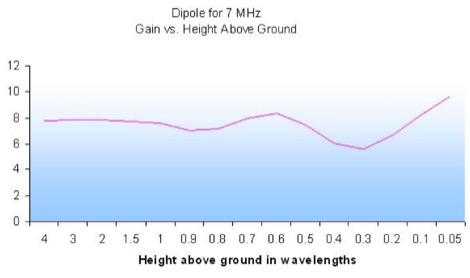 An interesting guide to aerials comparing height, gain and angles
 -
 Definition of antenna gain at wikipedia
 -
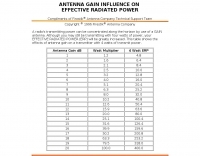 A radio's transmitting power can be concentrated along the horizon by use of a GAIN antenna. Although you may still be transmitting with four watts of power, your effective radiated powerwill be greatly increased. This table shows the effects of antenna gain on a transmitter with 4 watts of transmit power.
 -
 Guide to calculate effective gain of antennas
 -
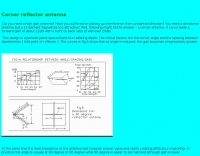 Explores corner reflector antenna design, detailing gain, front-to-back ratio, critical angles, and construction for VHF/UHF operation.
 -
 Decibels: dB, dBA, dBC, dBV, dBm and dBi? What are they all? How are they related to loudness, to phons and to sones? This page describes and compares them all and gives sound file examples.
 -
 Here you will find information on how antennas behave when stacked G/T is an important figure-of-merit for the antenna's overall receive performance, because it balances forward gain (G) against received thermal noise (T).
 -
 This article summarizes probably the most extensive numerical modelling calculations on the helical antenna ever performed.
 -
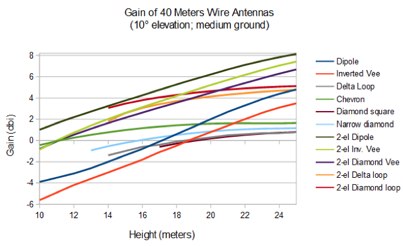 An comprehensive article on 40 meters antenna comparing vertical height to the resulting gain
 -
 In the long history of beam aerials there has persistently existed the claim that certain types of aerials perform better than yagis.
 -
 Info about Gain
 -
 Discussion at eham about wire size used in wire antennas, and how it affects the gain of the antenna
 -
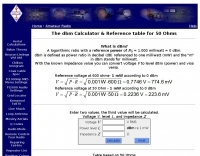 The dbm online calculator and reference table for 50 Ohm
 -
 Gain we can expect of a parabolic antenna by F4DAY
 -
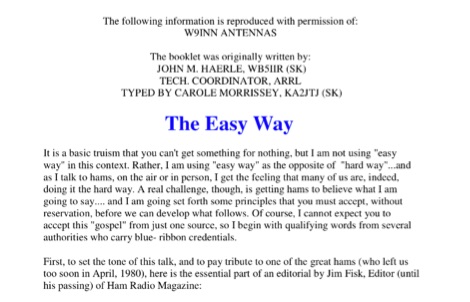 This document is a must read for anyone considering building a good low cost HF multi-band antenna system. The author combine in this document four important ingredients to produce simple but effective antenna system, like antennas of non resonant length, line attenuation, the transmatch and the balun
 -
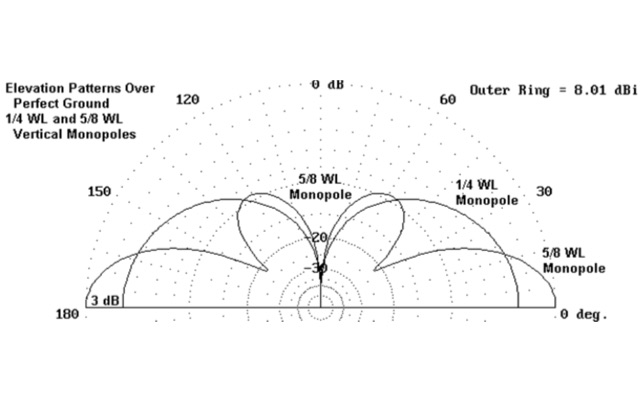 This article on basic antenna theory explains why is a 5/8 wavelength vertical antenna better than a 1/4 wavelength antenna