RF Amplifier Theory and Design for Amateur Radio Operators
Learn the fundamental principles of RF amplifier operation, design, and construction for various amateur radio applications.

Understanding RF amplifier theory is crucial for hams who want to build, maintain, or troubleshoot their stations. This category covers the fundamental principles behind converting DC power into RF energy, a core function for any transmitter. Operators learn about the characteristics of different amplifier classes, how to achieve linearity and efficiency, and the critical role of proper impedance matching to protect equipment and maximize output power.
Hams can find detailed tutorials on designing both vacuum tube and solid-state amplifiers, including discussions on common failures in classic tube amps like the SB-220. There are also resources explaining the impact of SWR on amplifier performance and how to use design software like Genesys for optimizing circuits. Whether for HF or microwave bands, these articles help operators understand the theory behind their antenna projects and transceivers.
Related Categories
-
 Article on how use Genesys sowftware to design RF power amplifiers
 -
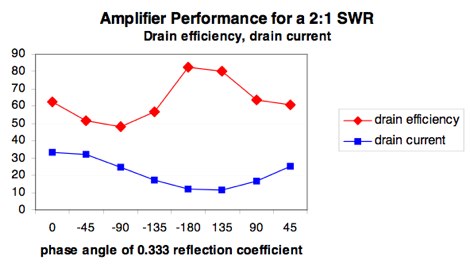 Article appeared on 10/05 issue of QEX about the impact of load SWR on the efficiency of Power Amplifiers, PDF File by K9LA
 -
 Details the design, development, and prototyping of a low noise microwave amplifier (LNA), covering conceptual design and gain stages.
 -
 Mark Connelly, WA1ION article on Medium Frequency Amplifier Circuits in PDF format, include some RF amplifier schematics
 -
 Negative feedback is often referred to as shunt feedback in conjunction with emitter degeneration.
 -
 This test circuit is easy to duplicate, and demonstrates the extreme voltages that appear in an amplifier when the load is improper for the amount of drive power applied.
 -
 Article on tubes and their usage in power amplifiers design. Explain failures of tube in RF power amplifiers, a common problem in the SB-220 SB-221, TL-922 and other amplifiers.
 -
 RF and Microwave Power Amplifier and Transmitter Technologies, amplifierlinearity, efficiency and available RF power devices.
 -
 What makes a good solid-state amp ? by Adam Farson, VA7OJ/AB4OJ, May 2002
 -
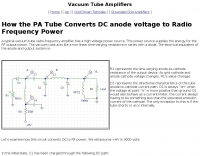 How the tube converts DC to RF Power
 -
 Not a project yet, but very theoretical thoughts about very practical amplifiers!
 -
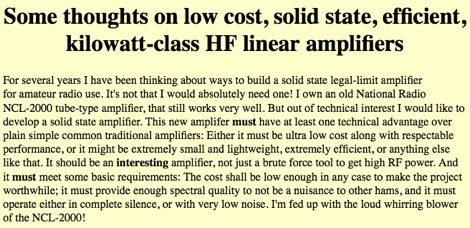 Thoughts build a solid state legal-limit amplifier for amateur radio use.
 -
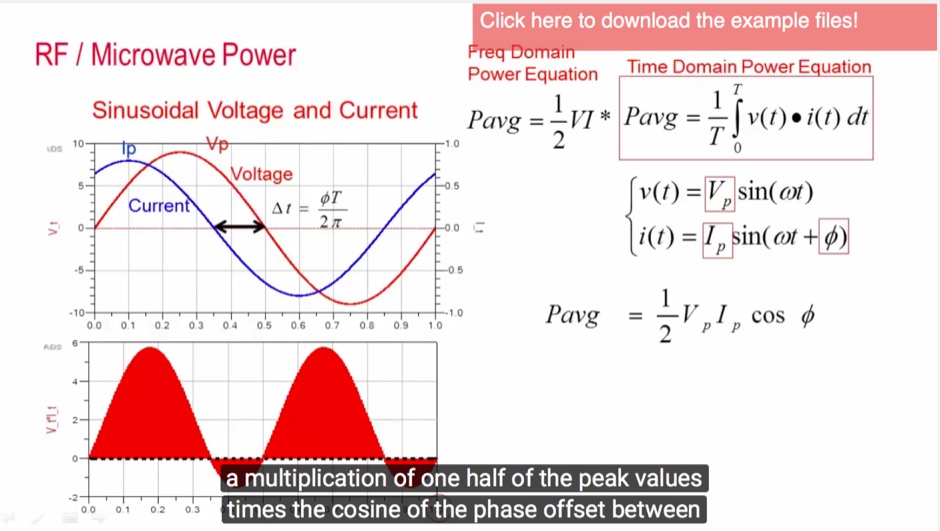 This video will provide a foundation for understanding how power amplifier circuits work. If you are new to High Frequency Power Amplifier Circuit Design, this is the place to start.
 -
 Measuring the output impedance (Zs) of solid-state broadband HF amplifiers operating in class AB eham article by ZS6BIM